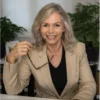

Solea Anani is the founder and guide of ANAM, a living sanctuary devoted to supporting the emerging human in deep relationship with the intelligence of the soul. Her work is rooted in the interwoven lineages of Animism, Depth Psychology, and Mysticism, offering a path that bridges the inner and outer worlds through embodied awareness and relational attunement.
In this episode, she presences the Chiron archetype as a living intelligence that shapes the wounds we carry and the shadows we can’t quite see. Hear the full conversation on The Gifts of Trauma Podcast.
As I was preparing for this interview, my own Chiron wound started showing up big time. I noticed an increased sensitivity to being visible, how my gifts are received, and bringing myself forward into spaces where others influence how I see myself. It created a kind of churn, if you will: a distinctly noticeable heightening of emotional discomfort.
If you are a healer of any kind (a therapist, a physician, a teacher, or a clinical practitioner), you probably know exactly what I mean. The specifics are not the same, but the pattern is. Most of us were drawn to this work by something we couldn’t quite name. Something that needed witnessing. Something that hurt. And somewhere along the way, we learned to tend to everyone else’s wounds while keeping our own at a careful distance.
Solea Anani calls this “the Chiron wound.” And in this opening episode of the Wounded Healer Series, she presences the archetype as something far older and far more useful than either a mythological or psychological concept.
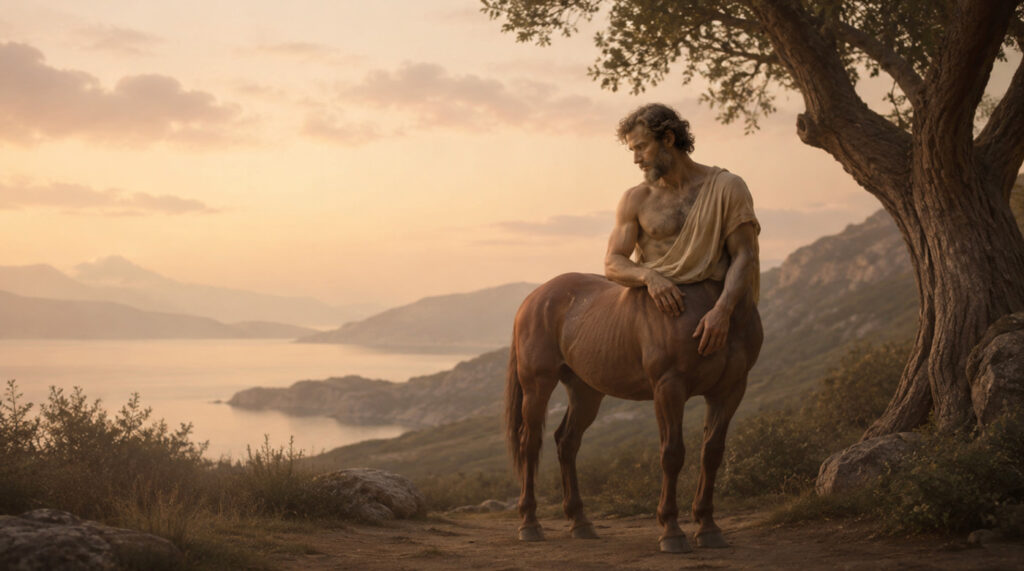
Chiron was the greatest healer of his age. An immortal centaur, gifted beyond measure. He was struck by a poisoned arrow that wasn’t intended for him while witnessing collective chaos. Because he was immortal, he couldn’t die from the wound. Instead, he had to live with it, forever. Once the arrow and the poison were in Chiron, he became the sacrificial target that represents an unintended individual wound being amplified by collective pain.
Does this sound familiar? Most healers don’t choose their wounds. We received them in childhood, through our own family chaos or perhaps through a system that failed us. Our bodies absorbed what the adults around us couldn’t hold. And like Chiron, many of us have gone on to build entire lives and careers around understanding and alleviating a pain we could never quite reach in ourselves.
Here’s where Solea’s reframe changes everything. Chiron’s release didn’t come from healing the wound. It came from becoming relational. He used his immortality, his greatest gift, bound up with his greatest burden, to free Prometheus from his own bondage. By becoming relational and giving away what he couldn’t use, Chiron became mortal and died, thus releasing his pain and opening a new structure in our ability to heal… Our wounds can be released by something bigger than our humanity. This is not a metaphor for ignoring the wound. It’s a map for understanding what the wound actually needs and what it might be offering in return.
Solea says that what our wound needs is not a program, a methodology, or even an intention, in the way that we typically use that word. Our wound needs something that’s simultaneously simpler and more challenging than all of that: start with being sincere. Here’s what she means. Simply saying, “Yes, I’m in pain. Yes, this hurts. Yes, it’s here; I’m experiencing it…” If we enter true intimacy with the wound, the wound will speak, and the wound will guide us.
Sincerity is the first practice. Not technique, not protocol. Just the willingness to stop turning away. For healers trained in evidence-based frameworks and ethical boundaries and outcome measures, this can feel dangerously unstructured. But Solea is precise about why it works: the wound has its own consciousness. When it is met without being pathologized or pressured to change, it begins to transform.
Solea described this as a process in which she turns towards the wound and creates internal altars that feed it and offer it presence. As she does this, she notices that the wound begins to change. Like everything in the universe, it’s in constant movement, in constant change. It has a shape-shifting dynamic, and in its changing, space is created.
Space. That word keeps showing up in this conversation. And Solea is careful to name what happens when space isn’t available, when the voltage of pain is simply too high, or when the wound is too fresh or too vast for any individual to hold alone. It reminded her of a Mayan ritual that takes place when someone dies. The family members of the person who died are left to wander the land or to wander the shorelines. They are crying and wailing, existing in between the worlds because the pain is so big. Their community follows them to make sure they stay safe. Knowing that their people are watching gives them the space to fully acknowledge their pain and even to fully collapse… They don’t need to work harder to create space; that work is done by the people who act as anchors within their community.
This is the heart of it for healers specifically. The wound was never meant to be held alone. Not Chiron’s. Not ours. The role of the wounded healer—as Solea understands it, as this entire series explores it—is not to be healed but to be in relationship with what hasn’t. That distinction is everything.
Solea closes this episode with a prayer of presence, an invitation to let the stillness speak, to let the body become the offering, and to attune to the heart as the place we can return to again and again.
Her prayer is quietly generous and unlike anything most of us were ever taught to offer ourselves. It is the simplest possible demonstration of everything she has shared. The wound doesn’t need to be “fixed.” It needs to be held. And it turns out, so do we.
The Gifts of Trauma is a weekly podcast that features personal stories of trauma, transformation, healing, and the gifts revealed on the path to authenticity. Listen to the full conversation, and if you like it, please subscribe, rate, review, and share.
Editor’s Note: This post is comprised of edited excerpts drawn from The Gifts of Trauma podcast transcript. Selected passages have been carefully woven together to create a cohesive narrative that speaks in the guests’ voices and faithfully represents their perspectives. – Rosemary Davies-Janes