

Gut Bacteria to the Rescue
In addition to contributing to the health of the digestive tract, the gut organisms are responsible for regulating the immune system and the central nervous system and facilitating overall well-being. Gut microorganisms produce several neurotransmitters, such as gamma-amino butyric acid (GABA), acetylcholine, and serotonin, as well as catecholamines, including dopamine, epinephrine, and norepinephrine. Maintaining a diverse and balanced composition of gut microbiota is needed for the optimal function of the gut-brain axis and for the development and proper function of the nervous system from birth to old age. The initial 1,000 days of life represent a critical window for determining long-term health. Nutrition in early life has a significant impact on developmental programming of metabolism, immunity, and gut microbiota, with long-term implications for chronic diseases such as obesity, diabetes, and cardiovascular disease.
Disruption of this balance, known as dysbiosis, can be caused by cesarean birth, absence of breastfeeding, stress, antibiotics, excess alcohol or sugar, or environmental factors, and can alter neurotransmitter levels, exacerbate the stress responses and make us more susceptible to developmental delays, impaired cognition, anxiety, depression, inflammation, and many other mental and physical illnesses. The diagram below demonstrates the connection between what we eat in early life and gut-regulation mechanisms that affect adult health outcomes.
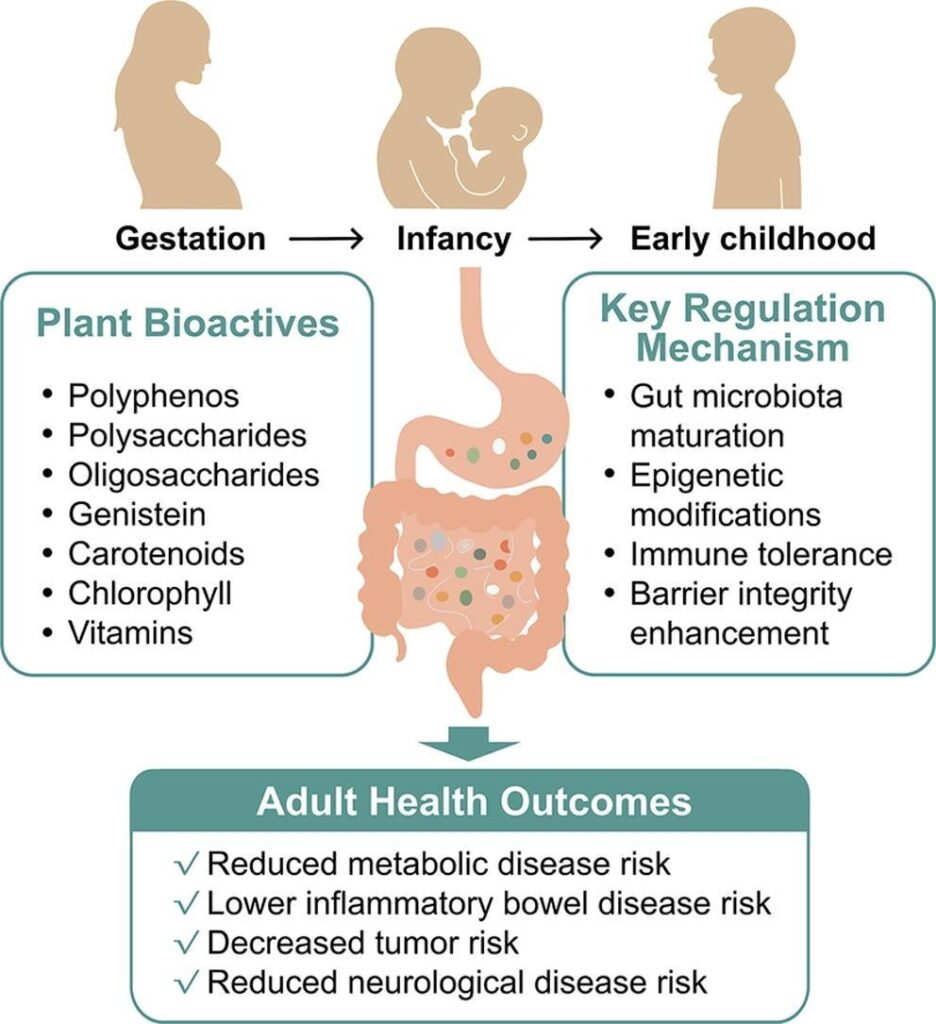
Open access from Lu F et al. Plant-derived bioactives in early-life complementary foods: a nutritional blueprint for lifelong health. J Adv Res. 2025 Aug 13:S2090-1232(25)00600-9.
Fortunately, we can calm the amygdala and decrease stress and anxiety by recruiting specific gut bacteria. Research on the gut-brain axis shows that certain bacteria, such as Lactobacillus rhamnosus (JB-1), can reduce amygdala activation and lower stress-induced cortisol. This species increases the activity of GABA, a calming neurotransmitter that decreases anxiety.
Bifidobacterium longum (1714 or NCC3001) is another friendly bacteria that reduces amygdala activation to fearful stimuli, reduces stress, and improves mood and emotional processing. The following chart lists some beneficial bacteria that can either calm the amygdala, decrease stress, reduce inflammation, or improve emotional stability and PTSD symptoms, as well as the prebiotic foods that nourish them. A new term for these organisms is “psychobiotics”.
| Probiotic | What it Does | Prebiotic Foods that Nourish |
| Lactobacillus rhamnosus JB-1 | Calms the amygdala, lowers cortisol, increases GABA, activates vagus | Fermented foods, oats, barley, sweet potatoes, apples, carrots, berries, resistant starch |
| Bifidobacterium longum 1714 | Calms the amygdala, reduces stress, improves gut barrier | Onions, garlic, leeks, Jerusalem artichoke, green bananas, chicory root, oats, barley, sweet potatoes, legumes, apples, berries |
| Lactobacillus helveticus | Lowers cortisol, improves sleep, reduces inflammation and anxiety | Fermented foods, oats, barley, sweet potatoes, apples, carrots, berries, resistant starch |
| Lactobacillus plantarum PS128 | Improves emotional regulation, reduces anxiety, stabilizes mood | Fermented foods, oats, barley, sweet potatoes, apples, carrots, berries, resistant starch |
| Bifidobacterium infantis 35624 | Lowers inflammation, improves stress tolerance, enhances vagal tone | Onions, garlic, leeks, Jerusalem artichoke, chicory root, oats, barley, sweet potatoes, legumes, apples, berries |
| Faecalibacterium prausnitzii | Lowers inflammation, improves emotional regulation, reduces stress | Oats, barley, apple, citrus, carrots, legumes, brassicas, resistant starches |
| Akkermansia muciniphila | Lowers inflammation, improves stress tolerance, improves gut barrier, may decrease obesity | Resistant starches (see below), overnight oats, lentils and legumes, pomegranate, cranberries, inulin, polyphenols, flaxseed, chia, walnut |
Nourishing Your Gut Ecology
We can encourage a healthy diversity of beneficial bacteria in the gut by supplying them with prebiotics—a type of indigestible fiber that nourishes the good bacteria. Prebiotics act as a kind of fertilizer for gut bacteria to generate useful compounds such as short-chain fatty acids, which fuel the cells of your colon, support your immune system, reduce inflammation, and improve the blood-brain barrier. We can ingest healthy bacteria (probiotics) by consuming fermented foods.
Prebiotics include specific fibers and plant chemicals known as fructooligosaccharides, polyphenols, and resistant starches. The chart below outlines some of these in more detail, as well as listing specific fermented foods to supply probiotics.
| Fiber | Resistant Starches | Polyphenols | Fermented Foods |
| Oatmeal and oatbran | Cooked and cooled: | Ground clove, star anise | Yogurt |
| Apples, pears | Potatoes | Peppermint tea | Kefir |
| Beans, lentils, chickpeas | Rice | Green tea/matcha | Sauerkraut |
| Sweet potatoes | Quinoa | Cacao | Kimchi |
| Ground flaxseed | Pasta (in salad) | Pomegranate | Fermented pickles |
| Chia seed, walnuts | Sweet potato | Black chokeberry (aronia) | Fermented carrots, beets |
| Broccoli, cauliflower | Barley | Berries and currants | Miso |
| Shiitake, oyster mushrooms | Bananas (slightly green) | Hazelnut, pecan, almond | Tempeh |
| Kelp, nori, kombu, chlorella | Legumes | Soy | Natto |
| Inulin | Fructooligosaccharides | Cherries, dark grapes | Kombucha |
| Garlic | Bananas | Coffee | |
| Jerusalem artichoke | Onions, leeks | Ginger | |
| Chicory root | Asparagus | Spinach |
Restoring Gut-Brain Communication
We’ve learned that an imbalance in the gut can negatively affect neurological development, mood, stress levels, perception, cognition, and behavior because of the connection between the gut and brain through the vagus nerve. Imbalances can be caused by a disturbed microbiome, nutrient deficiency, food allergies, constipation, inflammation, infection, and the production of toxic metabolites in the gut. These may result in increased anxiety, depression, and alterations in interoception, which subsequently distort or weaken the capacity to trust one’s gut feelings.
Trauma and chronic stress have a profound effect on our ability to sense gut feelings and how we interpret and act on those perceptions. Trauma shifts the nervous system into a hyperaroused or hypoaroused state, which negatively affects the function of the amygdala, the insula, the anterior cingulate cortex, the prefrontal cortex, and our stress hormones, causing us to make decisions that are not in our best interests.
We can turn on the parasympathetic nervous system and reset the amygdala, insula, anterior cingulate cortex, and our hypothalamic-pituitary-adrenal axis to reconnect to our body sensations, emotions, and gut feelings through practices such as mindfulness, breathing exercises, chanting, singing, yoga, body scans, dance, exposure to cold or heat, fasting, time in nature, being with others whom we trust and love, and somatic therapies such as Compassionate Inquiry. Simultaneously, we can optimize the gut microbiome through diet. Over time, these practices will strengthen the neurocircuitry of interoceptive awareness and decision-making so that we can accurately listen and respond to the inherent wisdom of the body.
81. Ma, Q.; Xing, C.; Long, W.; Wang, H.Y.; Liu, Q.; Wang, R.F. Impact of microbiota on central nervous system and neurological diseases: The gut-brain axis. J. Neuroinflammation 2019, 16, 53
82. Lu F, Yang C, Yang H, Wang P, Zhao W, Qin P, Li Y, Liu Y, Wang D, Zhao X. Plant-derived bioactives in early-life complementary foods: a nutritional blueprint for lifelong health. J Adv Res. 2025 Aug 13:S2090-1232(25)00600-9.
83. Santacroce, L.; Man, A.; Charitos, I.A.; Haxhirexha, K.; Topi, S. Current knowledge about the connection between health status and gut microbiota from birth to elderly. A Narrat. Rev. Front. Biosci. 2021, 26, 135–148
84. Bravo, J. A., et al. (2011). Ingestion of Lactobacillus rhamnosus regulates emotional behavior and central GABA receptor expression via the vagus nerve. Proceedings of the National Academy of Sciences, 108(38), 16050–16055.
85. Allen, A. P., et al. (2016). Bifidobacterium longum 1714… modulates neural responses during cognitive tasks. Translational Psychiatry, 6, e939.
86. Chanda, D., & De, D. (2024). Meta-analysis reveals obesity associated gut microbial alteration patterns and reproducible contributors of functional shift. Gut Microbes, 16(1). https://doi.org/10.1080/19490976.2024.2304900
87. Messaoudi, M., et al. (2011). Lactobacillus helveticus R0052 and B. longum R0175 on stress. British Journal of Nutrition, 105(5), 755–764.
88. Chanda, D., & De, D. (2024). Meta-analysis reveals obesity associated gut microbial alteration patterns and reproducible contributors of functional shift. Gut Microbes, 16(1). https://doi.org/10.1080/19490976.2024.2304900
89. Anhê, F. F., et al. (2022). Food polyphenols, gut microbiota, and metabolic resilience. Cell Metabolism, 34(3), 361–380.
90. Sajid Ali, Muhammad Hamayun, Muhammad Siraj, Sumera Afzal Khan, Ho-Youn Kim, Bokyung Lee, Recent advances in prebiotics: Classification, mechanisms, and health applications, Future Foods, Volume 12, 2025, 100680, ISSN 2666-8335.
91. Park I, Mannaa M. Fermented Foods as Functional Systems: Microbial Communities and Metabolites Influencing Gut Health and Systemic Outcomes. Foods. 2025 Jun 28;14(13):2292.