
Season 03 – Episode 15: Peace Activation Begins Within, with Eva Dalak
By The Gifts of Trauma /
Listen this episode here:
or here
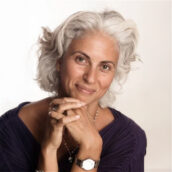
This conversation explores Eva’s transformative journey from traditional peacework to a trauma-informed, soul-centred approach. Her own experience of progressive vision loss forced her into two years of deep shadow work. In this process she identified and released unhelpful core beliefs and avoidant patterns Today, Eva believes she lost her eyesight to rediscover her true vision and destiny, through embracing her Palestinian-Israeli identity
She clearly explains why:
- Sustainable peace begins within us
- Traditional peacework as fundamentally broken
- Trauma-informed peacebuilding is able to end suffering comparisons and the weaponizing of trauma
- The Israel-Palestine conflict as a colonial themed theater in which global powers operate
- True conflict resolution requires the recognition of multiple truths and perspectives
Eva emphasizes that bringing people together in the midst of a genocide is immoral. Instead, she suggests the focus be on holding space for community pain, including the deep impact of collective generational trauma. She shares an inspiring vision in which she saw humans experiencing darkness as “particles of light” on a journey back to wholeness.
Episode transcript
00:00:02 Eva
And what I saw is really the understanding that we cannot right now, we cannot bring people together in the midst of a genocide. Bringing people together, I found, was immoral. What we can do is hold space for the pain of each community in its own legitimate right without comparing suffering, without competing over who suffers more, who’s more victim, and without also weaponizing these traumas. Because this has been really strong… Suddenly, having empathy to the Palestinian narrative was being perceived as an anti Semitic act and showing empathy to the Israeli suffering was dismissing the Palestinian suffering. And I didn’t want to be in either or. I really deeply believe there’s both. And, each suffering is valid on its own. At the same time, we need to speak truth to power and really see reality as it is.
00:01:05 Rosemary
This is the Gifts of Trauma Podcast Stories of transformation and healing through compassionate inquiry.
Welcome back to another episode of the Gifts of Trauma podcast by Compassionate Inquiry. I’m Rosemary Davies-Janes and today I’m delighted to be speaking with Eva Dalak, who like Scheherazade, the storyteller in the Middle Eastern collection of tales known as 1001 Nights, Eva is also a woman of many stories which she shares to offer hope, to those living in conflict zones. Eva, welcome to the podcast.
00:01:52 Eva
Thank you, Rosemary. Very happy and honored to be here with you today.
00:01:57 Rosemary
The honor is all mine. And I’d like to say right off the top that you generously provided me with a copy of the manuscript of your new book, and in reading your words, you connected the dots for me. You helped me understand why the co-founder of Compassionate Inquiry, Dr. Gabor Maté, you helped me understand his heartbreak and his frustration with the situation in the Middle East because as a Jewish man who has evolved through being a Zionist into a pro-Palestine supporter and also a trauma expert.. It became so clear to me when you brought in the dynamic, which I’m not going to offer a spoiler right now, but you offer an explanation as to why that cycle keeps perpetuating and it could be interrupted. So thank you for that.
We also often, in Compassionate Inquiry, state an intention. Normally it’s for ourselves, but I’m going to state an intention for this podcast for our listeners that they gather from your words, from the pearls of wisdom you share today. They also gain insight into this endless conflict that will shine the light on the solution that you’ve offered. Do you have an intention for what you’d like to accomplish in our next hour together?
00:03:28 Eva
My intention is always to be of service and… so that my words be impeccable and reach as wide an audience as possible.
00:03:38 Rosemary
Beautiful. Now, Eva, your full bio is in the show notes, but before we jump into our conversation, I’d like to share just a few points from it to give our listeners a sense of your background. You’re a Palestinian Israeli born Muslim. So you’re a Palestinian born in Israel. You’re also a Muslim and you were educated in a Christian Jesuit school. And after over 30 years working as a gender and conflict expert, today you’re a trauma-informed transformation catalyst who integrates body, mind and spirit, to heal the roots of conflict in relationships, organizations, and between nations. And two years ago, in response to the escalating crisis in Palestine and Israel, you founded Peace Activation, your organization which is a global peace initiative rooted in the belief that sustainable peace begins within. You host the Peace is Possible podcast, you author the other narrative substack, sharing stories of resilience and hope from the front lines of conflict. And you also, as I’ve already mentioned, you have a new book coming out in just a few days which we’ll be speaking about. And you love to dance. Eva, what else would you like to tell our listeners about yourself to give them a sense of who you are as a human?
00:05:01 Eva
I’m a mother of two beautiful boys and I think that’s one of the most challenging roles I’ve ever experienced. I find that being a mother is even more challenging in the way that it asks us to be present than any of the work that I’ve done in conflict zones. Yeah. And I live in beautiful Costa Rica with my beloved husband for the past 17 years and deep connection to nature, into our own nature.
00:05:29 Rosemary
Wonderful. Thank you. Now, Eva, I’d like to set the stage for our conversation with a quote from your new book, which is called Dancing In The Dark: How I Found My True Vision For Peace, which will, as I said before, will be published in just a few days.
00:05:44 Eva
The book is going to be released on October 7th, and I chose that date on purpose because it’s a date that has been associated with the horror that happened in Gaza by Hamas and the response that Israel had on Gaza and that since then, the whole world is witnessing. So it’s a moment of collective trauma. And for me, what I’m offering is a vision of hope that is an alternative to this re-narration of the same trauma over and over again. And that’s why in a moment, where everybody’s going to be focusing on the trauma of what happened on that moment on October 7, 2023, I’m offering a vision of hope, in October 2025.
00:06:25 Rosemary
Yes, I love that. Thank you. I’d like to start by speaking briefly about your decades of work in conflict zones. What is fundamentally broken about how we’ve been approaching peacework and what led you to believe we need something radically different?
00:06:42 Eva
I feel like what is fundamentally broken is the focus on the external action, and dropping ourselves at service to others. I worked with institutions such as the United Nations European Union delegation across different conflict zones, with the World Bank and other NGOs. And what I noticed is that we work so hard on serving others and we put ourselves to the end. And I remember when I started studying spiritual psychology at the University of Santa Monica in California, I realized that my tendency to work in conflict zones was to hide… so that I can hide my own internal chaos and my own internal conflict. And by focusing on being at service outside, and focusing on an external action, it allowed me to justify denial of my internal turmoil.
And I find that many of us, many of the people that go into such institutions, not everybody, but many of us that go there to be peace workers, are hiding or are running away from their own issue at home. And we’re bringing that into the conflict zones. And there’s a lot of abuse that happens in these spaces a lot. I worked in peacekeeping missions and so a lot of abuse has happened in peacekeeping missions with soldiers, with peacekeepers, including abuse of local population and just changing the whole dynamic in conflict. And I think that’s part of the thing that we don’t talk much about.
00:08:15 Rosemary
Yeah, yeah, I would say you’re absolutely correct on that. I’ve never heard anybody reference that before. Eva, you describe this shift from ‘peace as a political process’ to ‘peace as soul centered practice.’ This transformation came through a profound personal experience. And I wonder if you can share what happened after you received the news about your father’s death.
00:08:38 Eva
I think my world shattered. I was always a rebel. Growing up in such a patriarchal society and… in growing up Muslim in the family, in different patriarchal systems, whether it’s the state, the school and the household. So I’ve always been battling, reacting against the system or against authority. And I think when my dad died, my whole world shattered because I didn’t realize how much his structure was holding…. He was my backbone, he was holding me. And I never knew that until he died.
I loved speaking to him. My father was a very wise man, but I’ve always been in reaction to what he was teaching me rather than in acceptance. And part of it was also, by the nature of the work that I was doing, I was gender expert working for women’s rights. And as a Muslim girl, I’ve always fought for my own right as a woman to do things that I wasn’t allowed to. So for me, I was constantly in reaction and so understanding when he died and I wasn’t there. It took me 48 hours to actually arrive home, it just devastated me and I felt as if my whole structure, my whole being just dropped. And at the same time, in that same day, and I speak about it more in the book, he gave me the most wonderful gift that he could have given me. I have the chills now, but he gave me a gift while he was passing. He gave me a gift of life. And since then, he’s more present with me than ever. And yeah, we very connected.
00:10:18 Rosemary
Beautiful story. Thank you. I’m going to move far forward now to October 2023, when you founded Peace Activation, that was clearly a pivotal time in the ongoing Palestinian-Israeli conflict. Can you tell us a bit about what’s happened since its inception two years ago?
00:10:41 Eva
I founded Peace Activation because I saw it already in the process that led me to understand the true vision of peace is not what we are being offered and that the internal vision, the internal sensation of how peace feel like and that very often we are denied of feeling. And so for me, in October/23, another type of world also shattered in a sense, both in Israel and Palestine, but I think even globally. And what I saw at the time was like such a polarization of right and wrong, of good and bad, and condemnation of one thing versus another. And internally I knew I couldn’t choose sides. I just couldn’t. It was, for me, it was incomprehensible, just because of my background and the relationship that I hold both in Israel and in Palestine and myself. I have family in Gaza, I have family in Jaffa, I have family in the West Bank, I have family in Israel. So it was just like, how can I hold all this different truth?
And the insight or the vision that I received was actually to invite people to just share their feelings and not react and just say, how do I feel? And take that feeling of powerlessness and helplessness and hold it in a space that is safe to be seen and heard, and to share, and where it led me… because Peace Activation unfolded with the activity, it didn’t come with a vision, didn’t come with a five years plan, unfortunately didn’t come with a script. It unfolded with the activities and with the interest of people on the ground. And so from the first zoom room where people shared, then I went and I visited my own community on both sides. And what started to unfold is really holding training on trauma-informed peace building with… specifically for the alliance for Middle East Peace, which is A network of 170 organizations Palestinian-Israeli working on peace, both in Israel and in Palestine. And I was invited to deliver peace activation training and trauma informed peace building training in Hebrew for Israeli in Israel for Israeli organization, and in Arabic for Palestinian organization in the West Bank. Similar training, similar material, similar facilitator, just language different and location was different.
And what I saw is really the understanding that we cannot right now… bringing people together, I found was immoral. We cannot bring people together in the midst of a genocide. What we can do is hold space for the pain of each community, in its own legitimate right, without comparing suffering, without competing over who suffers more, who’s more victim, and without also weaponizing these traumas. Because this has been really strong. Suddenly, like, having empathy to the Palestinian narrative was being perceived as an anti Semitic act, and showing empathy to the Israeli suffering was dismissing the Palestinian suffering. And I didn’t want to be in either or. I really deeply believe there’s both, and. And each suffering is valid on its own. At the same time, we need to speak truth to power and really see reality as it is. So there is perceived threat and there’s real threat. And unless we’re able to speak that within a safe context and say, yeah, I hear you, I hear where you’re coming from and this is what you are currently doing, I can use… the example that I have in mind is pretty brutal, but it’s like someone raping a woman and saying, oh, but I’ve been raped. And the only thing that I see is the rapist. And I’m like, no, you’re right now… you’re raping that woman. So, you know, if I can intervene, that’s when I intervene. So I think it’s really important to understand that trauma blinds us to see what’s happening. And so for me to insist for you to see it is not gonna be helpful. The only thing that will be helpful is me holding space for you to go through your narrative, feel heard, and then guide you to see, okay, can you see the reality as it is now in the present, rather than speak about the past, in the present, that speak about what is happening right now.
00:15:04 Rosemary
Absolutely, absolutely. Very well said. Thank you, Eva. It sort of springs from the personal into the collective. So it seems like a good time to turn to your personal story now. And I pulled another quote from your book. You said. “I didn’t fall into darkness I answered its call. There I remembered the grief I carried was never mine alone. What breaks us open is sometimes what births us whole.” So obviously this is connected to your vision loss, which I understand that you lost progressively over a number of years. What was it like to so slowly lose something that you’d taken for granted? And this happened while you were dealing with the grief of your father’s loss. How was that?
00:15:54 Eva
I think it actually started when I lost my father because of the pain and the grief that I couldn’t deal with. And after my father died, I just went ahead like an autostrada, like a high speed train to continue working like crazy. And I remember I had a diagnosis that I have an issue in the retina that I need to address. And I didn’t listen to that first call, paying attention to my health and wellbeing. And I continued, just like heads on working, traveling. And it. It happened progressively over a period of two years. But the last bit was very fast, where I suddenly just realized I was like, oh my God, I can’t read, I can’t see. And from there it was just like, down the hill, very fast. And I think that in the beginning I just couldn’t believe it. It was like ,I couldn’t believe it. I thought somehow it was just a story, like a drama that the doctor was trying to get me into doing an operation that wasn’t necessary. I don’t have a lot of trust in the medical institution, so that wasn’t helpful. And then it was Covid. This was happening in the context of COVID and with so many chaos and trauma around me that, I just couldn’t take it as it was. I didn’t accept reality as is. And I think that’s what then brought me back to my knees, to see what other realities I haven’t accepted.
And it was a deep, dark, depressing period. Like when I think about it, I’m like, oh my God, I can’t believe I actually lived through that, to see. Because right now I can see. And so it just, for me, just like a chapter in my life for two years that enables me now to see in the midst of all the chaos that’s happening, that I know there is an end to that chaos. As hard as it may sound, there’s something good that is going to come out of it. And just like they say in Chinese, they say crisis. The word crisis is composed of two words. Weiji, danger and opportunity. Right now we’re living the danger full on. But the opportunity is here as well, and we need to open our eyes to see it and understand that it’s not going to come from outside. It’s not coming from the savior. It’s coming from us, from within us.
00:18:19 Rosemary
Yeah. Yeah. Wow. It’s an amazing story. And it… it strikes me, too, that a lot of the mystics have actually those seers who could see the future, were blind. And it fits like it was taken away, luckily for a relatively short period of time. But the insights and the inner seeing that you gained during that experience… I understand, also, you were very close to nature, and you share in your book a story about your special relationship with the ocean and the special swimming goggles that you had. And the story really revolves around when they were lost and then returned to you. Could you share that with our audience?
00:19:04 Eva
Sure. That… that remains a special story in my heart because it really gave me confirmation of how connected I was to the elements of nature. And the story was that I needed to use goggles to swim because the sun was very strong. It’s very strong and I couldn’t be exposed to any light. I really needed darkness. I needed to be in dark spaces. And so the goggles were covered, and so it protected my eyes from the sun, but also from water. And my son at the time was eight years old, and he asked me if he can use them, and I said no, because these are the only goggles I have to… that enable me to swim. And if I give it to you and you lose them, then I. I won’t be able to swim. And he insisted. My son can be really very inquisitive. And I ended up letting go, I was just coming out of the water. So after swimming, I gave him… I’m like, okay, you can have them for five minutes. I come out, he takes them, and there’s a wave that comes and takes the goggles. And he comes out crying, and he’s like, mom, I’m so sorry I lost the goggles. And I’m like, oh, my God. I just had a tantrum, like a melt down. Oh, my God, I told you. And I just started crying and went back to the sea and asked the sea to… the water to give them back. I said, this is the only way I can come back and swim in your water, in your body of water. Please bring them back. And there was a wave that brought them back, and I couldn’t stop crying because I was just, like, so overwhelmed by my emotions, by the loss, but also how the sea gave them back. The ocean gave them back. I’m just realizing how much I was holding my, my tears, how much I was playing ‘be strong,’ how much I was trying not to share how depressed I was. And so I think this just cracked me open even further to see how much I was supported by the elements of nature, by my family, by my friends, and yet feeling so lonely in the experience.
00:21:06 Rosemary
Yeah. Beautiful story. And I love, again, the parallel of the ocean being the originator of your flow of inner tears, allowing those tears to release. So evoking water. And we spoke, like, just a minute ago about people who are psychic, often not having vision. You experienced a vision, was it during an operation where you saw light particles fragmenting from the sun? Could you share that for our listeners?
00:21:36 Eva
Yeah, I experienced that vision after the surgery. So I had a surgery. I tried to retrieve my vision naturally, it didn’t work. Then I went to allopathy and did the surgery. And during the recovery period, I had this vision of the sun being made of particles of light. And these particles of light coming down, like coming out of the sun into the earth and becoming human. And how we are all, all of us, all human, not some of us all human, our particle of light. And we are here experiencing, actually the shadow part, the darkness. But we shouldn’t forget that we are all coming from the light and we are all light. And that’s where we’re going back to. And in between the inhale and the exhale, the inhale of the birth and the exhale of the death, there’s the journey. And that journey is the journey of us coming back to our wholeness and remembering that ‘the other’ is nothing else than me.
00:22:38 Rosemary
We’re taking a brief pause to share what’s on offer in the Compassionate Inquiry community. Stay with us. We’ll be right back. Did you know that Compassionate Inquiry offers a free public blog library with over a thousand short posts written by our practitioners and facilitators? Each is only a five or six minute read, and topics range from connecting with authenticity to overcoming food addictions, to understanding epigenetics, rethinking drug use, CI and psychedelics, and much, much more. You can also read excerpts from podcast guests interviews, tap the link in the show notes to access our helpful, enlightening and inspiring blog library.
Rosemary: There’s a quote that really supports what you just said. You said, “I believe that I lost my vision so that I could discover within myself where I had already lost my vision for my destiny. I had to lose my vision to find where, why, and what I am choosing to live.”
00:23:40 Eva
Yeah, yeah, I ran away all of my life, of being the Palestinian-Israeli peace activist. So October 23 brought me back to my … brought me back to my place in a way, because I finally realized I cannot run away of these identities. I cannot run away from this background. I have to bring the gift that I’ve been bringing all over the world, in the over 22 countries around the world where I’ve been working to bring these gifts, back home. And that this is really, I think we’re all born into an identity or a nation or a tribe or a family because we have gifts to give back to those family, tribe, community and identities.
00:24:27 Rosemary
Yeah. And when I put your experience in the bigger context of what is going on globally, astrologically, people who are mystics are talking about a huge shift. So the timing is really perfect for what you saw in that vision. It all fits in with what many others are saying. Now, I’d like to shift forward to a trauma informed perspective. And I think the best way to start that is going back to your childhood growing up Palestinian in Israel. You describe, “Living between worlds, Arab yet Israeli, part of the system, yet outside of it.” So I’m just interested in your perspective on how this early experience of really a fragmented identity reflected in your more recent vision loss.
00:25:23 Eva
I think growing up as a Palestinian Muslim in Israel, because in Israel, the identities are so fragmented in Israel, like you are either Muslim or Christian or Druze or Armenian or Turkasi or Jewish. It’s just like there’s such a kaleidoscope of identity, for divide and rule. And very few people are actually understanding the dynamic of the internal Israeli society and how fragmented we are and how we’re being played against each other, each identity against the other. And for me, this understanding, the fact that I grew up fragmented, allowed me to see how all this fragmentation are part of the one. And the work. we talk about shadow parts, it’s all connected. And so once I work through because of the experience that I went through, because I didn’t have anything else to do for two years other than work on my shadows, once I integrated all the parts of me that I have left behind, and many of them I left behind in Israel when I left at the age of 19, I just left that there. I had to go back and retrieve this memory, retrieve these early childhood experiences, all the places where I left or I abandoned myself in situations that were too hard. And this trauma-informed approach had allowed me to go back and reintegrate and understand/ Everybody does their best, and sometimes the best is not enough. It’s not a reason for us to abandon or reject and neglect. And so when I recuperated myself back, I also recuperated my energy and my relationship with my mother and with my father and with my sibling. All the different situations and institutions and, you know, systems that I’ve blamed for what was happening to me, and understanding that what was happening to me was happening for me and was helping me understand how I invited, actually, this experience because I wanted to experience a true vision. And what does this vision mean? In a way.
00:27:42 Rosemary
Yes, and if I could just underline something you said, because it really landed solidly in me. I’m going to invite our listeners to imagine being two years, unable to visually distract yourself, so you can’t escape into your phone. You can’t be scrolling on social… Like you just… And to spend two years working through your shadows, that’s like the double PhD in shadow work.
00:28:10 Eva
Yeah, it’s intense. It was intense.
00:28:13 Rosemary
And look at what came out the other side, it was definitely an investment in what was next for you. Now, from a psychotherapy perspective, you offered, as a key framework for understanding conflict, you offered the drama triangle. And I’ll also share a quote here so you don’t have to frame it up. You say, “As long as we remain in these roles, we remain trapped.” You realized that you’d been trapped in the rescuer role as a peacebuilder. So I wonder if you could just outline the three roles. I think of it as like a triangular wheel that, you know, when it’s rolled is very bumpy, shifting from one aspect to another. So if… can you outline that and then just say how your loss of your vision forced you out of that old role?
00:29:05 Eva
So the drama triangle brings together victim, perpetrator and rescuer. And the victim, I call it… it’s an invitation to dance. Somebody will come and complain about something. That’s the victim. I will hear the victim complain. I would jump into a solution. That’s the rescuer. And someone else will come and add to the issue that is happening and that’s the perpetrator. Or just hammer down the victim. And the interesting thing is that it’s really interchangeable. So the same person can be within the same conversation. A victim, perpetrator and savior and rescuer. And rescuer is someone that is often on the spot wanting to do an action, it’s the problem solver. It’s like the person that as soon as they hear a person sharing about their problem, they have already the solution, they have already the connection. And for me, there was no way into that Anymore. And It allowed me to really see how I was fully in the rescuer. I was either in the rescuer or in the perpetrator, potentially, but never the victim. And this situation, being without my eyesight, just forced me into so much dependency and a perception of a victim. Oh, poor she… She lost her eyesight. And I was like, there’s no way I’m entering that role. I know this role. This is the role that I help, that I save, that I rescue. This is not someone doing something to me.
And so it really forced me into the receiver, which I very rarely accepted. It’s much easier for me. It used to be. It was much easier for me to be the giver of advice, the giver of finance, the giver of support. But to receive advice or support or finance, that wasn’t a role I really enjoyed. And somehow during these two years, I stayed battling between the three roles. But what I understood is really that once I’ve become present, and that’s what losing my eyesight forced me…. It forced me to be present, to be really in my body. You’re talking about like you’re referencing distraction with the phone, etc. I think sometimes we’re distracted. Even without anything, we’re just like, out of our body. We just step out of our body. And most of the time I was out of my body, I was dreaming, daydreaming, or thinking about something like, we’re constantly distracted. It’s so hard to be fully present with what is. And for me to be fully present with what is, was like this eye loss, but also because nobody needs me. Nobody needs me. And that’s devastating for a rescuer. It’s like nobody needs me. And so my raison d’ etre, is just me. I only need to take care of me. And even that, I cannot, because I cannot see. So I actually have to ask for help, which for a rescuer is, or at least for me as a rescuer, is like condemnation to death. It’s like I have to ask for help, I have to accept help, and I’m not needed, I’m not useful. And that’s depressing, that’s devastating. And that’s… so many of our roles are based on how useful we are, because that’s how we define how lovable we are, how worthy we are. And I had to accept and work through this, like, being worthy of love and help, even if I’m not useful and needed.
00:32:40 Rosemary
Yeah. And that comes up a lot in the Compassionate Inquiry training. The core belief that my value is tied to my work, my productivity, my some contribution that we make externally as opposed to, really who we are as a person without doing anything else. So it’s interesting that core belief was totally reshaped.
00:33:08 Eva
Yeah, yeah. I feel like we became human-doing rather than human-being. And this experience forced me to be, just to be. And it’s the hardest thing I’ve ever done. To be with what is.
00:33:25 Rosemary
Yes, because you made a very good point. We don’t need vision to be distracted. If we wanted to be distracted, we could listen to podcasts, we could listen to audiobooks, we could take a walk and let our mind just do what it’s always done. So you chose to go inward, which I think is a very brave thing to do. And you dealt with your shadows. Now, in the shadows, I imagine there was also some generational trauma. Gabor Maté talks about how trauma gets passed down through generations, and you write about carrying the silent grief of your grandparents who lived through the Nakba. Can you just explain what that is for our listeners?
00:34:04 Eva
And for me, the story has been, is that my grandmother’s family were all running away from the war. And so just to clarify for the audience, the Nakba is what Israelis refer to as Independence Day. And so for Israel, in Israel’s creation, Israel was created on the 15th of May, 1948. And that’s what we refer to as the Nakba, the catastrophe, because that’s when millions of refugees were expelled or fled to other countries. And for my personal story, my grandmother was pregnant with my mother and her whole family was fleeing from Jaffa. And then she had contraction with my mother, and she had to step out of the boat that was heading to Gaza, where some of my family members are still, those that are surviving. And she gave birth to my mom. And that’s the only reason why we are in Israel, actually, or why I was born in Israel, because my grandmother gave birth to my mother and immediately afterward their borders were closed and no Palestinian was allowed to come back. And so for those Palestinians that stayed in their home or couldn’t leave for various reasons, these Palestinians are the Palestinian citizens of Israel. That’s what we need to understand. And these Palestinians became citizens of Israel only in 1967, because that’s when Israel occupied the west bank and Gaza. And so Moshe Dayan at the time said, they couldn’t deal with both internal Palestinians and externally from the country. So the Palestinians in the west bank and Gaza were referred to as the occupied territories and the Palestinians inside Israel recognized Israel, became citizens of Israel. Or that was the process that they had the nationality or they had more rights. It’s still an apartheid state, but they had more rights than they had before. And just we say second class citizens. I don’t think that we were second class citizen. I think we’re like third or fourth or fifth. Because between all the fragmentation of society, we were the least, I would say the least advantageous or the more disadvantaged.
00:36:27 Rosemary
Yes, thank you. That was very clear. Can you speak a little bit about the way these cycles that have been inherited… You’ve just put it in great context. Your grandmother experienced the Nakba and you are the grandchild. So that’s three generations. So how are these cycles staying present or emerging?
00:36:50 Eva
So I live in Costa Rica. When the genocide happened in Gaza, I feel it here in Costa Rica. I feel it in my dreams, I feel it in my body. My whole being is completely connected to my family in Gaza and in Palestine and Israel. And I remember when my mom called and said, oh, there’s the whole building of the family that just crashed on the whole family. So they all died. I remember saying, I know, I felt that in the night, and the pain and the grief. And suddenly I realized that there was so much silence around when I was growing up. Like we never spoke of the Nakba and speak about it in the book. Like, I didn’t even know about it until I left Israel, and studied international relations and studied political science. And suddenly I discovered this whole new world of something that was completely denied and reprogrammed in the Israeli system. There was no reference to the Nakba.
And of course, remember that the generation of my parents are the most direct generation that is traumatized. And so my parents didn’t tell me about what happened. All I know is my mom just said, oh, I was born during the war. Oh, and we got married during the war. Ah, and you were born after the war. And so war is like all around us. And war is so normalized. Also, because the Israeli society is such a militarized society that the IDF, the Israeli Defense Army and even defense is like, is such a present everywhere. And it has nothing to do with defense. It has to do with monopolization of violence and including it in state violence. And so the normalization of violence for anybody, not just like towards the Palestinians, like violence against women, is very high in the Israeli society. And people are not doing the connection between the traumas of the creation of how Israel was actually created, of the occupation that’s happening just next door, and of what’s happening for these soldiers that go and have a carte blanche nearly, to do whatever they want with the Palestinians, and then these soldiers go back home. And how do you think they will behave? They’re not going to be behaved with empathy and listening skills. They’re going to take the same attitude, and also the trauma of what they saw and what they did, and they will be bringing it back home. And so this is what’s happening in Israeli society right now.
00:39:17 Rosemary
Yes. And if you look at it from an epigenetic perspective, you were an egg in your mother’s uterus when your grandmother was carrying your mom. So what your grandmother experienced, I can totally understand, you can feel that in a very real way, even though, I don’t know. Could you get further around the world before you start coming back from Israel, in Costa Rica, like you’re on the other side of the planet? So it is very bonded within us. And it’s interesting too, because Gabor Maté wrote about this extensively in his book, When the Body Says No that trauma can manifest as physical symptoms. So the holes in your retinas appearing months after your father’s death, it seems to mirror Gabor’s teaching.
00:40:07 Eva
Absolutely. Absolutely.
00:40:08 Rosemary
We externalize what we have not healed within.
00:40:11 Eva
Yes. And we externalize what we didn’t heal within. Only if we’re not willing to see it.
00:40:16 Rosemary
Yes.
00:40:17 Eva
And then it comes from the energy from our energetic body. Then it comes in the physical body. And that’s why I chose to go within, because I knew that, as a spiritual psychologist, I knew that losing my eyesight didn’t mean just like a hole in the retina. Losing my eyesight meant there’s something I don’t want to see. And during this whole process, I was like, what is it that I don’t want to see now, and what is it that I haven’t been seeing? And when did it start? And I didn’t think about… It wasn’t like a planned research project of, oh, it started when I was young in my mom’s belly, and the traumas? No, it went like, really uncovering what is it that I didn’t want to see, and what else didn’t I want to see and what… you know, just like going through every experience in my life and realizing how deep the wounding is, and how there is no space to speak about this wounding because it’s ugly, because it doesn’t look good because there’s shame, because there’s blame. Like I have to blame someone for it. I didn’t know who to blame. There was no one to blame other than me. And that sucked.
00:41:27 Rosemary
Yes, totally. And you extrapolated out in your book, not only… and I’ll read the whole quote. “We externalize what we have not healed within. And nations mirror the traumas of their people. Therefore, the violence we see in the world echoes the suffering we hold inside.” So your body obviously signaled to you what your mind had yet to learn.
00:41:51 Eva
I feel like there’s a blind spot that is not being addressed. And part of the process right now is everybody’s speaking, of the Palestinian, Israeli, the endless conflict. No, it’s not an endless conflict. And it’s not just like Palestinian-Israeli. There’s Germany here. That is a key component. There’s France, that is a key component. There’s the US that is a key component. And somehow by polarizing these two sides, and that’s part of why in peace activation, I say there are no sides, there’s only one side, and it’s the side of the truth. And so unless we are able to understand that there are multiple truths and it’s not just two truths, and also there’s multiple perspectives and able to put things into the context of colonialism, into the context of when was Israel created and how was it created? The only resolution that Israel respected was the resolution of the UN of its own creation, nothing else. It despised the UN, it criticized the UN, it rejected the UN. However, without the resolution of the UN, Israel wouldn’t be created. There wouldn’t be a Nakba. And that’s what people fail to see. And so working also on collective trauma without addressing our own trauma and blind spots is eating half the cake. It’s like not addressing the full of it.
And that’s part also for Gabor’s courage to come as a Jewish that survived the Shoah, the Holocaust, and have visited the Palestine and have visited Israel and is able to speak so eloquently about what’s happening. And articulating it for many Israelis as well. At the same time, there’s such a barrier for people to hear that, especially Israeli-Jewish, oh, he’s just like any Jewish or any Israeli that speak towards what’s happening is perceived as, oh, bad you. Or I feel like there’s something there that at least for me at Peace Activation is I really want to rally everybody and I want to make sure that when I speak and that’s always my Intention is that I speak also to the heart of that Israeli and Jewish person that doesn’t feel seen by a Palestinian. To speak to that ear of the Palestinian Arab that hasn’t been heard by an Israeli Jewish. And this is the jewel. This is the jewel of what my loss of eyesight had brought me. Because without seeing, there’s no identities, there’s humans. And what I speak about is my love for humanity. And that our shared humanity is the only side we need to be on. And that’s the only way that we can succeed. Because there are elements of extremism everywhere. It’s not just like in Israel and Palestine, there’s elements of fanaticism everywhere. So let’s get real about what are we talking about here, when we put two tribes or two communities against each other, it doesn’t serve anybody. It serves the money, it serves the company. It serves the ones that want to do something with that hatred and that violence.
00:44:48 Rosemary
Absolutely. And you were so right to go back to colonialism, because I remember thinking, gosh, a long time ago Leon Uris published Exodus. And I remember thinking like what on earth gave the British Prime Minister the authority to give away territory belonging to another nation? And that tends to get forgotten. And it’s so outrageous because that was what was going on at the time, 1948, right after the war, countries were annexing other territory, redividing, recreating country borders. It became common.
I would like to reflect another one of your quotes to you. “Surrender is not about giving up. Surrender is about letting go completely of any expectation, hope or waiting for anything.” So I’m wondering if you’d be willing to project out a little bit, what might surrender look like in the peace process that you envisage?
00:45:50 Eva
I would say it looks like swallowing your anger and your righteousness and your unexpectation and really being present with what is with reality as is and the system of oppression that justify acts of violence. And deep, deep, heart centered listening. Deep heart centered listening. Because each listening act will lead us to the next act. And a peace process is a process that would take time, that takes patience, that takes sitting in and connecting to the feeling inside, and being okay with the triggers. When I say swallow your anger is not necessarily, not expressing it, but it’s owning it more. Owning it and not throwing it on the other.
00:46:46 Rosemary
Yeah, thank you. And it sounds as if the listening process also is not linear. It’s more like tracking a honeybee flitting from flower to flower.
00:46:57 Eva
Yes.
00:46:57 Rosemary
Just being open to whatever flower is available next for you.
00:47:03 Eva
Yeah. And also this internal listening, because when… When I listen to my anger gives me a lot of information about why I’m angry. What is it that I haven’t been receiving or giving to myself, what are my needs, what are my feelings, and what really is happening inside, and how the external reality is just a reflection of my internal experience. And if I change this internal experience, will the external reality change? Most probably.
00:47:36 Rosemary
I’m curious too, because you spoke about the challenge you had in releasing your ‘rescuer identity’ and leaning into accepting support. And you speak in your book about, during your vision loss, leaning into the power of sisterhood. You know, how women’s circles held you when you didn’t hold yourself, and you were probably previously the holder of everybody. You were facilitating, you were taking care of everybody else. What did you learn through allowing yourself to be held, when you couldn’t hold yourself?
00:48:15 Eva
I learned how a mother holds a baby, how much support there is around me that I haven’t been tapping into because I was in a reactive mode. How the universe, spirits, sisters, like, you name it, it’s all around me, just present and willing to support. And when it’s not coming from entitlement. And that’s really important to outline, because I feel like we can divide it into givers and takers. And a lot of the givers don’t want to take, but they mistakenly, they don’t want to receive as well. And a lot of the takers want absolutely… like they have entitlement issues. So it’s like the other side of the same coin. And so how to find the balance of, yes, I accept support am grateful to that support without feeling entitled to that support. And I think that’s key in the surrender and in the receiving support from sisterhood, from community, from anybody. It’s very important to find a balance. And it’s a very fine and subtle balance.
00:49:26 Rosemary
Yeah, thank you for that. But you’ve also highlighted the burden of polarity, of duality. This framework that we grow up with, it’s either wrong or right. It’s either good or bad. And the flight of the bumblebee is really the gray area in between. And learning to navigate that gray area, because as the world gets more and more polarized, that’s very involved in what you’re describing as this vision of healing.
00:49:54 Eva
Yeah, it’s coming to unity. That’s why I say it’s like ‘the other is me’. And so understanding that I. The reflection that the other is sending to me and that triggers me or that upsets me, is at the end of the day, the parts of me that I haven’t integrated and I haven’t accepted. And so if I accept those parts of me, then I can manifest like a relationship that is looking completely different. And I think that’s where we’re moving in… People think that something new is going to come out of nowhere. No, no. Something new is going to come from within. Once we understand, we will come to unity. Come to unity only when we are in unity inside.
00:50:34 Rosemary
Yes. Very well said. Many trauma therapists struggle with savior complexes. I think that’s fair to say. And you offer some practical healing applications for professionals to consider. And I will share one quote, and then I’ll invite you to share other thoughts. You say. “To healing is to wake up. To wake up is to see clearly, and to see clearly is to recognize the structures that keep us in suffering. To reclaim peace is a radical refusal to accept oppression as fate.” And if you were to break it down, obviously we need to work on ourselves first, then collectively and then globally. But what would you suggest?
00:51:20 Eva
Work on your couple, if you’re married, work on your relationship with your kids, if you have kids, work on your relationship with your neighbor and your colleague. I feel like a lot of the time the closest relationships we ignore, and then we want to, like, work on the relationships outside. That’s part of the syndrome of the rescuer, is, oh, things are not going well here. Let me go on a mission and see how I can save another community. So I feel like the most challenging is to be working on your own relationship to yourself, first, and to your couple and your kids and your family and your neighbors and your colleague. And then it’s all the same. That’s the thing that we miss. We think that it’s different. Working on internal conflict, or in therapy is different than working on community projects. It’s all the same. When I moved from Ivory Coast, I was working in a peacekeeping mission with women in communities, etc. So doing a lot of work externally. And when I moved to study spiritual psychology and I started working on the internal conflict, I’m like, oh, my God. It’s actually the same. It’s just that instead of working on an external community, I’m working on an internal community. But there’s somehow a hierarchy of what work gets done first, and often the internal work gets last. And that’s why peace activation, I put it in the upfront. It starts with self awareness, the shit that you didn’t deal with. You’re gonna bring it to the community where you’re gonna be working on. So the family dynamic that you had with your sister, your brother, your mother, and your father that you didn’t deal with, you’re gonna recreate it with your colleague on the ground. And when your colleague is gonna tell you something in a tone that reminds you of your mother, you’re gonna lash on that person, unrelated to what they were saying. And that’s what we don’t see. And that’s what I’ve seen throughout this more than 30 years, in conflict zones. I’m like, oh my God. Okay, this is what’s happening. And I’ve been just like 15 years in spiritual psychology and more than 30 years in conflict zones. And so I see them and that’s the intersection that Peace Activation is bringing. And that’s the added value. Because most of the time we either do personal development or we work on the community or we work on trauma. And it’s like the fragmentation of… Even the work that we do is fragmented. And what I invite is actually just know, we cannot come to unity if we are not united even in the work that we do. Who I am as a parent, as a wife, as a neighbor, has to be reflected in who I am as a peace activator. And so the relationship that I have is really important.
00:54:04 Rosemary
So if, heaven forbid, if a trauma therapist were to fall into victim blaming or oversimplifying complex political realities, that could be coming from their own individual and collective trauma. So listening to what we say when we interact with other people is really important as well.
00:54:30 Eva
And I think Gabor Maté speaks to that. I don’t think that he would be speaking about what’s happening right now in Palestine and Israel if it didn’t touch his own trauma as a Holocaust survivor. And so for me, it’s not that we’re gonna be… I’m not perfect, obviously. Like, I have my own issue with my husband, with my kids. I’m not always in peace, but having the honesty to deal with it, in the moment. So it’s not that we’re going to become. Everybody’s gonna become perfect as a trauma therapist, but that when you see your blind spot or when it is reflected back to you, then you’re able to pause, just take in the breath to pause and say, oh, I haven’t seen that. Thank you for reflecting that back to me, and let’s see how I can amend. And that’s the key. How can we amend? How can we repair? Because that’s why we’re here. We’re here to grow and evolve together. And it’s not that we’re not going to make mistakes, it’s that we are going to make mistakes, but how fast will we do the repair? That’s the indication.
00:55:29 Rosemary
Thank you. Thank you, so that is one element that any trauma informed healing professional listening could integrate into their work right away. Now, Eva, we’re coming toward the end of our time together, but before we wrap up, one question we always like to ask at the end of the podcast is… you have hundreds, thousands of people listening. If you could offer one pearl of wisdom with them that you haven’t already shared and you’ve shared so many. But if you could offer one thought, a quote, an inspiration to leave them with, what would you like to say?
00:56:10 Eva
I would invite them to feel how peace would feel like, how would it look like? How would it smell? To be at peace and really to embody peace from a place of a relationship to self. That is an invitation to dance.
00:56:29 Rosemary
Beautiful. Eva Dakak, thank you so much for joining us today on the Gifts of Trauma podcast. It’s been an absolute delight and I really recommend your new book to our listeners. You’ll find a link in the show notes. We’ve only touched on a minute number of facets that are covered in depth in Eva’s book and it’s an easy read. It’s not the size of Gabor’s books. I’ll put it that way. Yeah. Well, thank you so much for being with us today, Eva.
00:56:59 Eva
Thank you. Rosemary. Thank you so much.
00:57:11 Rosemary
The Gifts of Trauma is a weekly podcast that features personal stories of trauma healing, transformation and the gifts revealed on the path to authenticity.
Listen on Apple, Spotify, all podcast platforms. Rate, review and share it with your clients, colleagues and family. Subscribe and you won’t miss an episode.
Please note this podcast is for informational purposes only. It is not a substitute for personal therapy or a DIY formula for self therapy.
Resources
Websites:
Related links:
Books:
- When the Body Says No
- Dancing In The Dark: How I Found My True Vision For Peace. (Available Oct 7, 25)
- Exodus
Podcasts:
Quotes:
- “Peace cannot be imposed through declarations. It is an ongoing process, a daily act of quiet courage… and it must be made again and again.” – Eva Dalak
- I didn’t fall into darkness—I answered its call. There, I remembered the grief I carried was never mine alone. What breaks us open is sometimes what births us whole.” – Eva Dalak
- “I believe that I lost my vision so that I could discover within myself where I had already lost my vision for my destiny. I had to lose my vision to find where, why, and what I am choosing to live.” – Eva Dalak
- “Wholeness is not something granted by a government, a passport, or a flag… Wholeness is something we must reclaim from within.” – Eva Dalak
- “Peace is not something we wait for. It is something we activate. We do not wait for peace; we embody it. The work is not done. It is just beginning.” – Eva Dalak