
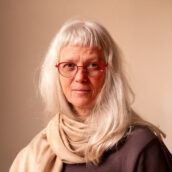
Season 03 – Episode 13: Resolving Math-Anxiety Through Trauma-Informed Teaching, with Dr Bea Bleile
By The Gifts of Trauma /
Listen this episode here:
or here
This conversation explores how academic learning is impacted by a student’s emotional state, prior experiences, and the safety of the learning environment. Bea, who has been teaching in various roles since 1993, saw that traditional teaching methods fail to account for the “whole” students who enter the classrooms. This failure often results in elevated student anxiety and hindered learning.
As a teacher committed to evolving current educational institutions and systems, she addresses:
- The impact of negative emotions on learning
- Math Anxiety, where it comes from, when and how it shows up
- Teaching as a shared experience between teacher and student, not just an information transfer
- Systems that discourage vulnerability in teachers, and prioritize conformity over critical thinking
- How acknowledging mathematics’ inherent difficulty can help students overcome anxiety and fear
Bea sees Compassionate Inquiry’s potential to transform the current education system through; creating safety and rapport in classrooms, encouraging students to embrace their struggles, allowing mistakes to help students embody knowledge, educating teachers on students’ nervous system responses and underlying beliefs, and embracing somatic approaches to addressing student blocks.
Episode transcript
00:00:00 Rosemary
How does feeling overwhelmed or unsafe or ashamed impact a student’s ability to learn?
00:00:08 Bea
It shuts them down completely. And then they avoid doing the work because it’s too hard. It brings up, when they can’t do it straight away, all the fear comes up and, “I’m no good, I can’t do this.” And then it becomes a self fulfilling prophecy. It can reinforce the belief that, ‘I can’t do this.’ We all come to the place of learning with our whole selves, with everything that has happened to us, with everything that we still carry with us, with our families, our history, we’re there, all of it is there.
00:00:43 Rosemary
A student who has math anxiety? How do you identify these folks who are scared?
00:00:49 Bea
Oh, I look at them. Also through working to make the classroom a safe one. When I explain something, I look around and I see who’s sitting there with the glazed over eyes… and I can tell they’ve checked out. But before I did the Compassionate Inquiry® training, I didn’t really understand what was going on inside them. So I wasn’t able to say. “I see you. It’s a completely normal response. You’re frozen or you’ve run away. It’s okay, just catch your breath. Do whatever you need to do to make yourself safe.”
00:01:31 Rosemary
This is the Gifts of Trauma Podcast. Stories of transformation and healing through Compassionate Inquiry.
Welcome to the Gifts of Trauma podcast by Compassionate Inquiry. I’m Rosemary Davies-Janes and today my guest, Dr. Bleile, and I will be exploring connections between maths anxiety, maths teaching practices and trauma. Bea, welcome to the podcast.
00:02:07 Bea
Thank you so much, Rosemary. It’s a pleasure to be here.
00:02:10 Rosemary
I’m so happy to have you with us today, as simply researching for this episode has been quite the education. I’ll introduce you to our audience by sharing just a few snippets from your bio. You were born in Southern Germany and while studying physics at the Swiss Federal Institute of Technology in Zurich, you discovered your appreciation for mathematics. You wrote your PhD in low dimensional algebraic topology at the University of Sydney and you currently work, or should I say teach, at the University of New England in Armadale, New South Wales. And I confess I have never heard of some of the areas of mathematical expertise that you possess. I’m not sure I could even pronounce them correctly, so please include them if you’d like to. So really, what aspects of you Bea, does your formal bio not address?
00:03:05 Bea
In Judaism it’s called Tikkun Olam, and it’s called, ‘mending the world.’ And I’ve known for a very long time that the world requires mending. I wouldn’t have said it quite like that. And I think that drives me in everything I do. Going back to the work… You said teach or work? I would say work. I teach, but that is actually work, and that is part of what I found, what spoke to me of reading Bell Hooks’ book, Teaching To Transgress because she says, “It’s work.” But that launches right into it. And we’re at the bio, so for me it’s work. I also do research.
00:03:48 Rosemary
Is there anything you’d like to say about your personal life, just so people can get to know you as a human being?
00:03:55 Bea
Yes. When I studied at Zurich, I met the love of my life there, and he’s the one who brought me to Australia. At that stage it was the end of the 80s. Australia was so much more open than any society I’d been in before. And I really loved that and I fell in love with the countryside. I felt at home. I remember driving through a valley and rolling hills and eucalyptus trees and I started crying. And I said to my partner, Imy, I said, some people aren’t born at home.
00:04:36 Rosemary
Yeah, I hear you, I hear you. So there is a deep resonance between your new homeland and your heart.
00:04:43 Bea
Yes, yes. So we moved here in ‘92. So we’ve been here in this house that I’m sitting in now for a long time, and my partner Imi is at the moment living in Sydney. That makes life a bit more complicated and interesting. And our son was born in ‘95. He’s currently working in Vienna.
00:05:07 Rosemary
Now, if I understand correctly Bea, Armadale is about halfway between Sydney and Brisbane on the east coast of Australia. Is that right?
00:05:16 Bea
That is perfect. That’s how I would have said it. And I’ll add, we have in Australia… there’s the Great Dividing Range along the east coast and it goes up fairly steep…. The escarpment goes up fairly steeply and we’re on top of that. So called the Northern Table. And I want to acknowledge that I live and work on Aboriginal land. I pay respect to elders past and present. Sovereignty was never ceded, always was, always will be Aboriginal land.
00:05:46 Rosemary
Thank you. Yes, that’s very much appreciated.
00:05:50 Bea
Yes.
00:05:50 Rosemary
Beautiful, beautiful. I have a resonance with Australia as well. I wasn’t born there, I was born in Canada, but I grew up in Victoria. I relate to what you say about the open society. It was so much more casual and friendly. Those would be the words that I would use to describe it.
00:06:08 Bea
Yeah, yeah, yeah. And you could do what you felt like. People might think it a bit odd, but they wouldn’t be bothered and they wouldn’t think any less of you. It’s just, oh, they’re doing this, that’s okay.
00:06:18 Rosemary
Yeah, Wonderful. Now, I understand from my research that you believe in the liberating power of education, and I’d like to frame up our conversation by sharing a quote from the book you just mentioned, Teaching to Transgress: Education as the Practice of Freedom. It’s a book you suggested as a resource for our listeners, and it’s linked in the show notes. So here are two passages that leapt out at me. The first explains, “Almost all our teachers at Booker T. Washington were black women. They were committed to nurturing intellect so that we could become scholars, thinkers and cultural workers. Black folks who used our minds. We learned early that our devotion to learning, to a life of the mind was a fundamental way to resist every strategy of white racist colonization. Though they did not define or articulate these practices in theoretical terms, my teachers were enacting a revolutionary pedagogy of resistance that was profoundly anti-colonial. Within these segregated schools, black children who were deemed exceptional, gifted, were given special care. Teachers worked with and for us, to ensure that we would fulfill our intellectual destiny and by so doing, uplift the race. My teachers made sure they knew us, our parents, our economic status, where we worshiped, what our homes were like, and how we were treated in the family. I went to school at a historical moment when I was being taught by the same teachers who taught my mother, her sisters and brothers. My effort and ability to learn was always contextualized within the framework of generational family experience. Certain behaviors, gestures, habits of being, were all traced back.”
Now that’s very resonant with the teachings of Gabor Maté in Compassionate Inquiry. But before we diverge, I have a second short quote that asserts, “Attending school was sheer joy. I loved being a student. I loved learning. School was the place of ecstasy, pleasure and danger. To be changed by ideas was pure pleasure. But to learn ideas that ran counter to values and beliefs learned at home was to place oneself at risk to enter the danger zone. Home was the place where I was forced to conform to someone else’s image of who and what I should be. School was the place where I could forget that self and through ideas, reinvent myself.”
Wow. I’m going to just pause so our listeners can let those concepts land.
Now, Bea, what stands out for you about this book, which is described as a collection of essays that address the urgent need for changes in teaching practices.
00:09:19 Bea
That we all come to the place of learning, with our whole selves, with everything that has happened to us, with everything that we still carry with us, with our families, our history. We’re there, all of it is there. And what also stood out again was the working with them. There is no separation between the teacher and the student. As I’m teaching, I know, and I’m going to teach you, it’s working together. And that comes again later on in the book. There is a discussion and exchange between Bell Hooks and one of her colleagues. And there they also talk about really working, where the teacher works through the material with the students. Otherwise there’s no learning. It doesn’t work. Like you open the top of their head and you pour in the knowledge and then you close it again. Often we are taught like that and it doesn’t work, it doesn’t stick, it doesn’t stay. It has to be embodied. We come with our whole body. Everything is there.
00:10:27 Rosemary
Definitely. Now the author, Gloria Watkins, AKA Bell Hooks, that’s her pen name. She names Paulo Freire as a major influence on her thinking. And he was a Brazilian educator and philosopher whose work revolutionized global thought and education. I’m curious, has his work influenced you in any way?
00:10:49 Bea
It hasn’t influenced my teaching, but reading, Teaching to Transgress spoke to me. It helped me to better understand what I have been aiming for. I mean, some things I’ve been quite clear about, and I was very glad to find that there were others who’ve been aiming in the same direction. I’m not black, clearly, and back in Germany and Switzerland, the society was quite homogeneous. There, I guess it was mainly class differences. Then they also talk about that class is not spoken about, it’s just meant to make no difference. And then, still, people who come from a lower class are often excluded unless they actually acquire the language of the middle classes and adjust culturally. There’s this pressure to culturally adjust and speak like the others, otherwise you will be dismissed or excluded.
00:11:45 Rosemary
Yeah, yeah. It’s a notion that has been around for a long time. Conform or fail. Conform or die. Resistance is futile. I’m just going to reference Paolo Freire again for a second because I was quite astonished to see that his best known book, The Pedagogy of the Oppressed, was published back in 1968. So he was really well ahead of the curve in reimagining teaching as a collaborative act of liberation rather than just a straight old transmission of information such as you just referenced. And it struck me that the CI training certainly covers both of these bases, but it’s one of the few learning experiences I’ve ever had that did so. There was information transfer and experiential learning. From your perspective as a teacher with lots of experience, how prevalent is this sort of teaching?
00:12:40 Bea
I would say probably not very prevalent. I’m going back now to the quote you read from the book about the black school and the teachers knowing the children. That would have been so wonderful. And here I feel that the school system often seems to be aimed at getting students to do as they’re told. And there is a notion of this as actually critical thinking. So there is a pretense, and that also comes up in that discussion, that there is a pretense, to want to foster critical thinking, but it’s actually not really done because to do that, the teacher has to allow themselves to be vulnerable. Because I could be wrong. And I teach in the third year abstract algebra course. I teach teachers, or we learn together. And some of them say the way things are in class, if they actually admit, if they made a mistake, or allowed them for the notion that they could be wrong, the class would destroy them. They would just go for them. And I think, how can anyone learn in an atmosphere like that?
So that is such a challenge, and it’s so difficult. So hearing that, I think we’ve gone backwards in some ways, and maybe in the first attempt, it went sideways and then backwards. And I really would love it to give it another go. Like collectively, as societies. I mean, it’s slightly different here to the way it is in the US. I don’t know so much about the Canadian system, but certainly there has been an American influence from the US. Dumb. I hate the word. But people say dumbing things down, like pretending it’s all easy. <= Reel Part 3
Reel Part 3 cont…
And in mathematics, that is devastating, because maths is hard. A lot of mathematicians do it because it’s a challenge, and we find it hard. And I’ve seen excellent mathematicians admitting that or even looking at me… I remember as a student, I went to a conference in Barcelona on the future of mathematics. And they had, in maths, we don’t have Nobel Prizes, we have the Fields Medal. And they had four Fields Medal winners there speaking about their project, like their research, and how they saw it fitting into mathematics, into the future. And one of them was… when we went up to the front to speak to him, he was looking at me almost for confirmation, and I felt pressured into nodding. And I thought, you’re the expert. Why are you looking to me to confirm that you’re right? But there was also, I sensed an insecurity. And one example I like to give is a colleague, Amnon Naiman. And he’s a brilliant mathematician and he shaped his area. He works in algebraic geometry. And I once met him when I was doing my PhD at Sydney Uni. He was walking around with a reasonably fat book and he was so frustrated because it took him so long to read one page. So in maths you don’t just read maths, you have to work through it. And then the idea that it’s just all simple and easy makes people think that they’re not cut out for this.
00:16:01 Rosemary
Yeah, yeah, I hear you. It’s so interesting because you touched on the class system. It gets complicated when you get into education, because I think a lot of the way the system is related to economics, budget cuts, fewer teachers, larger classrooms, more workload. It’s, I believe, incredibly complex. And the few teachers I’ve experienced as a student who were vulnerable, it makes the world of difference. I had an art teacher in high school. He was an unusual character. He had survived a concentration camp in Czechoslovakia during World War II. That was where he grew up. And he had a ‘everyday is a gift’ kind of attitude towards life. And he brought in, when we were doing life drawing, he brought in nude sketches that he had done of his wife into a high school with lots of teenage boys in the class.
00:17:00 Bea
Wow.
00:17:01 Rosemary
And he had such respect that none of them did what you would expect teenage boys to do when presented with an artistic rendering of a naked woman.
00:17:12 Bea
Yeah. Wow. Yeah.
00:17:15 Rosemary
And he made a huge difference, I’m sure, with every class he taught because he led with his heart. They’re rare. They’re rare, but when you find one, it changes your learning experience totally. So what Bell Hooks… I would have loved to have experienced more of the teaching style she describes, but I’ve had a snippet here and there and it’s amazing.
00:17:37 Bea
Yeah, yeah. I’ve also had, through the work, the year long training in Compassionate Inquiry, looking at my beliefs and where I go back to that I feel I can’t do things. And also looking at where I was seen and where… Because there’s this spark in me and, ‘No I’m not going to do this,’ and the resistance and the fighting back and the, on one hand, not trusting my own ideas because they’ve been dismissed and poo pooed, and on the other hand, part of me still somewhere in there, hidden, coming up and going, ‘No, I know I’m right and I know this.’ And I’ve… on my last trip back to Germany. I’m really glad I caught up with a primary school teacher of mine. Like, I only had four years of primary school in Germany, so he was the second one I had in year three and four. And he saw me, and it made all the difference. So for two years, I was blessed with every day I went to school. I was seen, I was heard. I could contribute. Gerhard Martin, I’m so thankful to him for doing that. And there was also, because now we have problems with controlling the class. One of my schoolmates, he couldn’t sit still. These days, you’d say, oh, he’s probably got ADHD or whatever. That wasn’t spoken about. But our teacher knew how to deal with it. He just allowed him to do whatever he needed to do at the back of the class. His seat was at the very front. But when he needed to, he could take himself away and he could look after himself. And all of us knew that was okay because he needed to do that. None of the rest of us would have ever dreamed of doing that. And it was fine.
00:19:27 Rosemary
Yeah. Yeah. And thank you for bringing that up because when we’re seen and heard, it makes all the difference in the world.
00:19:35 Bea
And that is what happens a lot in my classroom. That I see the students, I don’t know their family history, and I make a point of asking students to introduce themselves. And so there is some personal connection and information there, but nowhere near to the extent of what Bell Hooks was describing, of course. But in the moment, in the present, I see them and I want to hear them and I want to work through the material with them.
00:20:09 Rosemary
We’re taking a brief pause to share what’s on offer in the Compassionate Inquiry community. Stay with us. We’ll be right back.
If you’ve been listening to our podcast and are curious about the Compassionate Inquiry approach developed by Dr. Gabor Mate and Sat Dharam Kaur, consider joining the professional training program. It’s open to all healing professionals, including naturopaths, physicians, bodyworkers, coaches, and therapists. In addition to learning how to use compassion to support your clients in their most vulnerable moments, with greater empathy and authenticity, you’ll also deepen your own internal process. If you’re interested, look for the link in the show notes.
I read something that you wrote before we got on the call today that surprised me. You said you spent the first year of your PhD being scared, and that you remembered that fear. Can you tell us a bit about that experience?
00:21:07 Bea
I wanted to do the work, but I was afraid that I wasn’t cut out for it, that I wouldn’t be able to do it. This approach-avoidance conflict. So I was scared, just scared. And after the PhD, I thought, okay, maybe now I can fly and take off with the maths research. And then, you mentioned a university’s financial cuts and there are also staff cuts, in our case, they said they wanted to cut 2.5 positions in mathematics and people around the university were saying they want to get rid of you and your partner because you speak up. So there’s this challenging of authority, this challenging of the system, speaking up about what was going on at the university. And so we got redundancy letters and we fought the redundancies and they were, in the end they were rescinded. And that sort of crushed that attempt to, okay, I’ll start flying with research. I know I can do this. I’m going to really grab it and run with it. And that didn’t happen. And in fact, until then, I had been a very confident teacher. And when I came back to teaching, I had lost my confidence in teaching, through that experience. So the trauma from, originally from my family, of being dismissed, and not trust… learning to not trust myself and learning the adults know better and what do I know and I must be wrong. And that… I had that reinforced by a physics teacher in the last two years of my high school education. And then I went to study physics because I wanted to get on top of it. I only realized that… that all came out later, only as well over the last year or so. Now, where was I going with that?
00:23:00 Rosemary
I was talking about your fear and…
00:23:03 Bea
Yes, that’s right. So then that part of me, the protector that went, ‘Oh, no, you can’t do this, you better just lower your expectations and you’re not cut out for this.’ That came between me and teaching.
00:23:16 Rosemary
Yeah. So you have a part that was protecting you in adulthood the way it had protected you when you were a child. ‘Just stay small and you’ll be safe. Don’t push the boundaries.’ It’s fascinating because you spoke earlier about a professor that was looking to you, as a student, for validation, which is what we’d say in CI. And you talked about your fear when you went through your PhD. So it’s almost as if we’ve got this mixture of people, one with authority at the front of the room and a number of other people who are learning from the teacher. And everyone is bringing, like, aspects of confidence and fear as a teacher, as you’ve just very clearly outlined. You have to be careful not to color outside the lines of the establishment, and the curriculum that you are supposed to be following, or you could be made redundant if you’re not brave enough to fight it. So these are the students’ fears, there’s some trepidation on the part of the teacher and they’re all coming together in an environment that is intended to enable people to learn. It seems like that’s possibly not the best environment for learning.
00:24:25 Bea
No, not very conducive. And all the more joy, when you manage. And in our case, it was more about university politics and quality assurance, excellence and so forth. But then later on, we were told that we weren’t allowed to tell students that mathematics is hard.
00:24:47 Rosemary
I’m sorry, that’s ridiculous.
00:24:50 Bea
Yeah, yeah. There was a review of mathematics and the chair of the review panel said, you can’t say
that They interviewed us and I told them about my teaching philosophy and how to address the fears that students have, especially those in first year who have to do maths. They don’t want to do maths, they’re scared of it. And so you take some of the initial fear away by saying, “This is hard. If you’re finding this hard, there’s nothing wrong with you. This is how it is.” And no, you can’t say that.
So mathematics at school became just learning tricks. Just if you see this problem, this is what you do. And then you just mechanically do. There’s no understanding, just a…. This is what you do. And you go through the recipe, through the steps, and that’s it. That’s not mathematics.
00:25:41 Rosemary
No, not as you recognize it for sure. And acknowledging that mathematics is hard is so validating because to Gabor’s point, ‘You’re not alone. No, this is a difficult lesson to learn.’ You also said that mathematics is often not explained.
00:26:00 Bea
There can be an attempt at explaining it, and going on in my mind, might be something completely different. And reading textbooks. One textbook, I open it and I start reading it and go… This doesn’t make any sense to me. And I read another textbook and it suits me. So I always tell students, go and look around which textbook works for you, because there are different ways of thinking about it, of approaching it, of what’s going on in our minds. So it might not even be that it was badly explained, but it might have been explained in a way that was meaningless to the student.
00:26:37 Rosemary
Yep. Yeah. And I’m a person with some neurodiversity and maths anxiety. And in high school, I remember out of four years of high school, I struggled with every math teacher except one, and she made maths make sense to me. Something I had never thought possible. So in her class, for the first time ever, I got an A. Now that may not give you enough data about me, but I’m curious about your take on that. Is it just as simple as she made sense to me, to my brain wiring? Okay.
00:27:13 Bea
She took the time to see. Because what you need to find out is where the block is. Because sometimes we get stuck on something that nobody knows what we’re stuck on. But you have to like, dig into that and see, where’s the block. Like what is it that you’re not understanding so well? Often, ask questions. When students have a question I come back with a question to try and understand where it is that they’re blocked or what the problem is, where the hurdle is. And some students have not appreciated that. But things are changing so we’re getting away from students just wanting the answer, which I’m very glad about. And I’m also very happy to report that at the university now I can say it’s difficult and, and I’m supported by the university in this project to work on CI-informed math teaching. Looking at what Compassionate Inquiry… what I’ve learned in the year long training, how to incorporate that in maths teaching. So that’s different, that’s changed.
00:28:19 Rosemary
Yeah. And I have lots of questions for you on that, but I just will add this addendum. That math teacher who made math makes sense to me was in my second year of high school. So I thought I’ve nailed it, I’ve aced it, now I can do math. But my teachers, in the two subsequent years, I was right back in that same boat and I didn’t connect the dots.
00:28:38 Bea
All of us can do maths. If you can go to school, you’ve managed to learn to read and write and you go through school, you can do the maths at school, you can do undergraduate maths at university. Some of us might have to work harder than others. It might come more naturally to some than to others, but all of us can do it. It’s like learning a language, learning another language, the language of the sciences. And you have to work at it, so things won’t make sense immediately. That’s normal. When you learn a language, it doesn’t all make sense straight away. And it’s hard because it’s a very precise language. You try and do a problem and you don’t even know where to start. And that’s normal.
00:29:18 Rosemary
Yeah. Thank you for saying that.
00:29:20 Bea
Your experience, it lands so well because that is what I have experienced in teaching, that everybody can understand it and you understood it, and it’s beautiful.
00:29:32 Rosemary
Yeah. Yeah. It was like a shining moment. Because, of course. What did I make it mean? It’s… ‘No, there’s something wrong with me. There’s something wrong with me. That was a fluke.’ So after that one shining moment, I put myself back in, ‘I can’t do this.’ And it’s interesting because you shared an article written in 2019 called, Everyone Can Learn Mathematics to High Levels, and it offered the evidence from neuroscience that should change our teaching. It’s written by Jo Boaler and it’s linked in the show notes. Now, the author makes some points that contradict accepted norms. The first was about how unsuccessful early learners who receive negative messages from schools can go on to become some of the most significant high achievers in our society, such as Albert Einstein. They’re not outliers. And she speaks of a boy who, in the first years of schooling was labeled by his teachers as having a very low IQ. They said he had learning disabilities and he was the worst child they had met in 20 years. This boy went on to graduate from Oxford University with a doctorate in applied mathematics. So I’m wondering what you’d like to say about this. It seems to be part of this theme.
00:30:49 Bea
Yes. It’s… the brain grows, if you challenge yourself. If you take on the challenge and you struggle with it, your brain will grow, you will make more connections, it’ll become easier. The more you do it, the easier it will become to learn new things. And then, it’s still a struggle. Like when I learn new mathematics, it’s a struggle. Like with Amnon reading this book. Oh, he was so frustrated. That’s how it is.
00:31:18 Rosemary
So would it be fair to say it’s almost like going to the gym. If you have no muscle tone, you know, at first you lift the weights and it’s like, ‘Oh, I can’t do this. It’s too hard.’ But you build the muscle. If you keep at it over time, you build the muscle, you build the flexibility, you build the strength. That is something that is not talked about very often, especially when it comes to maths.
00:31:42 Bea
Yeah. And it is such an important insight, and I was so happy when I found it because I knew this intuitively from having taught, that it works. That students, no matter how scared or how much they believe, they can’t do this. If it’s possible to calm them down enough so that they can listen and allow themselves to not understand it without panicking and freezing straight away, I just go, ‘Okay, let’s just calm down and let’s quietly… We will trace it back, trust me.’ So there is also… There’s a rapport that I establish with students and a trust, through being vulnerable and through saying, “This is normal. I’m scared too… at times, I find maths hard. You can do this.”
00:32:30 Rosemary
Yeah. And not to jump to our inner critic. And it’s… We can beat ourselves up. Hmm. It’s, ‘What was I thinking? Why did I think I could do math? I’ve never been able to do math before.’ We can spiral down there. It’s very easy and there’s lots of support for that. Thank you for sharing that. Jo Boaler also says in that article, “The knowledge we now have about the working of the brain is so significant, it should bring about a shift in the ways we teach, give messages to students, parent our children and run schools and colleges.”
Now, you clearly embodied that perspective because you undertook the Compassionate Inquiry® year long training to improve your teaching practice. In particular, how you address the trauma that hinders some students’ progress. Now, I’m curious, how did you identify the Compassionate Inquiry® training as an approach that would help you achieve this goal?
00:33:26 Bea
That was through my personal crisis in the relationship with my partner at the beginning of last year. We’d been fighting for a while, basically just triggering each other without understanding what’s going on. I had sought help already, and then I came across Gabor’s book, The Myth of Normal and thought, oh, I want to read this. But it was in German and it was over in Switzerland. I thought, when I get back to Australia, I’ll get hold of the English version. And then in January last year, I was really not well, psychologically, not well. And I had realized a lot of the patterns of a lot of the things that I’d been putting up with… So feeling I needed to make everybody happy, I had to carry it all.
And then I went and got the book and just read it very quickly. I just soaked it up. Then at the end, Gabor talks about starting to heal yourself. And I was raw and very vulnerable. And so I was in the middle of it all. And with that, I was able to get a glimpse of healing. Until then I thought, you can liberate yourself from your patterns and from what happened. And you’ve got psychological problems and you can learn to deal with them, but this idea of you can heal, what do you mean you can heal? Wow, that was a revelation to me. And then I thought, wow, this is me just reading the book. And I thought, wow, I want to learn more. And then I started looking up Gabor Maté on the web. And then I looked at the Compassionate Inquiry website and thought, wow. And then I just knew, I want to learn this and this is what will help me with students.
00:35:16 Rosemary
Yeah. So it was not an intellectual insight, it was coming from your heart or…
00:35:22 Bea
Yes.
00:35:23 Rosemary
It was your wise self really speaking with you.
00:35:28 Bea
Yeah. Just from the experience, the difference it made to me, the power of it. I thought, ‘Wow, this is profound.’
00:35:37 Rosemary
Yeah. So you did undertake the year long training and you completed it, was it in May this year?
00:35:43 Bea
Yes. Yes.
00:35:44 Rosemary
Yeah. So would you like to speak just a little bit, how the Compassionate Inquiry® training landed first on a personal level, how it helped you understand yourself differently?
00:35:56 Bea
Oh, it was a lot of work. And so many things became so much clearer. Things that I’d been stuck on where sometimes I hadn’t even realized I was stuck on. Some things I had, it was, ‘Oh, okay.’ For example, the lack of confidence. I knew that I was carrying that, but I didn’t understand how it all hung together, and I didn’t feel it. So there… the difference between knowing something in the head… and some things that I knew. But then through the work in the dyads and triads where we practice Compassionate Inquiry with each other, because, feeling it in the body, like where can you feel it? And realizing the tensions. And before I had been aware of tensions in my body, and had managed to release some of them. And with the method of Compassionate Inquiry, I was amazed how quickly you can go so deeply and bring up the belief and examine it and then heal from it.
00:37:02 Rosemary
Yeah. Yeah. Thank you. Thank you for sharing. Now, how did becoming a trauma-informed professor or teacher? I know it’s early days yet, but how is it beginning to change your approach to teaching, how you relate to students? Is there any… are there any examples you could share with us, a story of something that has shifted?
00:37:24 Bea
Yes, and this is another thing that is important in doing mathematics, I guess in doing everything, but especially in mathematics, is to allow ourselves to make mistakes and to allow ourselves to ask a question as it comes up. I used to say there are no stupid questions, but that’s not really true. But it’s important to just allow ourselves to ask any question, whether it’s stupid or not. Just ask it and then we can look at it and we can do something, see where it takes us. So that, allowing ourselves to make mistakes. I’ve been saying that to students, but I hadn’t quite mastered allowing myself to make mistakes. Sometimes, yes, but the inner critic of, ‘What did you do and why did you do this and how could you be so stupid?’ It was still there. And students sense it. They know. So I meant it. It wasn’t that I didn’t mean it, but I can say it now with full authenticity, and it’s embodied. And I say it differently, and it lands differently for students. I’m different as I’m saying it. One question is, ‘Who are you in the session? Who are you when you do this or when you do that with clients? As a therapist/’ And it’s the same with teachers. ‘Who am I when I’m teaching?’
00:38:42 Rosemary
Yeah. What parts, what aspects of you are coming out in your approach?
00:38:48 Bea
Yes. And so having done some of this work and having overcome my own fear of asking questions in front of my peers, I did ask questions in recent workshops, whereas before I would have just not said anything and felt, I’ll look that up later. And I’ve met so many younger colleagues and also men. So I think being a woman probably made it harder to ask questions, because there’s a tendency to be dismissed. I had, I remember as I was studying at ETH was, a lot of good colleagues and a lot of support from peers and also from teachers. But some of them thought I was there just to find a husband.
00:39:31 Rosemary
I’m sorry. I think there are much easier ways to find a husband…
00:39:34 Bea
…than studying physics or mathematics. But maybe I wanted an intelligent one who would have…
00:39:45 Rosemary
Oh, my. Wow. Okay…
00:39:48 Rosemary
Thank you. And you know, you, having been through the Compassionate Inquiry training, you’ve also seen the value that happens in a classroom, even though the classrooms tend to be virtual. When someone does ask a question, so many other people will comment and say, ‘I was thinking the same thing. Thank you for having the courage to be the one to ask that question.’ There’s so much transferred value, because if a question shows up in one mind, it’s probably not alone.
00:40:20 Bea
Yep. Yep. And it’s the same in mathematics. So there… with being able to tell students, please do allow yourself to make mistakes. And also, when I make a mistake, I think it’s in the authenticity in my saying it is different. And also what I just thought of now is, that when I make a mistake myself, I’ve learned to be gentle and to be compassionate and curious. ‘I don’t know why I thought this…’ and then I can let it go. So my behavior, what I do when I make a mistake has changed. And so that is what they see and what they learn.
00:40:58 Rosemary
Yeah. And I’m just going to carry on with the gym metaphor, because if you lift a weight incorrectly, you can strain a muscle, you can hurt yourself. That’s definitely a way to learn not to do that again. But you don’t beat yourself up and say I did that wrong. You just take the feedback and it’s, ‘Oh yeah, if I do that again, I’m going to be in pain for several days after’, a week after or whatever it was. So it’s, I think if we could be kinder with ourselves because training can be hard for a lot of people too. Especially if you’re really out of shape and you keep at it. It’s not fun, it’s hard work in a different way. Now I’m curious as a teacher, a professor, how do you spot a student who has maths anxiety? Is it purely by grades or how do you identify these folks who are scared?
00:41:46 Bea
Oh, I look at them. So body posture and avoiding, like when I ask a question it’s like avoiding and also through working to make the classroom a safe one. Some students will open up, some are shy and won’t, and others will open up and share. And that is how I know. But when I explain something, I look around and I see who’s sitting there with the glazed over eyes going…. And I can tell they’ve checked out. But before I did the training I didn’t really understand what was going on inside them.
00:42:22 Rosemary
Yeah.
00:42:23 Bea
So I wasn’t able to say, “I see you. It’s a completely normal response. You’re frozen or you’ve run away, it’s okay, that happens. It’s an involuntary response of your nervous system. Something triggered you, you’re off. Just catch your breath, do whatever you need to do to make yourself safe and then come back to what we’re doing and ask the question if you don’t know what we got up to while you were gone for a while or leave.” There’s a lot of teaching online. We have a lot of external students and the lectures are recorded so they can just stop watching and then come back to the recording later.
00:43:05 Rosemary
Yeah. And that adds an extra layer because you may not see them if they’re watching the recording. You may not see them at all.
00:43:20 Bea
Yeah.
00:43:21 Rosemary
So based on, you know, your experience in the Compassionate Inquiry® program, how does feeling overwhelmed or unsafe or ashamed impact a student’s ability to learn?
00:43:33 Bea
It shuts them down completely. It can just shut them down and then they avoid doing the work because it’s too hard. So it brings up, when they can’t do it straight away, all the fear comes up and, ‘I’m no good, I can’t do this.’ And then it becomes a self fulfilling prophecy. Some students still struggle on anyway, and then it just makes it a lot harder. Sometimes they give up when they’re doing an assignment and they can’t do it straight away.
00:44:02 Rosemary
Yeah.
00:44:03 Bea
It can reinforce the belief that, ‘I can’t do this.’
00:44:07 Rosemary
Yeah, yeah. And it’s again, building the muscle. I relate to that personally because when I began my training in Compassionate Inquiry, it was like, for the first time ever outside of a math or a statistics class, I had some real challenges with what I was learning. I was fascinated, I was interested. And the day after I’d watched a module and read the transcript, it was gone. It just didn’t stick. The biggest challenge was the autonomic nervous system. Parasympathetic response versus sympathetic response. And I kept at it though, just as you said, I kept at it. I would copy the transcripts, I would paste them into word documents, I would edit them, I would go over them, because I’m more of a visual learner. And eventually I did get it to stick. What came up like a year or two later, was that there could have been parts of me that just didn’t want to go there. I could have been emotionally blocked as well. Because of course the first thing, as you said before, I made it mean ‘There’s something wrong with me, I’m defective in some way.’ And it’s like, ‘My brain has stopped working. I can’t learn anymore, I won’t absorb information.’ And that’s a heavy self criticism to live with. Yeah. So I’m sure you’ve run into that. I wonder, based on all your years of experience as a teacher, and what you’ve learned as a student, because at your level, you’ve spent quite a few years as a student, as well as quite a few years as a teacher.
00:45:41 Bea
Yeah. I didn’t know what to do with myself when I stopped being a student. It was an identity crisis.
00:45:47 Rosemary
Yeah. So I’m wondering if you could suggest a few key practices for our listeners and maybe for our listeners who are currently going through the Compassionate Inquiry training, or a different training, Is there anything you can suggest that would help them learn more effectively or perhaps retain what they’ve learned better, make it stick?
00:46:11 Bea
I found, myself, that when I write something down, it sticks better. Even if I’m never going to look at the notes again. Just the fact of having processed it, you don’t just listen, you actually process it. You process it from listening to, or even if you’re looking at somebody writing on a board. When I teach by writing on the pad and then the students see that on the screen. In one first year class, I encourage students to actually take notes. And they did, a lot of them did, and they found it helpful. So then if you write things down, it sticks better.
00:46:50 Rosemary
Yeah. And tests…
00:46:53 Bea
Tests.
00:46:54 Rosemary
I wonder if you have anything to say about tests, because I would freeze when it came to a maths test. That was a big issue for me.
00:47:04 Bea
Yes, tests are horrible. I would change the marking system, the grading system, so that we tell students at the end of the course, the year, whatever the period is, that yes, you’ve mastered this material sufficiently, you can continue with your studies. Or we believe you haven’t quite mastered this yet, you need to look at this again, please come back, or do some more work. And you could even work out ways of doing the work without having to complete the whole course again. And then students who do exceptionally well, you tell them, and give them an award or say, “This was very well done, this was brilliant.” And we have students in a lot of different places and we used to have centers where students could go to do exercises, to do exams, and we don’t have that anymore. So it’s now online and it can be a horrible experience, I’m told. So I’ve started to add oral exams.
00:48:05 Rosemary
How does that help, if the exams are oral versus written?
00:48:09 Bea
It helps because when a student pauses and is stuck, I can help them out of the hole.
00:48:16 Rosemary
Okay, wonderful. Thank you. And I know it’s early days, you just finished your Compassionate Inquiry training, but I’d also like to ask just briefly how you’re integrating what you learned into your teaching approach. Have you made any shifts yet or is it still a work in progress?
00:48:31 Bea
I have integrated some of the things I’ve learned in creating safety. Aiming to create safety. The way I talk about fears and beliefs has changed, because I wasn’t aware of the nervous system responses and through the training, being able to observe myself I now understand better what is going on in others as well. I guess I saw it before when students were checking out, but I didn’t know what was going on. What I hadn’t realized is the strength of the beliefs, how they are formed, and how strong they can be. And I may have, before, tried to encourage students to overcome… To… How to say it? I guess I didn’t realize that you need the body as well to overcome the beliefs.
00:49:22 Rosemary
Yeah. Yeah. You were using more mindset than somatic approaches to help your students.
00:49:27 Bea
Yeah. And that is… that now goes back to teaching as… The practice of freedom is through doing the mathematics together with the students. The students overcome their beliefs by doing Mathematics. So that is the profound thing and the doing, that also takes the whole person. So you can’t just sit there telling myself, ‘I can do this,’ that won’t work. But actually doing it together and knowing and feeling that, ‘I’ve done this.’ And what you said, that was so beautiful when you said maths made sense for you. That’s exactly what I’m aiming for, to show that this can make sense to you, and that is then liberating.
00:50:06 Rosemary
Yeah, yeah. You’ve got to put yourself in the arena. You’ve got to do the work. And it’s the same thing. Going back to the physical workout, is when you see your body changing, when you notice that you’re stronger, that’s when it kind of all comes together. That’s really the payoff for us, is, ‘I’m getting this. It does work.’
00:50:25 Bea
Yeah, yeah. So that’s the beauty in teaching. I see the light come on, the light bulb moment, and. ‘I get this now.’
00:50:34 Rosemary
Yes, yes.
00:50:35 Bea
That is so beautiful to be able to be part of that.
00:50:39 Rosemary
Yeah. So put the rubber to the road, and I guess too, try it different ways. Figure out what your sweet spot is. For me, watching videos, it just goes in one ear, out the other. But if I read, if I work with the transcripts, then it sticks. So just keep at it. Go at it this way, go at it that way, go at it the other way.
00:50:59 Bea
Another thing is also that even if you can’t recall what you’ve learned, it’ll have gone somewhere. So another thing that we learn in Compassionate Inquiry is to trust the process. So when I was watching and reading, I also found the summaries very helpful. The video summaries and then also the very short summaries, the PDFs, to just go, ‘Ah, yeah,’ remind myself, what was all this about? And that helps bed it down. But then I also let go of it and thought, it’ll come up.
00:51:37 Rosemary
Yeah.
00:51:38 Bea
Trust the process.
00:51:39 Rosemary
Yes. That’s beautiful. Bea, I would like to close with the question we ask all our guests, seeing as you have the ear of the world, the CI world, anyway, what would you like to leave our listeners with after this conversation exploring teaching and learning and blocks, and how we can work with those. What would you like to leave our listeners with as a thought that they can contemplate or some words to live by?
00:52:10 Bea
There is collective healing when we do the work together. It’s easier, more sustaining, and it’s the way to go into the future, to do things together by working together. Because then you already have the safety. Yeah. We didn’t get to say that it was in the bi weeklies. Even when people had their cameras turned off, when I was the patient, knowing that they’re there made a difference. I knew I was held by all of them. I get goosebumps talking about it. And Gabor uses it in the videos, you can see he uses the audience, so when we’re there together we can contribute to each other’s healing.
00:52:53 Rosemary
Thank you. Yes. Beautiful answer. Bea, thank you so much for sharing your time and insights with us today here on The Gifts of Trauma podcast by Compassionate Inquiry. I appreciate your curiosity, your willingness to challenge socially accepted norms and beliefs, and I wish with all my heart that the world will gain more teachers who share your openness, your willingness to make mistakes, and your passion for learning and teaching. Thank you so much for being with us today.
00:53:29 Bea
Thank you. Rosemary
00:53:40 Rosemary
The Gifts of Trauma is a weekly podcast that features personal stories of trauma healing, transformation and the gifts revealed on the path to authenticity.
Listen on Apple, Spotify, all podcast platforms. Rate, review and share it with your clients, colleagues and family. Subscribe and you won’t miss an episode.
Please note this podcast is for informational purposes only. It is not a substitute for personal therapy or a DIY formula for self therapy.
Resources
Websites:
Related Links:
Articles:
- Reflections on Compassionate Inquiry® and Teaching Mathematics
- Everyone Can Learn Mathematics to High Levels: The Evidence from Neuroscience that Should Change our Teaching
Books:
- Teaching to Transgress: Education as the Practice of Freedom
- Pedagogy of the Oppressed
- The Myth of Normal
- Bell Hooks Books
Quotes:
- “Attending school was sheer joy. I loved being a student. I loved learning. School was the place of ecstasy, pleasure and danger. To be changed by ideas was pure pleasure. But to learn ideas that ran counter to values and beliefs learned at home was to place oneself at risk to enter the danger zone. Home was the place where I was forced to conform to someone else’s image of who and what I should be. School was the place where I could forget that self and through ideas, reinvent myself.” – Bell Hooks
- “If you’ve managed to learn to read and write, you can do maths. It’s like learning another language. You have to work at it. Things won’t make sense immediately. And it’s hard because it’s a very precise language. You try to do a problem and you don’t even know where to start. That’s normal.” – Bea Bleile
- “The knowledge we now have about the working of the brain is so significant, it should bring about a shift in the ways we teach, give messages to students, parent our children, run schools and colleges.” – Jo Boaler
- “Another thing that is important in doing mathematics, I guess in doing everything, but especially in mathematics, is to allow ourselves to make mistakes and to allow ourselves to ask a question as it comes up.” – Bea Bleile