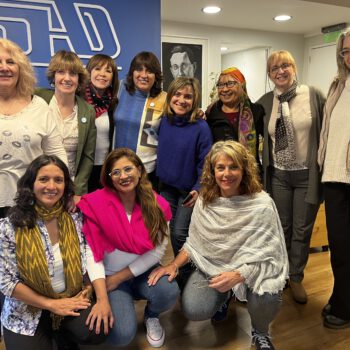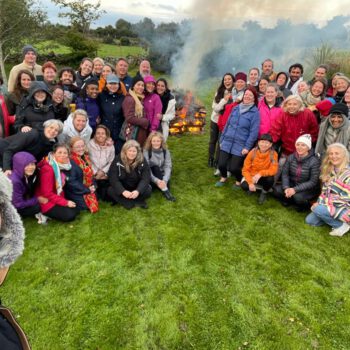

I work at the University of New England in Armidale, Australia as a Mathematician. In 2024 I applied for the year long Compassionate Inquiry® (CI) training to improve my teaching practice, in particular how I address trauma that hinders students’ progress.
At the personal level the journey has been intense and liberating.
Integrating what I am learning into my teaching practice is a work in progress. As demonstrated by the three examples below, the impact of the CI training has already been profound.

–
My Starting Point
Students taking mathematics courses broadly fall into two cohorts: those who study mathematics as part of another degree, for example in the natural sciences or engineering, and those who study mathematics for its own sake. In the first cohort there are many students with signs of maths-anxiety. For some students in the second cohort anxiety shows up when they are required to do mathematics rather than apply methods they have been taught.
My approach has been to acknowledge the anxiety and state that mathematics is hard: We cannot expect to understand everything the first time round. Struggling is a normal part of doing mathematics, and, as Jo Boaler writes [Boaler], it is in fact good for you. During class I do mathematics in front of and in collaboration with students with emphasis on understanding what we are doing and why we are doing it. I encourage students to ask questions and to let me know when what I say does not make sense to them.
Through this approach I have been able to guide many students from feeling anxious to realising that they can do mathematics.There were students I struggled to connect with, and with others, individual sessions shifted into counseling. As a result I had been thinking about training to better support students for several years; when I met Compassionate Inquiry I knew this was what I wanted!
The Power of Compassionate Inquiry
Already within the first few weeks, the CI training helped me to better understand and improve my teaching practice.
Since most of our students live off campus and study online, I often record my lectures. In June 2024 I recorded a welcome video for my introductory course in abstract algebra. In contrast to live lectures during term, there was no audience for this video and without an audience it used to take me several attempts to produce a recording I deemed acceptable. This time, I exercised compassion towards myself and consciously decided that it did not have to be perfect. I wrote down the main points to cover and recorded the video in one go. For the first time ever I was happy with the result and liked myself in the recording!
During the training we dive deep into the practice of creating safety. I often talk to my students about great mathematicians making mistakes or struggling to understand something, or about the times when I was scared of doing research at the beginning of my PhD. As soon as I learned about the skill of creating safety, I realised that this is what I had been aiming for. What I had not realised is that fight, flight or freeze are automatic responses of our nervous system to perceived threats. I can now tell students that going blank is an involuntary and understandable response.
Some time ago, I encouraged one of my students to think about the answer to a question she asked during a tutorial. When the student said “I cannot think” I responded with “Then I cannot help you”. The reply I gave my student had never really sat well with me and I am grateful to the CI training for providing me with other options to respond to a situation like that.
During my training I have also improved the way I ask questions. I have always been curious why and where students get stuck and often answer a question with a question. This helps me to understand students’ thinking and to guide them to answering their questions themselves. Some students do not like this approach and even complain about it in surveys. Through the CI training I started paying attention to who I am when I ask such questions. I became aware of my self-judgement for not being perfect. I also admitted to myself that I was still struggling with asking questions in front of my peers and practiced doing so at two workshops I attended last year. As a result I am able to encourage students to ask questions from a place of humility, compassion and curiosity. This makes all the difference, as there is a different quality to the interactions enabling students to show compassion towards themselves and to open up to mathematical inquiry.
What Next?
I was part of the May 2024 cohort of the CI Professional Training program and hold deep gratitude for the teachings and for being part of the CI community. A special thank you goes to my facilitator, Priya Duggal, for her healing presence, kind wisdom and suggestion to write this.
Currently I am on a Special Studies Program investigating the effects of a CI–informed approach on students with maths-anxiety. I welcome discussion, suggestions and advice regarding this Program, so please contact me on [email protected].
[Boaler] Jo Boaler, \ Everyone Can Learn Mathematics to High Levels: The Evidence from Neuroscience that Should Change our Teaching
https://blogs.ams.org/matheducation/2019/02/01/everyone-can-learn-mathematics-to-high-levels-the-evidence-from-neuroscience-that-should-change-our-teaching/?