
In Terry’s former career, troubleshooting large, complex IT systems oriented him to search for root causes, rather than working around symptoms. Today as a CI-trained, Internal Family Systems (IFS) practitioner, he continues to search for root causes by facilitating a process of assisted self-discovery, that enables his clients to untangle their trauma dynamics, restore their systems’ harmony and balance.
This post is a short edited excerpt of Terry’s journey into the world of trauma, developmental psychology and Internal Family Systems. Listen to his full interview on The Gifts of Trauma Podcast.
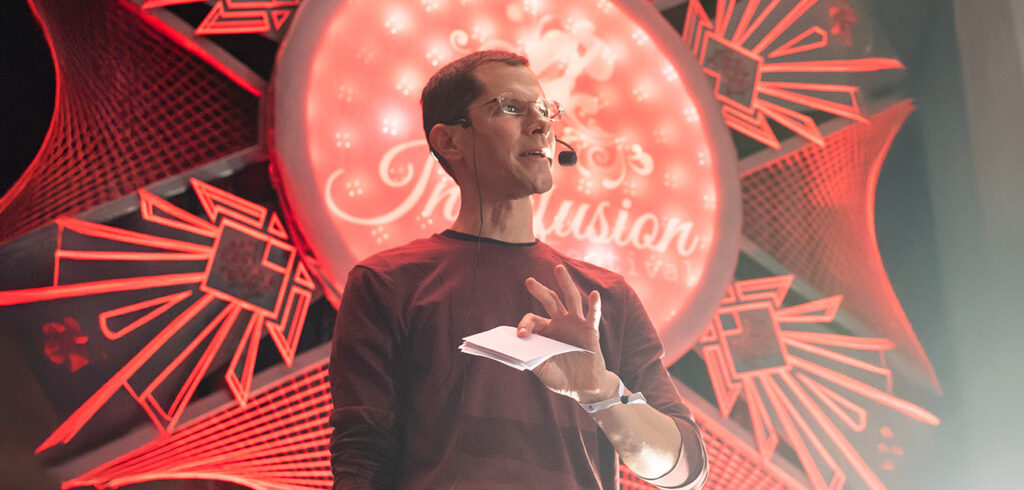
Terry Baranski
I’m an Internal Family Systems Practitioner, but prior to that, I worked in IT for over 15 years. One day I came across a YouTube video of Gabor saying how we get virtually everything wrong in parenting. I’d studied how hunter gatherer cultures parented children who were consistently balanced and mature… so Gabor’s video made sense to me. When I saw Gabor, I remembered reading, When the Body Says No, which led me to trauma, and as I have a passion for learning, I dove in.
“What’s trauma? What’s developmental psychology?” I learned so much about myself, my patterns and the world. I took in everything I could find from Gabor, and through him, Bessel van der Kolk, Peter Levine and Internal Family Systems’ (IFS). Their perspective on how the human mind works also made sense to me. Eventually it became clear this was my new career. I never saw it coming, but the time was right and I was ready. It’s been quite a journey from IT to healing, but it’s so rewarding to have passion for my work again and to be contributing to the world in this way.
IT is very left brain/analytical. But IFS and Compassionate Inquiry (CI) don’t use that kind of analysis. They’re not about figuring anyone out. In IFS, I work with multiple parts, assess how those parts relate to each other, and see their dynamics within the larger system. That’s exactly what I did in IT. I worked with big, complex systems comprised of components that invariably interacted. When there was an issue, I would trace it back to get to the root cause. Both IFS and CI approaches are root cause oriented, as opposed to talk therapy’s symptom orientation. In IT when I was troubleshooting an issue, it could be tempting to observe the symptoms and try to work around them. But I learned that if I didn’t get to the root cause, if I didn’t uncover what was driving it, the issue always came back. That’s exactly what I now do, therapeutically.
There are interesting parallels and differences between Compassionate Inquiry® and Internal Family Systems. I use IFS in the vast majority of my sessions, as its view of the mind resonates with me. Gabor sees the mind quite differently, so understanding the differences is helpful.
In modern culture, we view the mind as one thing, saying “I” and “me” as if referring to a single entity. IFS sees the mind as made up of parts, not one thing. When Gabor talks about parts, he takes a metaphoric approach. He’s said he doesn’t see parts as real, so Compassionate Inquiry practitioners work with parts through a metaphoric lens. IFS sees parts as real entities.
I guide clients to meet and connect with their parts. Our parts are younger than we are. They’re our inner children, stuck in the past, and they really need our help. Our capital “S” Self is the aspect of us that’s in charge of our inner healing. As an IFS practitioner, I guide the Self to connect with and heal the parts.
It really is amazing how parts can drive physical symptoms, chronic pain, autoimmune disorders, all of the things Gabor talks about. When we’re triggered, it’s a part being activated by what it’s carrying from the past. In IFS I see pain shift when the Self connects and attunes to the part, something many parts have been wanting for decades. Once the Self and the part connect, the healing can begin.
Recently I worked with a client experiencing depression so severe she was bedridden. It would ease for a week or so, then it came back. We connected with the part that brought on the depression. It saw the man in her life as toxic. Depression kept my client from seeing anybody. It kept her away from him. The part’s goal was accomplished but there were consequences. (Parts rarely see the consequences of their actions.) Being bedridden caused great pain, not only to my client but to other parts and the entire system. To resolve this, an agreement was made. When my client admitted to the part, “You’re right, this man is not appropriate for me, at least not right now.” All of a sudden there was no depression. She agreed that the part will protect her in future encounters with men. It will let her know if it sees any problems, (parts often spot them before we do). There’s a beautiful intelligence at work here that tends to be pathologized by approaches that medicate it or try to fight it with willpower.
Another client had insomnia, a symptom not typically related to trauma. We got curious and I asked her to go way back and inquire if she was ever scared of sleeping? She said no right away, so I knew a rational part was answering. We invited it to relax and she sat with that question for a moment longer. Thirty seconds later she said, “I was terrified of falling asleep. I thought a monster was coming to take me so I tied my ankle to the bed with a rope so I’d wake up if it did.” That memory was initially outside her conscious awareness, but when she remembered, she wondered how she had forgotten, as it went on for some time.
So her part is scared of falling asleep. There’s always a root cause and that part’s living in the past, so its fear is as real now as it was when she was four. We got the part out of that traumatic scene, brought it into the present and updated it on the client’s current age. When the healing was complete, that part released its fear. My client’s not up all night anymore. It’s such a dramatic difference. And again, there’s intelligence there. It makes sense. If I’m scared to fall asleep, I’m going to do everything I can to stay awake.
The Gifts of Trauma is a weekly podcast that features personal stories of trauma, transformation, healing, and the gifts revealed on the path to authenticity. Listen to the interview, and if you like it, please subscribe and share.