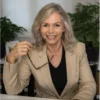

A family doctor (GP) experienced in addictions work and homelessness, Aisling is also a Compassionate Inquiry® Practitioner and a health/life coach. She helps people move past symptom management to wholeness. Rati is a Compassionate Inquiry® Practitioner, Facilitator and Mentor, and a psychedelic-assisted therapy preparation and integration practitioner. She employs a variety of modalities to empower people to find their inner healer/teacher.
This post is a short edited excerpt of Rati and Aisling’s perspectives on the connections between childhood trauma and menopausal symptoms. Hear their interview on The Gifts of Trauma Podcast.
Rati Roberta Riccardi: The Consciousness-Expanding Explorer’s Lens
Are there connections between my childhood trauma and menopausal symptoms?
Has my lack of safety, attunement, and normality around this affected the severity of my symptoms?
I’ll answer by sharing what I learned through Compassionate Inquiry®.
You see, I thought I should be more whole, as I was only hit once by my dad, and I wasn’t sexually abused. But when I turned one, my mother returned to work, and I was handed over to a nanny. I hadn’t understood the intensity of that until I started studying trauma and Compassionate Inquiry®.
Imagine after spending 9 months in utero and 365 days with my mother, on the 366th day, my mother disappeared. That’s how I came to understand the severity of my abandonment trauma.
The absence of safety that this left me with repeated throughout my life. I was single for many years and raised my son alone. I had to make some choices at work that put me in a very unstable situation. And I couldn’t sleep, because I was busy working out what I had to do the next day.
While my hormones were stable, I survived. But when they started to decline, waves of anxiety, dread, and fear started to emerge throughout my body. That’s what’s helped me to integrate my past with the amount of stress and anxiety my menopause is surfacing.
So yes, I’m relating an absence of safety, an absence of emotional attunement with my mother who returned to work (because she had to), with the severity of my menopausal symptoms. It all started with my childhood trauma.
Dr. Aisling Quiery: The Authenticity-Attuned Healer’s Lens
When I first encountered the ACEs (adverse childhood experiences), they really blew me away. All ten questions focus on abuse and neglect, or toxic stress, and how that impacts the body in later life—not just mental health but also many chronic health conditions.
So if ACEs increase our risk of chronic illness across the board throughout life, they’re going to impact us during menopause as well.
Progesterone and estrogen have lots of effects in the body. We know that stress, in general, depletes or suppresses estrogen and progesterone. So during menopause, we can either increase our estrogen and progesterone with HRT or reduce our stress to increase our natural estrogen and progesterone levels. This simple fact changed my GP practice.
Women come in to talk about their menopause symptoms: heavy bleeding, hot flushes, vaginal dryness, brain fog, various aches and pains, and mood changes. They might notice they’re more irritable, getting angry more easily with people around them. They may also feel low, tired, or sleep deprived.
Usually they want to explore HRT, which I’m happy to prescribe if I think it will help. I’ll say that, then I’ll ask, “Can you tell me a little bit more about your life and what’s going on?”
Almost always, women of this age carry huge amounts of stress, which can involve looking after young children or grandchildren, caring for aging parents, or being sandwiched between two or three generations, all of whom are demanding attention. They may also have careers where they carry a lot of responsibility.
So I’ll ask this beautiful Compassionate Inquiry® question: “What are you not saying no to?”
I’ll ask that, and then often I’ll mirror back the woman’s answer, saying, “What I’m hearing is you have all of these caring responsibilities, you’re working this hard, you’re doing that, you’re doing this, and you’re doing these other things. How does that sound to you?”
Hearing it mirrored back can actually be very powerful, particularly when a woman has normalized her situation. “Wow, that sounds like a lot,” she might say. And I’ll respond, “Yeah, that is a lot. How easy is it for you to say no?”
She almost always answers, “It’s extremely difficult.”
That’s when we get into more subtle childhood trauma. When women talk about their beliefs, and I ask them to tell me about saying no, they’ll reply, “There’s nobody else. I’m on my own. If I don’t do it, nobody else will. My needs don’t matter. I have to do all of this. I can’t take time for myself. I have to show up for all of these people.”
Women are bearing huge emotional burdens, and they’re not able to say no. There are yeses they want to say but can’t because they’re looking after everyone else’s needs.
The conversations I’m having with women often sound like…
Them: “Okay, I’m willing to try HRT. Let’s give it a go.”
Me: “I’m willing to prescribe it for you. And what about looking at these other things?”
Some women come back and tell me HRT made a huge difference, but for many it doesn’t. So rather than increasing the levels of their HRT hormones, I’ll invite them to look at other areas of their life—such as when they’re saying no, where they can reduce their emotional burden, and how they can give themselves more space.
I ask them to look at what they’re eating and how well they’re taking care of their bodies.
I’m always surprised by how women normalize their own experiences. Some say, “No, I’m not under stress.” Then when I ask them about their lives, they’ll tell me they’re working 12 or 14 hours a day, minding loads of children, running a couple of businesses, looking after aging parents… Their lists go on and on.
I was recently reflecting on my own relatively low-stress life. If I had all of the stressors many women manage, my perimenopause symptoms would probably be much more distressing.
I think menopause and early elderhood should be times for slowing down, not working so hard, and exploring our post-menopausal zest for life.
Margaret Mead coined this term in the 1950s, saying, “There is no greater power in the world than the zest of a postmenopausal woman.”
I think this is a new phase of life for women, when we get to do what we’ve always wanted to do—maybe travel or start new projects—as we have this new zest at this new stage of life.But that rarely shows up as an option for women at this stage of life. So I’d like to invite women to ask themselves:
“When did I first learn that my needs didn’t matter or that I had to put everyone else before myself?”
“What are my beliefs about myself?”
“Is living the life I want really as impossible as it seems?”
The Gifts of Trauma is a weekly podcast that features personal stories of trauma, transformation, healing, and the gifts revealed on the path to authenticity. Listen to the interview, and if you like it, please subscribe and share.