
Dr. Gallagher holds a BSc in Trauma Studies, a MA in Conflict Transformation and Social Justice and a PhD focusing on the Campaign for Recognition by the WAVE Injured Group, which lobbied successfully for a special pension for those injured during ‘The Troubles.’ Currently a Trauma Education Officer for WAVE Trauma Centre, Paul also teaches BSc and MA courses.
This post explores Paul’s healing through academia, community support, and advocating for those injured and marginalized by traumatic events. Hear his full interview on The Gifts of Trauma Podcast.
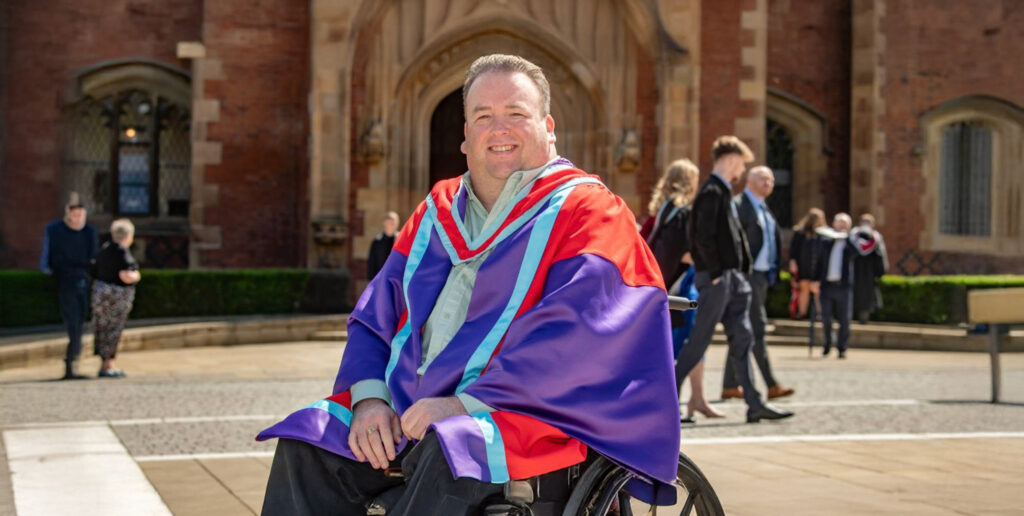
Part of my healing journey was through formal education, which began rather late. (I was 40.) Big gaps happen for us all when life gets in the way, and for me, that happened in 1994. I was 21 and living with my family in West Belfast when four men carrying automatic weapons forced their way into our home. I was shot with a machine gun at close range. I lost my lung and my spleen. My femur was shattered, and my spine was hit too. I survived… paralyzed and emotionally traumatized.
My family witnessed the horror of that day. They’d kept me alive, then disposed of the blood-stained couch and repaired the bullet holes in the walls. They also came to see me every day with smiles on their faces, making sure I was okay. But it was all about me. The nurses, the doctors, and all the other support systems were taking care of me, making sure I was okay. But nobody was asking them if they were okay. There was no support in Northern Ireland for the rest of my family. Likewise, when I was out of the hospital, I got some support for my medical and physical needs, but no support for my psychological needs.
If I’d had any issues, I’d have been physically medicalized or put onto antidepressants. Alcohol was one way of coping. I enjoyed my alcohol, maybe to excess, in those days, and other substances too. They got me through, but it could have easily gone another way when I was low and experiencing suicidal ideation. The support of my family and a good group of friends kept me going even through those tough years of drugs and alcohol and everything else.
And then I found WAVE and moved into this second phase of my life. Things began to fall into place. The WAVE Trauma Center is a charitable organization set up in 1991 by a group of women whose husbands had been murdered in sectarian attacks in and around Belfast in the late 80s and early 90s. Their support systems were shattered, so these widows came together around kitchen tables, over cups of tea, and set up this group to support themselves. At first, a lot of it was practical… They were looking after each other. The trauma training came later.
Over the years, WAVE has become one of the largest NGO recipients of government and charitable funding and donations in Ireland. I arrived at WAVE in 2010, 15 years after my big T trauma. I wanted to be involved in the ‘WAVE Injured Group’ as it didn’t just meet and sit and chat. At that time that group was becoming politicized, fighting for social justice, for reparations and financial support for people who had been left on the economic scrap heap, and for people who had experienced severe life-changing injuries in bomb attacks before I was born. Their physical and psychological injuries were severe, so we were campaigning for additional support, reparations, and pensions. Many had been on welfare for most of their lives because of their injuries. They didn’t get to go back to work, as disability discrimination laws didn’t exist until the 90s.
The ‘WAVE Injured Group’ came together as a collective because we’d been stuck in our own homes with our own issues. We came for mutual support and to leverage WAVE’s access to politicians and policymakers. In 2012, we collected a petition with 10,000 signatures from across Northern Ireland and told our politicians. Here are the policies and framework we’ve designed for reparations and a special pension. After just a few years of campaigning, they agreed. This victory was part of our healing, as for years the notion of who’s a victim, who deserves it, who doesn’t, good victims, bad victims, etc. had been debated. Coming together as a collective and creating a new identity for ourselves was healing as well. No longer victims, we were campaigners, survivors, and people who could speak to the media, who could speak in front of Parliament, and who could ask anybody listening to support us. It took years, but we were successful.
So is there a difference between understanding trauma academically and the grounded community healing that happens through WAVE? I see them as completely connected, as they all come from real needs. WAVE realized that to understand what words like “trauma” meant, they needed to build their training on academic theories. One need came from the WAVE staff, from looking at their needs. To ensure they weren’t retraumatizing clients or causing harm, they had to know what trauma is. So WAVE’s academic courses developed from a need for staff education. Then education became a need for clients as well. Initial basic training developed into diploma and degree courses. It all rose from the needs recognized within WAVE over the years: needs around somatic healing, talk therapies, and peer and social support. One complements the other and has consistently over the years.
WAVE also has medical students reviewing clients’ individual needs assessments. They detect patterns in hypertension and heart disease, and many other physical aspects. This expands the need for our services, so we can deal with the whole body and all the different connections in terms of social support. It’s based on the academic view and on practical lived experiences. You can’t separate one from the other.
We’re also teaching a whole generation of people training to work in different fields. Counseling degrees in Ireland don’t deal with trauma. It’s a complete gap that I can’t get my head around, so we have a branch of our trauma education called citizen education. In this, people like myself and others come into diverse university curriculums that teach social work, nursing, medicine, etc. We meet first-year students face-to-face and become their case studies. They listen to us and ask questions. I suppose when they first hear that trouble victims are coming in, they wonder, ‘What do ‘The Troubles’ have to do with us? That’s in the past.’ But when they listen, they understand, ‘Okay, these are the people we’re going to be treating. These are the generations of people who’ve been impacted, but also their families and the people yet to be born will be impacted by what happened decades ago as well.’ Students as young as 18, 19, and 20 are getting so much from us on the citizen education side, but also in the academic setting as well. So academic, lived, and community experiences; they’re completely melded together.
The Gifts of Trauma is a weekly podcast that features personal stories of trauma, transformation, healing, and the gifts revealed on the path to authenticity. Listen to the interview, and if you like it, please subscribe and share.