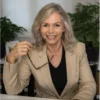

“One of the premier social, cultural, and psychological healers of our time,” Vimalasara is an award-winning author of 11 books, the new First Aid Kit for the Mind Course,and a leading African Descent Voice in the field of Mindfulness Approaches for Addiction. Jordan is an International Speaker, a Polarity Integration Consultant, Plant Medicine Guide, Accidental Activist for Transyouth Suicide Prevention and the creator of the HeartLine Approach to Gender Affirmation course.
In this excerpt, personal narratives reveal the ways gender functions as a social construct and lived experience while challenging normative expectations. Hear the full interview on The Gifts of Trauma Podcast.
J’aime: When we share our pronouns, we’re signaling safety and inviting the presence of all people.
Vimalasara: To be aware of your gender and signal it can be healing and accepting. To be aware of how bias can put people into boxes and how bias boxes us and makes our worlds small is also important. We can’t truly see our clients unless we begin to look at our bias.
I found gender a difficult topic, as I’m nonbinary, I have a more feminized look, and I’m a Buddhist practitioner. Part of the Buddhist transformation is to let go of all gender, but what really got me thinking about pronouns was working on conflict transformation and anti-bullying in schools in Vancouver about 15 years ago. I’d be with seven- or eight-year-olds who would introduce themselves by name and pronoun. So I found myself wondering, what’s my pronoun? Then I came across this passage from Max Glamour. It was so powerful, and it resonated for me. “I’m not non-binary in the sense of the third gender or something in between. I’m non-binary in the sense that the binary itself is the problem. I don’t want a new category added to an existing system of classification. I’m refusing a system that produces a regime of normative, gendered expectations. My non-binary isn’t an identity that is simply looking for recognition. It is a critique of the metaphysics of gender built on colonial domination. My gender is a refusal of the assumption that men and women are natural, exhaustive, or desirable containers for embodiment and desire. My gender is a disruption, a disidentification, a structural exit, a refusal of the classificatory logic that makes gender a legible commodity in the first place.” That speaks to me and where I’m at around my nonbinary gender.
Jordan: I sit firmly in the gender binary, having been socialized as a female until I was 36 but knowing I was a boy since I was two. And I love that your story is different, Vimalasara. It expands the understanding of gender and welcomes the differences, not as good or bad, right or wrong, but simply not the same.
Rosemary: I don’t really think about gender. I just look at people as human beings. My family went to Provincetown, Massachusetts, for the same two weeks every summer. We’d gather with the most wonderful people: lesbian couples, gay couples, and other amazing individuals. As a kid, I had no idea what gender they were, and it didn’t matter. I loved them because they were beautiful humans. So I was raised as a female by a straight couple and exposed from a very young age to a community that did not comply with gender rules. They set their own.
Vimalasara: I love that we don’t think about gender, as I believe these are social constructs. Who decided that this was for men and that was for women? But our world is gendered, and we are treated differently. These constructs have an impact.
Jordan: My ex-wife and I were a lesbian couple for 12 years before I started my transition, and we didn’t have roles. My job allowed me to do more around the house. I took care of the cars, the animals, and the yard. I also did more of the cooking and cleaning. So it was a joke that I was the ‘house husband.’ But when I started passing well (as a man), one day my wife said, “I guess I have to be the wife now. I guess I’m going to have to want this.” She pulled out a broom and started sweeping. She was so upset. “Wait a second,” I said. “Time out. What is this ‘I have to be the wife now,’ thing?’ I don’t think anything needs to change with how we’ve set up our life.” For her, it was a very intense moment of having these gender roles not put on her but taking them on herself because of this social construct where men do this and women do that.
Vimalasara: Bias; brings up disability. Especially in the West, the world has been created to suit people who can walk, run, and speak verbally. It’s designed for the white heteronormative. Yet these biases are so unconscious. We talk about decolonizing… Even in BIPOC and queer spaces, we have to decolonize our minds. It’s not just about the white; it’s about the other decolonizing, because we have been impacted, as Resmaa Menakem says, by historical trauma, institutional trauma, personal trauma, persistent trauma, and epigenetic trauma. So I have to decolonize as well. I have to be aware of my bias. Once upon a time I was too scared to be with only people of color. I felt more comfortable being with white people because I was raised by white people. To be too scared to be in a room with people who reflect you—that’s sick!
J’aime: This speaks to patterns we adapt to survive, which brings us right back to the things that help us get to a certain point and then stop us from getting any further and then start to eat us up. Jordan: After moving through the world as a butch lesbian for 36 years, it was very interesting for me to start passing. I used to walk into a room and have the answer, but nobody would even look at me. Now when I walk into a room, everybody asks me for the answer. One day I came across a situation with a very large communion table. The woman who was a steward of the table was directing six guys on how to assemble it. They wouldn’t listen to her, so after an hour and a half it was still in pieces. I approached her and said, “I’m sorry this is about to happen, but just tell me how it needs to go together.” She did, and I told these guys, and in 10 minutes, it was assembled. So I can see the gender bias more clearly now than I could before. It’s a real thing that happens every day.
The Gifts of Trauma is a weekly podcast that features personal stories of trauma, transformation, healing, and the gifts revealed on the path to authenticity. Listen to the interview, and if you like it, please subscribe and share.