
In this excerpt, Kevin Young and Sat Dharam Kaur ND explore what traumatized elephants teach us about men’s mentorship and why it’s time for the divine masculine to step up. Hear the full conversation on The Gifts of Trauma Podcast.
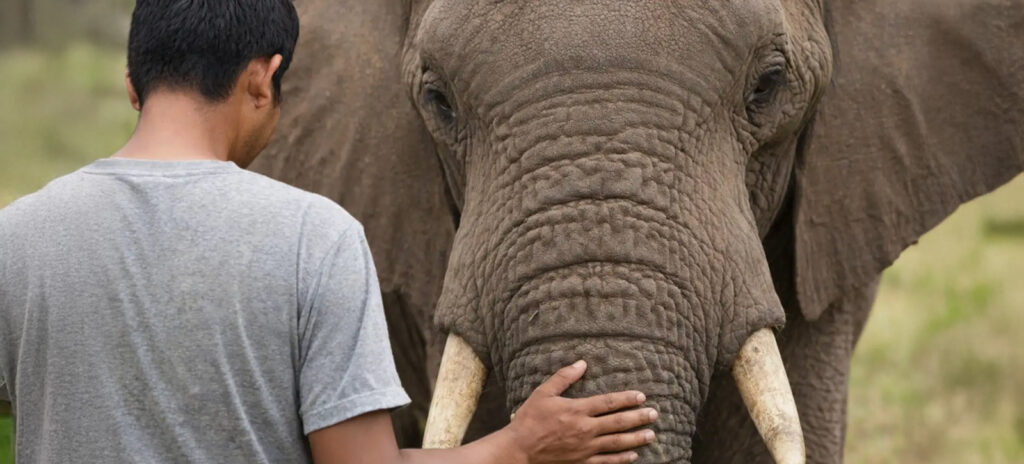
Katie Hollamby (Pexels)
Kevin: In the book The Evolved Nest, author Darcia Narves talks about what happened to bull elephants in South Africa at the end of the apartheid era. I’m going to share the story, as it’s really important—and—an uncanny metaphor for what’s happening in the world right now.
The crux of the story is that female elephants suckle their young for about four years. The young male elephants will stay in the matriarchal herd until they’re about 10, then they go off to live with the mature males.
They don’t become sexually active until they’re about 30, so until then, they’re mentored by older males. Through 20 years of guidance from older males in their community, they learn how to behave and how to navigate life as young male elephants.
Around 1994, when apartheid ended, Game farm and wildlife reserve owners wanted elephants on their reserves. Since South Africa was no longer the racial pariah of the world, they saw opportunities to expand tourism, and they began bringing in male elephants as young as 10, 12 or 14 years old.
Shortly after they brought in these young bulls, for the first time in recorded history, they started finding rhinos dead, mutilated, and sexually abused. At first, they couldn’t work out what was happening, but through a process of investigation, they discerned that these young male elephants, which had been removed from their mentoring herds and didn’t know how to behave, were mutilating, murdering, and sexually abusing the rhinos. This sort of behavior had never before been observed or recorded. And it was new behavior. In effect these young males had PTSD, caused by being taken from their herds before they’d been mentored by the older males.
And when I look around the world and see young men who don’t have patriarchal role models to look up to, they too don’t know how to behave in the world.
They don’t know how to support women, their families, societies, or communities. So I really think there’s a place here for the divine masculine to step up. It has to have a role in the healing, in the bridging of the gap from where we are to where we want to be.
I said earlier that I felt it was time for me to step up—and I think this is about offering a male voice or invitation to those who are defined as male in the world, to my masculine friends and male colleagues, to step up as well, because the prevalent models of the divine masculine….
They’re the abandoned elephants, and I want to address this because I look around and think, hey, I’ve done some meditation, and I’ve done some work… and when I look around and through the eyes that I’m looking through, I think this isn’t this difficult. It doesn’t seem to be that difficult. When I look out into the world, these answers, they’re pretty obvious.
So when I see how men in particular are running the world, if I were to use an emoji, it would be the ‘face palm.’ So when I see how men are running the world, I think, guys, this isn’t that difficult. Come on, let’s do this; let’s step up. And maybe that’s another invitation to my masculine and male friends. It’s not that difficult. Do the work, be kind, mind your business, and support and love each other.
Sat Dharam: I guess we need Kevin to get out there talking to the men so more step up and train in Compassionate Inquiry®. That’s the answer to everything! Seriously, Kevin, I think you’re spot on.
Not only do we need to focus on nurturing parents before they conceive, nurturing women during their pregnancies, and supporting new parents in the first few years of their children’s lives, but also, our work is 100% around:
How can we support men in healing their trauma so that they can show up and support their communities, support their wives, their children, themselves, and other men?
How can we support men so they can be the wise elders for the young men, just like the elephants?
That’s also missing. We have good models of men. But where are their followers? Where are their male followers? What’s missing there? Gabor has looked around at conferences and said, “Guys, we’ve got a thing going on here. I’m looking, and I can find maybe two or three men in here; otherwise, it’s all women.” So he presenced that.
There’s a responsibility for the men to come to terms with who they are among themselves, without having power over women. Who are they if they don’t have power over women? I guess that’s the question. Who am I if I don’t have power over women? Where does that begin? Is that part of the early childhood problem? If the women aren’t supported, is that one of the distortions that happens to a young boy? Is that why, when he grows up, he needs to have power over a woman? We have to discern and address this conundrum on all levels. We have to find a way to hear what’s going on for the men, to listen to them and provide wisdom. Provide guidance as the elephants do for their young.
It’s fascinating. We’re talking about creating a culture of nurturance, whether it’s through the fathers, older brothers, or uncles, who have wisdom, or whether it’s through the matriarchal side and the mothers.
The divine masculine, or mature masculine, would ideally support the feminine, and the mature feminine would ideally support the masculine. Both need this reciprocity, which is missing right now as well. It’s coming along, but it’s missing internationally for sure. Right now we have antagonism between mature feminine and mature masculine; there’s fighting instead of reciprocity, which would be amazing. The other piece we need to talk about in terms of bridging the gap is mutuality and respect, equality, and collaboration. When we have the best of both, we will have an amazing society.
The Gifts of Trauma is a weekly podcast that features personal stories of trauma, transformation, healing, and the gifts revealed on the path to authenticity. Listen to the full conversation, and if you like it, please subscribe and share.