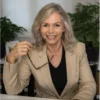

Anouk Bindels is a psychologist, systems therapist, coach, and trainer with a private practice in the Netherlands. Her work focuses on understanding the roots of trauma and the protective patterns people develop in response to difficult experiences. Drawing on 40 years of experience supporting people affected by trauma, her Heart & Brain healing approach brings together lived experience, extensive training, and a desire to offer more integrative support.
In this excerpt, Anouk describes her journey from an infancy shaped by survival, through being labelled a “difficult” child, to supporting clients who have themselves been described as “difficult” or “too complex.” Hear the full conversation on The Gifts of Trauma Podcast.
She was eight months old, infected with typhus, and rushed to hospital, where she was isolated for five months. And as an eight-month-old will always want to pull out a breathing tube, a catheter, an infusion… because that’s what a baby quite naturally does… they “fixated” her.
ANOUK: Fixation is when they take your arms and fix them to the bed. And of course, 65 years ago, they didn’t know anything about attachment theory. My system had gone totally into survival. From then on, my neurological program and my nervous system were of course wired for survival and dissociation. Because in order to survive, at that point in my life, I think I had already dissociated.
When she was ready to come home from the hospital after five months, she cried when her mother tried to hold her. She looked instead for the nurses who had been there all along.
ANOUK: How I was wired as a child made me the ‘difficult child’ in our family. The difficult child is the child that resists. In my case, I would resist anything that had to do with touch on my body.
Less than three years after her discharge from the hospital, at only four years of age, she was sent to a children’s home run by Catholic nuns while her mother recovered from a serious accident. Everyone agreed it was the best place for her.
ANOUK: The children’s home was a very hostile environment. We were punished; we were beaten. And especially… if you had peed in your bed, you would be taken out and made to stand in the hallway. Imagine a four-year-old standing in the hallway holding wet sheets… and the other children passing.
That was the beginning of my life. A deep search. Because those experiences actually brought me to a place where psychology alone was no longer enough.
She grew up fearful, invisible in classrooms, unable to maintain friendships. She developed an eating disorder in her teens. She studied psychology and built a practice and a life. She married twice… her first husband died of cancer. Her second husband of eighteen years was a man she described as beautiful and loving, a lawyer who lived with bipolar disorder. They raised their children together. Then one Sunday morning, ten days after they signed the contract on a house near the coast, he walked out and did not come back.
ANOUK: I still remember the exact moment, like a film, that the two police people were standing at our door. What happened to my body? I remember leaving. They asked, “Can we come in?” I let them in and said, “Did something happen to my husband?” They said, “Yeah.” I noticed my heart racing, my throat closing, my breath stopped. I noticed my mind already doing something very strange. And from that moment, I don’t know what happened, except that I was looking at myself from a distance and functioning from a very distant position. Now I know, of course, that was dissociation… a very old program inside my nervous system. It was fully awake again.
Six weeks after the funeral, she was back at work. Functioning, not feeling.
ANOUK: I was in survival. Six weeks after the funeral, I was back to work, functioning as if everything were normal. Just as I had been trained to for my whole life, I was taking care of the kids, taking care of everybody. I was functioning on autopilot, and I was not taking care of myself, not taking care of my body.
Nine months after her husband’s suicide, on Good Friday, her body finally said “No.”
ANOUK: I ended up in the hospital with paralysis in both legs and myelitis in my nervous system, in my pelvic area. My legs were thrown out fully, and I was incontinent. I couldn’t hold my urine; I couldn’t hold my stool. And I ended up in the hospital. That was when my body fully said, “No.” I was wheelchair-bound for about six or seven months.
The turn came not from a treatment but from a moment with her daughter and son, who came to the hospital. Her daughter’s twelfth birthday party had been cancelled, and she brought her mother a small toy sheep.
ANOUK: She said, “Mom, I don’t want to lose you also,” and cried. They both came and they cried, and I had to… I was holding them, and I was feeling them. I was really feeling them. And then I cracked. My heart cracked. Something else cracked. And it was a crack where some light came in. And that was the beginning of my healing journey.
It was not a quick journey. It took four years for her to move from that crack to full embodiment. These were difficult years. Anouk says that dexamethasone, a synthetic corticosteroid prescribed to treat her paralysis, damaged her immune system and contributed to the later onset of esophageal cancer. Then, there was a near-death experience during chemotherapy when her heart stopped and she was brought back. Each crisis, she says, brought her deeper into her body.
Finally, she says that psychedelic work within a carefully held therapeutic container helped her access what previous approaches had not reached.
ANOUK: I could really look into my childhood from a fully different perspective. My default mode network was deactivated, my coping strategies didn’t work, and I fully became embodied. That’s what psychedelics did… They helped me open a pathway for reconnection and recondition my body to a completely new mind and mindset.
Today, the clients who find their way to her are often those who have been told they are “too much,” “too complex,” or “too far gone.”
ANOUK: When patients come to me, I do hear, a lot of times, “I’m a difficult patient. I’m a complex trauma patient. You know, Anouk, I’m almost dying.”
My healing journey has never been about becoming someone else. It has always been about coming home to myself. The losses, the illnesses, the grief, the spiritual searching, all of the professional training… It has all pointed me in the same direction. Coming home to myself, to greater compassion, to greater authenticity. To me, healing is not becoming a better version of myself, but maybe becoming more fully who I am or who we are as human beings.
The difficult child, it turns out, knew exactly where to go.
The Gifts of Trauma is a weekly podcast that features personal stories of trauma, transformation, healing, and the gifts revealed on the path to authenticity. Listen to the full conversation, and if it resonates, please subscribe, rate, review, and share.
Editor’s Note: This post is comprised of edited excerpts drawn from The Gifts of Trauma podcast transcript. Selected passages have been carefully woven together to create a cohesive narrative that speaks in the guests’ voices and faithfully represents their perspectives. – Rosemary Davies-Janes