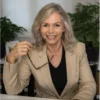

Anouk brings a unique synthesis of clinical expertise and lived experience to the fields of growth and development. She joined Compassionate Inquiry® in 2020 and today serves as The Portal Facilitator, Circle Leader, and administrator. Integrating Compassionate Inquiry®’s trauma lens has both validated her belief that our personal histories and professional lives are fundamentally interconnected and deepened her client-facing work.
In this excerpt, Anouk traces the converging threads of her life through birth, grief, cultural in-betweenness, and the thresholds that shape our lives. Hear the full conversation on The Gifts of Trauma Podcast.
Chris Hepburn
A Korean-Swiss psychotherapist raised in Taiwan, Anouk is also a midwife, grief specialist, Nonviolent Communication (NVC) practitioner, Portal Facilitator, mother of four, forest school founder, and “third culture kid.” Her life has taken so many turns that it would be easy to miss the threads of pure essence weaving everything together. But far from missing the confluence, she names it herself:
ANOUK: I would like to sum up everything that I do, both professionally and personally, as everything that was meant to be. Everything that happened has brought me here today, where I am doing what I do. I’m very grateful to have the lived experience to refer back to, because I think there are some things that cannot be learned cognitively. We can understand it cognitively, but to really, really understand it on a somatic level or an emotional level, I truly believe it’s easier if we have a connection.
The connection between what she has lived and what she offers has become a map for Anouk’s life path.
ANOUK: I noticed that birth and death are different sides of the same coin. One of the things I’ve always been good at is sitting and waiting, not pushing (no pun intended, as a midwife) but just waiting for whatever is going to come next and trusting the process. Our bodies know what to do. They know how to birth, they know how to be born, and they also know how to take their last breath. It sounds simple, but it’s not easy to do.
While she’s never worked in palliative care, supporting others entering life’s thresholds has given Anouk a unique relationship with grief.
ANOUK: Grief is a natural and normal part of life. That’s how I work with grief. A change of any type in life is going to involve a certain amount of grief. But grief is healthy. Grief is great. If we embraced it more and allowed just being with it more, I think we’d have fewer pathologies.
What shifts grief from natural to something more complex? Anouk explains with this highly relatable scenario.
ANOUK: We’re a child again. We’re eating ice cream, and it falls. Did the person who bought us the ice cream say, ‘Oh, look at that, your ice cream fell. Oh, you must be so sad.’ They’re empathetic. They’re validating our experience. They’re holding us in our emotions of disappointment and maybe some sadness. And, ‘It’s okay. That’s normal. It happens.’ But if we have a parent or a caregiver that looks at us and says, ‘Why did you do that? You should have been more careful holding your ice cream.’ If we’re met in ways that are not empathetic, that are blamey, that are their own projections… at the end of the day, that’s going to imprint on us. And if we grow up thinking, ‘Well, too bad, you should have been more careful.’ That’s also how we’re going to move through the world. That’s when grief can become pathological… When that lack of empathy turns into a deeper issue where we can’t connect to other people, we can’t become intimate, and we have a harder time being vulnerable.
Anouk’s own relationship with grief is personal as well as professional. Half Korean and half Swiss, she was raised in Taiwan, a third-culture kid who grew up belonging fully to none of her cultures and whose Korean grandmother, now 102, carries within her the living memory of war.
ANOUK: A third culture child is someone who grows up in neither the culture of their mother nor their father. So I didn’t grow up in Switzerland; I didn’t grow up in Korea. I grew up in a third culture that didn’t belong to either of them.
I know some family history. I know that there has been a lot of hardship, and it’s still, I believe, energetically in the field. It hasn’t been dealt with. I also know that the female lineage, the Korean lineage, has been through so much that all I can do is focus on myself and work on what I can do to be able to change what’s been happening ‘till now… So the future lineage can have, as Gabor says, the blessings of that trauma.
Long before she had clinical language for any of this, Anouk was already doing the work. She founded and ran a forest school, working with children in nature.
ANOUK: When I’m working with three-year-olds, it’s, in my opinion, the best stage because they’re independent; they can speak. They still need some guidance, but not too much. And you really learn that balance. I’ll point something out and then just observe them, hold space, and trust the process. I worked for almost two decades in the forest school, and often, if anything was complicated, I would be the one dealing with that child or that parent. So already, back then, I was going to the kids that needed extra support or the ones that had a hard time detaching and coming into the forest with us. And I think all those years working with kids helped me understand and see very quickly who came in with a secure attachment and was totally healthy in their exploration of the world… and who struggled already at the start.
What she was watching for in those children, the spark of authentic selfhood, easily present in a three-year-old freely exploring the world and so easily dimmed by the time we reach adulthood, is exactly what she now calls Essence Recovery.
ANOUK: Our inner flame might go down like the flame in a Bunsen burner. We can make it really small, but we can also make it big again. When we can reconnect to that part, when we can recover that part, when we dig through everything that’s been dumped on top of that part, then we can truly live a life with meaning and purpose and joy, regardless of what happened.
For anyone standing at a threshold right now, a birth, a death, a diagnosis, a marriage ending, or anything that asks everything of them, Anouk shares a gentle, affirming invitation:
ANOUK: You’re not alone in this. Reach out a hand… that’s what I do.
The Gifts of Trauma is a weekly podcast that features personal stories of trauma, transformation, healing, and the gifts revealed on the path to authenticity. Listen to the full conversation, and if it resonates, please subscribe, rate, review, and share.
Editor’s Note: This post comprises edited excerpts from The Gifts of Trauma podcast transcript. Selected passages have been carefully woven together to create a cohesive narrative that speaks in the guest’s voice and faithfully represents her perspective. – Rosemary Davies-Janes