

Compassionate Inquiry® (CI) has profoundly shaped the way I hold space for my clients, inviting them into deeper awareness, authenticity, and healing. Through my practice, I have witnessed how the approach creates the space for profound transformation, especially when combined with creative methods like art therapy.
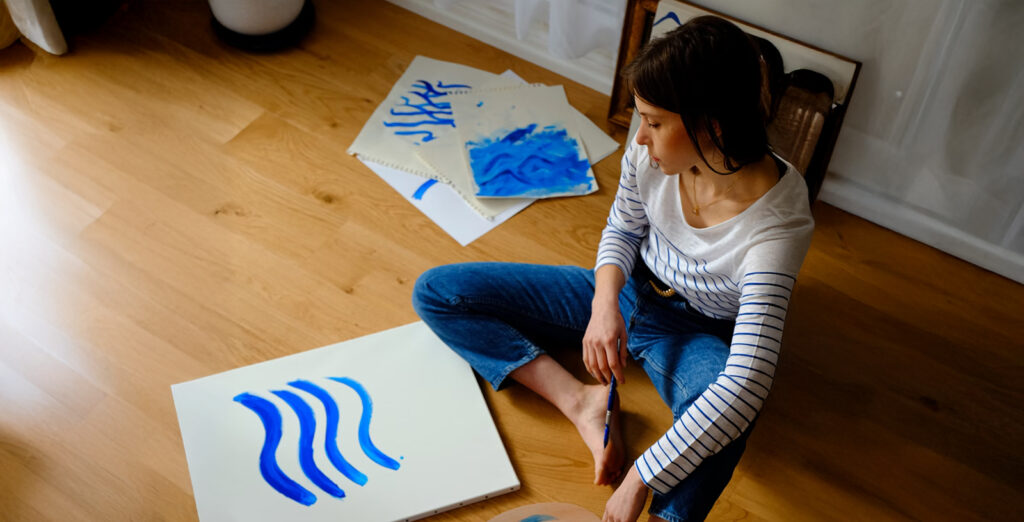
In the heart of this work lies a powerful realization: when words or bodily awareness feel inaccessible, creativity can offer a bridge. I’ve often observed clients experiencing disconnection—moments when they cannot feel their bodies or when their minds dominate the session. In such instances, I introduce art therapy to support their process of reconnecting to their bodies.
One of my clients was working through feelings of invisibility rooted in a childhood overshadowed by a dominant father. During a CI session, we discovered that he couldn’t access his body sensations. I guided him into an art therapy exercise. I asked him to close his eyes, feel his hands, and choose one to hold a pencil. With no intention other than to move his hand freely, he created faint, cloud-like lines barely visible on the paper. When he opened his eyes, the image perfectly reflected his experience of feeling unseen. This moment was transformative—he not only connected with his story but also began to feel his body for the first time.
Another client, a cancer survivor struggling to set boundaries, expressed frustration over her inability to say “no.” Despite her awareness, she could not physically access the emotion of anger. We used the same art therapy method, and what emerged on the paper was a distorted face with a twisted mouth—unable to speak. When I asked her to focus on her body while looking at the image, she immediately felt a tightness in her chest and recognized the anger stored there. This process helped her reconnect with her body and take the next steps toward healing.
What makes CI and art therapy such a powerful combination is their mutual emphasis on fostering presence and authentic expression. While CI invites clients to uncover the stories they unconsciously carry, art therapy helps externalize these narratives, making them visible and tangible.
This integration can flow in multiple directions:
Starting with Art Therapy: Beginning a session with art allows the client to connect with their subconscious and emotions, setting the stage for deeper CI work.
Integrating Art into CI: During a session, art therapy can help when the client feels stuck or overwhelmed, bridging the gap between mind and body.
Concluding with Art: Using art therapy to close a session offers a grounding and reflective way to integrate insights.
My own journey with art therapy began as a story of self-discovery. Growing up, I believed I wasn’t “talented enough” to draw or paint because my mother was an exceptional artist. Her talent left me feeling inadequate, and for years, I avoided art altogether. It wasn’t until adulthood that I allowed myself to create without judgment. This shift was liberating, and it led me to become an art therapist. Now, I know that art therapy is not about talent or creating masterpieces—it’s about authentic expression and connection.
In our CI Focus Group sessions, I’ve seen how this approach inspires others to explore their creativity and emotions, even those who’ve never considered themselves “artistic.” CI and art therapy together remind us of the possibilities within ourselves and the relationships we can build—with our bodies, our stories, and the world around us.
Through these practices, we open the door to transformation, proving that healing is not only possible, but also deeply human.
Let your inner creativity blossom and guide you. Give space to the emotions that arise, trusting them to reveal the beauty within and around you.