
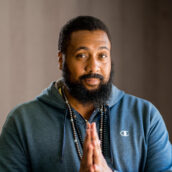
Season 03 – Episode 08: The Sound of Healing, with Reggie Hubbard
By The Gifts of Trauma /
Listen this episode here:
or here
Listen to hear a powerful and playful discourse that flows from racial anger to curiosity, skepticism, critical thinking, surrender and stroke recovery. Reggie speaks about how his unwavering self-care practices unleashed the transformative alchemy of inner peace. He also describes teaching peace and mindfulness practices to political activists and US Congress members, supporting their need for grounding in chaotic times.
He also invites us to:
- Express our grief and connect with our emotions rather than avoiding difficult feelings
- Consider suffering as a collective experience of shared understanding and support
- Embrace our vulnerability and surrender ego to open deeper connections and healing
- Replace our need for results with non-attachment to enhance our peace and presence
- Welcome life’s dark moments as paths to deeper understanding and authenticity
Throughout this conversation, Reggie demonstrates his use of sound bowls and gongs to facilitate emotional release and healing.
Episode transcript
00:00:00 Reggie
Many people, especially in the lines of work that have become my vocation, delight in the… I just don’t have time for that, or I would do more of that if there were only more time in the day. But you can’t chase peace. You can’t chase like well-being. You have to begin with it, and you have to create structures in your life that reinforce it as a foundation as opposed to, “Oh shit! I didn’t meditate today.” So for me, I have sound bowls in my house, literally at my feet, so when I walk out of the bed or when I wake up and I’m still in that “where am I” state there’s a sound bowl right there that can be, like [sound bowl chimes] as I wake up. So this vibe is in my brain when I leave the house. So if someone cuts me off in traffic or I get an e-mail where someone shows their entire ass and ignorance or you’re in a zoom call that could be 15 minutes but someone won’t shut up and it lasts for 40. You know, like, all these things happen like instead of me being worked up, like… I’ve already invested in this, [sound bowl chimes].
00:01:26 Rosemary
This is The Gifts of Trauma podcast stories of transformation and healing through Compassionate Inquiry. [sound bowl chimes 3 times]
00:01:57 Kevin:
Welcome to another edition of The Gifts of Trauma podcast. And I am here with… this might be a little a little, I might be taking liberties here, Reggie, but I’m going to say I’m here with a new friend and his name is Reggie Hubbard. And Reggie, I have so much I want to talk to you about because we’ve already been talking for 15 or 20 minutes, and it’s sparked, and it’s fired off things that I want to get into with you. The first thing I want to say is that we’re going to talk a lot about what you do, who you are, where you’re at in your life, what’s coming up in your life, what’s gone on in your life. And one of the things we’re going to talk about, I’m sure given the backdrop, the space that you’re sitting in, our audience can’t see that. And maybe I can count, on a quick count, I can count 6 gongs ranging from what looks like 50 inches down to 20 inches, something like that. We’re going to talk a lot about that. But the first thing that I like, Reggie, is I like the sound, the resonance of your name. Reggie Hubbard. Please Reggie, tell us without getting into too much of your work, you know too much of your story. Introduce yourself to an audience that don’t know you. Who is this nice sounding Reggie Hubbard?
00:03:15 Reggie
Peace with you Kevin, and thank you for the chance to be in community and the share. I am many things. I am a caring human. I am a stroke survivor. I’m a descendant of enslaved humans that believe in the power of prayer and the call of liberation. I’m a social justice seeker. I’m a healer. I’m a person that loves to be curious, playful and kind of a trickster. So the rules never really worked for me because I’m a big bodied brown guy in a society… so I’m in the Washington DC area. America doesn’t like black people, right? They take our culture and put us under oppression, right? So I grew up in a land that saw me as a threat when all I wanted to do was be a blessing. Over the course of my life, I have found peace with the world that sought to demonize me and have now become a conduit of that peace for all people.
00:04:19 Kevin
Wow, thank you for that introduction. I want to get the order of my questions right, Reggie, because every time you talk, I think of a new question I want to ask, and for a time limited podcast, that’s maybe not the best thing to be doing. Tell me, this isn’t a question that I had in my mind until you started speaking there.
00:04:35 Reggie
Yeah.
00:04:36 Kevin
Tell me how you found peace with the place that wanted to oppress you.
00:04:44 Reggie
Anger became my native tongue from a very young age. The sage James Baldwin has once said. To be black and conscious in the United States is to be in the constant state of rage. So I can cosign that through my lived experience. And for a time that you’ll was a beautiful experience, in my younger days because it catapulted me. And, you don’t think I can do this? Let me show you. So it was just this whole thing, right? Anger, if left unchecked, transitions from fuel source to destructor.
00:05:26 Kevin
For real, yeah.
00:05:27 Reggie
Yeah, so that anger had started to become destructive. self-destructive.
Kevin:
What did that look like, Reggie?
Reggie:
Oh, 20 hour days of work. Like no regard for the temple through which you do the work. Drinking bourbon for breakfast, chain smoking cigarettes for lunch, maybe catching dinner, right? All of these different things. Tremendous stress and pressure, not only because of the job, but because I’m one of a few people of colour in a powerful position. So right, all that drama and stress. So I began to notice that the drive that got me to a certain place started to become my harshest critic. So, why didn’t you just like, why didn’t you do more all of these different things like my aly became like my demon like super quickly. And luckily as a philosophy major, I began to be like, OK, what is this? This thing? And having a fair amount of spirituality in my life at one point in my mid to late 30s in a prayerful state, my ancestors were essentially, just, “What are you doing? We didn’t send you here for this. You need to change.” So I took that very seriously because it was like one of those, like,.. “What!!?” I took that very seriously. And on April 1st, 2013, Yep, I took a vow of clean living, right? So vegan cleanse, got some running shoes and started to do things that were better for my body, but to also… to detox my system, to just give me a completely different experience, to adopt more wholesome habits. That reborn day, April first. Begat my yoga practice, begat my meditation practice, begat ways of interpreting the world from a bigger scale than my own pain, right? So I found peace with racism by seeing how it benefited me because that drive came from racism. As I’ve gotten older, race is still the water that I swim in. But I’m so well versed in that, for lack of better terminology, I pimp your ignorance. Oh, you think just because I’m big and black but I can’t do this or I’m already past you, baby. So seeing it as not a thing for me to overcome, but a condition that I can surpass, like yoga and meditation and sound music practice gave me the opportunity to see things more clearly, extract the wisdom, release the poison that preceded.
00:08:26 Kevin
Reggie, to lead me in a little bit. I was curious there. When you’re telling me just that little bit of timeline, I’m curious, because my guess is that a lot of young black men, as you’re describing, and my friends will tell me the same. It is not a surprise that a young black man would grow up angry. That ain’t a surprise, but what might be a surprise, and I don’t even know that this may be broader than that. It’s not a surprise that a young man who was devoid of opportunity, devoid of good working conditions and devoid of a good lifestyle. And even here there are young men like that. It’s not a surprise that they would grow up angry. What is less common is that they manage to find their own way out of that. Hey, listen, I don’t need to tell you, but the trajectory of young oppressed men, particularly black, that trajectory, you know what’s gonna happen there? So I’m curious. And I think you said you had your philosophy major when you saw this. What did you say? You saw this ally become your demon?
00:09:29 Reggie
Yeah.
00:09:30 Kevin
So tell me a little bit about that timeline and what was going on that you were wanting to study. A philosophy major again, I’m guessing, Reggie, you’ll tell me. I’m guessing that’s not an obvious major for a young black man.
00:09:42 Reggie
No, You can imagine the conversations I had with my folks. I’m first generation in my family to go to college and I go to Yale University and I’m like, yeah, I’m majoring in philosophy. “Whoa! What?” And 17/18 year old Reggie was just like, I don’t really know what this will lead to, but it helps me process my thoughts. There’s a lot going on in here. It helps me communicate, like, it helps me write like it’s giving me tools to process the experience that I have. All of these things were happening in my early, my late teens, and I didn’t really have any person to talk to about it, right? I became… which is probably why I naturally fell into like, yogic and meditative and dharmic experience because the philosophy major gave me the space with which to unpack what was going on up here in my head, and to write about it or find my words for it or just sit in the confusion. I wish I had the photo. I got to find it. There’s a picture of me, junior year of college, with the book, Being and Time, by Martin Heidegger, which is the densest tone of existential philosophy in Germanic prose. What? So it’s a lot. And there’s a picture of me holding the book on my head and my eyes are crossed, right? There’s no way I can totally understand what’s going on, but I was willing to try, right? Willing to bend this mind. Willing to entertain different ideas so that I could figure out what was more mine, right? So early on in my life and acquired the mechanism of critical thinking. I know what it was.
00:11:36 Kevin
From where, Reggie? Where do you acquire that from? Where does a young man, particularly a young black man, the first in his family to go to college? Where does a young man acquire that from?
00:11:47 Reggie
I think part of its native, right? It’s like, it’s within us. I, as a teacher, believe that.
00:11:53 Kevin
I agree.
00:11:54 Reggie
So all of the experiences that life had gave me, I had to figure out a way to make sense of it, right? Asking the question, I now believe that you ask these questions and the universe, higher power, guides, ancestors, whatever you want to call them, hear your questions. And so it becomes a relationship between you and this thing that’s bigger than you. And in my experience, the more I was questioning it, querying, even in moments of grief, angst and anger, the answer came, or the answer would come. Then with respect to young black men in the conundrum globally, men of colour and marginalized communities, that’s become a central part of my teaching, right? So I’m in partnership with the Kripalu Institute and we have this program called, Permission and Refuge Healing Retreat for Men of Colour, which is manifold, right? So one, Kripalu isn’t necessarily the most diverse place on the planet. However, in partnership with them, I’m able to help them as an institution grow in their awareness of the necessity of diversity of not only constituency, but of teachers. And there’s a certain portion of the program which is scholarship driven. So this mighty institution of restoration is actually doing real restoration by giving people from marginalized communities a chance to be and eat well and sleep well and have world class educators give them, like, knowledge in a cohort of their peers. That’s three years old, right? So that’s another thing that my experience of not having something combined with my creative instinct and critical thinking has led to the creation of, now, a foundational program for black male healing in the United States.
00:13:44 Kevin
Let’s just take a moment. I, I think I was about to celebrate you there with a quip or a quirk and you know what Reggie? I think that just deserves to be honoured with the moment.
00:13:57 Reggie
Received.
00:13:59 Kevin
Thank you for that. And it was bringing me back to something that we said just earlier on and I wrote it down. And when you talk about these young people, mostly young men and mostly young black men in these oppressive situations, and you said something earlier, I thought it was really cool. And you said the wings of imagination cannot soar from the mind of burnout or the mind of exhaustion.
Reggie:
Oh, yeah, yeah. Uh uh.
Kevin:
And when we think of all the wisdom, the intelligence, the love, the care, the compassion that is resting in our young people, but it ain’t going anywhere. It ain’t going anywhere from a mind of burnout or in our trauma world, in the Compassionate Inquiry world, we might call that from a traumatized mind a hyperactive, hyper alert, hypervigilant, for perfect… for perfectly understandable reasons.
Reggie:
Totally.
Kevin:
And here you are using your power, your ability, your skills to create a space that young men can allow the wings of imagination to soar.
00:15:04 Reggie
And it’s a beautiful thing that happens, Kevin, because first of all, people are like, is this shit for real? Like all, I have to do is get there and everything else is paid for and I can do whatever I want? I was like, within reason if you’re in the room, I need your full presence. If you’re not in the room and you need to walk or you need to rest or you need to like try something different, go for it. So that level of freedom, that permission, the security within which people have that… I’ve had brothers telling me, but I went to this retreat and it totally changed my life. I didn’t know, (A) that I didn’t have to walk around so jacked neurologically (B) From a place of peace, from these basic practices, from the connection with other beings like me, I have more confidence to try something or, I give people tools, like we talked about earlier, just because someone is being ignorant and racist towards you, you don’t have to take that on. You can be like, oh thank you for demonstrating your ignorance. I choose not to invest in your dying paradigm. Yeah, go on, be gone with love and respect. Go here. That’s a choice, right? That’s an empowered choice that most people, regardless of this isn’t just a… like a racial thing like, many people invest in other people’s small opinions of them, you know. What meditation and yoga have taught me is, I can divest my attention towards your limited expectation and do exactly what I’m called to do in the world because I’m not here for you. Especially since this stroke recovery. I’m here for a reason. And it is not to trifle with the fickle imaginings of short sighted people.
00:16:47 Kevin
Reggie, let’s introduce a little bit of Irishness from my side here. Do you know what a leprechaun is?
Reggie:
Yeah, Yeah.
Kevin: Everybody knows what the leprechaun is. And I’ve adopted a little thing from Gabor’s work around this. And I’ll say to people, hey, I’m from Ireland and I breed leprechauns. Yeah, and people do that – what you’ve just done. They laugh. And I’ll say to them, and you know what? I’m pretty sure from looking at you, I’m pretty sure you’re a leprechaun. I can see your green skin, I can see your orange beard, I can see your pointy ears. I can see that little hat that you’re wearing, and I’m pretty sure you’re a leprechaun. And I’ll ask people, what would you say if I said that to you? And the usual answer is like, What have you been smoking or are you taking funny pills or something? And I say, yeah, I said, OK, so let’s hold that. And then if I say to them, “You’re a useless piece of shit and you’re not lovable and nobody really likes you,” what would you think of that? And you can see them get hurt by that. They invest in that, to use your term. They take that on, they invest in it, and they give some energy to the belly because they’re already carrying. They know they’re not a leprechaun, they’re 100% certain, but they’re not 100% certain that they’re not a useless piece of shit and not lovable and not likeable. And it’s that same thing that I hear you say that… Reggie, help me understand that that must be a really powerful and difficult thing for a young… a person of any description, but particularly someone who has suffered as young black men do. That must be a really powerful tool, but a really difficult one to to embody. I guess that would be hard to take on board.
00:18:44 Reggie
Yeah. That’s why we do the retreat in community. They can be with other misfits. So we’re building, The Amazing League of Misfit Toys. You know what I mean? And if you were to ask me, I think you’re a leprechaun. I’d be like, hell yeah. And here’s why! Last Monday and this past Monday, I saw five different rainbows in three different states. One of them was over a gig where I was getting ready to play. Like one of the after effects of the stroke is that I can hear rainbows. Like I’m tuned to that frequency. It’s really wild. I came out of the dining hall at the Omega Institute and it was so loud. I was like, where’s the rainbow? Like it, It’s in my head and I looked and it’s over the place where I’m about to gig. And so I made the choice there. So my current practice is to the point ,I am a magical being. I am not a normie, like I am a magical being. And how can I remember that? So when you said you’re a leprechaun, I was like… I just said that last week. And one of the other rainbows was on my family’s land in Virginia. I have the gong over my shoulder. It was named Oracle. I started playing the gong. And real talk, a rainbow came out in the sky as I’m in the front yard of my grandfather’s land and it was there for 45 minutes. And my grandparents live on Peacekeeper Lane. So the gong is now named Peacekeeper. And I’m like, I’m playing music to rainbows. So when again, when you said leprechaun, I was just like, yeah, but I’m finding pots of gold. I’m banging gongs. So anyway, thank you for that. I’ve now shared that story with thousands of people. I’m very happy about that.
00:20:40 Kevin
Thank you. Thank you, Reggie. It’s already… Yeah. Again. This conversation would go a million places. I really want to focus on what I want our listeners to hear from you. And probably a little bit selfishly. I wanna be honest. I wanna focus on what I want to hear from you. So yeah. Yeah. And…
00:20:55 Reggie
Remember when I told you I’m an open book? You didn’t expect someone to jive so hard with your leprechaun? Yeah, open book, let’s go!
00:21:02 Kevin
We’re already going. Reggie We’re already going.
00:21:06 Reggie
We’re going, yeah, I know, right? You expected that to land flat, anyway. Continue.
00:21:12 Kevin
A little brief story, one of my other Compassionate Inquiry colleagues that I am really fond of is a guy called Juliano and I first met Juliano in a zoom meeting and it was about DI, diversity, equality and inclusion. And I do not want to label Juliano, but he is a special being as well. And we were talking at the time about pronouns, and we were going around the room and asking people their pronouns and, she, he, they, them, he, him, etcetera, etcetera. And I came to Juliano and Juliano said my pronouns are majestical, delicious. That was the first time I heard Juliano talk. And I thought, I need to talk to this person. I need to find out. I need to find out more about them.
00:21:57 Reggie
That’s great.
00:21:58 Kevin
And anyway, Reggie, let’s get back to what we’re talking about.
00:22:02 Reggie
Yeah.
00:22:03 Kevin
A black progressive political activist.
00:22:07 Reggie
Yeah.
00:22:07 Kevin
Who is growing peace and ease as a foundation and not an afterthought. Talk to me about those couple of little quotes just there.
00:22:21 Reggie
Many people, especially in the lines of work that have become my vocation, delight in the… I just don’t have time for that, or I would do more of that if there were only more time in the day. But… and you can’t chase peace. You can’t chase like well-being, you have to begin with it and you have to create structures in your life that reinforce it as a foundation. As opposed to “Oh shit I didn’t meditate today.” So for me, I have sound bowls in my house, literally at my feet. So when I walk out of the bed or when I wake up and I’m still in that, Where am I state there’s a sound board right there and can be [Sound bowl chimes] like as I wake up. [Sound bowl chimes] So this vibe is in my brain when I leave the house. So if someone cuts me off in traffic, or I get an e-mail or someone shows their entire ass and ignorance, or you’re in a Zoom call that could be 15 minutes but someone won’t shut up and it lasts for 40. You know, like all these things happen. Like instead of me being worked up, like I’ve already invested in this. [Sound bowl chimes] So that vibration for me, allows for a graceful response, allows for me to, rather than get lost in thought or create a story that is only to whatever… I’m like, OK, let me go back to that place where I was this morning. OK, this is a mild annoyance. Keep it moving. That discipline over and over again builds the foundation. The one thing we know about life is that the disruptions become more pronounced. So by creating foundational peace, your practice just becomes an opportunity to come back to the foundation as opposed to grasping for it as an afterthought, they’re already laid.
00:24:48 Kevin
And that leads us, certainly leads my mind beautifully to…. I watched the brief Ted Talk, the San Paulo Ted Talk, and it was called The Power of a Purposeful Pause. So you and I, Reggie, and maybe some of our listeners, we understand… maybe that’s an assumption. I’m trying to understand what meditation isn’t, what my practice is, what my practice isn’t. We maybe know a little bit about that. So for someone, hey, they’re getting caught in these wrangles when the person drives in front of them or the person won’t shut up in the Zoom meeting and they’re getting caught up in the narrative and their minds twisting and they’re getting angry and getting hot and bothered and they don’t have a foundation of peace. How would you introduce someone like that to a practice? What would be the first instruction that you would… or the first invitation, maybe not even an instruction, that you would give to someone.
00:25:43 Reggie
So last night I had given impromptu teaching to about 500 activists on the John Lewis Good Trouble Day Activist. So all across the United States, there were commemorative events for Congressman John Lewis, civil rights icon, and they asked me to come and talk about what you just asked. And there were a lot of people there who don’t meditate or like, are angry, justifiably so. And so what I said to them is, that this is for political activists, and I’ll extrapolate that to regular folks. I was like, our work is as much physical, mental and spiritual as it is political and philosophical. Honor the body, relax the mind. Nourish the spirit. Boom, you know. And then I was just like, so, blew their mind. And then I was like, just give the shoulders a bit of a shrug. 10 seconds. Deep Inhale through the nose. Exhale out the mouth, then I’ll stop. And I was like, how do you feel? Better? I was like, give me 10 more seconds. So they bring the palms together, close the eyes or soften them and hear the hands moving, feel the heat generating. Deep inhale through the nose. Exhale out the mouth. Rub the hands, nourish the hand, crack the knuckle, release, shake the palm. How do you feel? And so I give people 10 seconds. If I’m giving you bite size, you’ll be inclined to, if I have an opportunity to give you the full discourse. But so I talk about it briefly, but practice is something you gotta feel like. You’re doing the shoulder shrug, all this is so stupid, blah blah blah, OK. And then inhale through the nose, exhale out the mouth, pause, presence. Are you feeling better? So I’d have a scaffolded approach, and I’m telling people what feels good in the body started there. Do that again and again. Someone said something crazy, ah that was so stupid. Inhaled, exhale, take hands to the face, maybe keep you from saying something, but also to relieve tension in the jaw. So the beautiful thing is that I’ve started teaching activists and politicians. So they were like, yeah, we’re skeptical, but can you come be with us for 15 minutes? Huh? So you’re…. This is psychological abuse for whatever. So like, I would go in there and do these things and then the next thing you know, they’ll be like, yeah, right before that tough vote, I did that hand thing and shoulder thing and I’m like, whoa! Huh? So I specialize in teaching skeptics, having been one my damn self. The first time someone asked me to go to yoga, it’s like, I’m not a skinny white chick. Why would I do that?
00:29:00 Kevin
Thank you. I’m glad you do. I would put myself in that. Yeah, the more religious, the more spiritual practice I do honestly think my skepticism… I used to be skeptical about the spiritual world and all my faith in the phenomenal world. And I think right about now, 95% of my faith is in the spiritual world, and my skepticism is all in the phenomenal world
00:29:20 Reggie
Yeah, yeah
00:29:21 Kevin
But what I was going to say there is even as maybe moderately experienced practitioners of mindfulness and meditation, it amazes me that every time I lead a three or four minute grounding and this is every time, Reggie, every time I lead it, I open my eyes and I say shit. I forgot how much I enjoy that. You do it like 4 times a day for people. I’m like….Oh yeah
00:29:45 Reggie
Why don’t you do more? Yeah!
00:29:50 Kevin
I invite people to stretch their arms up. Oh, you might want to make a noise, you might want to stretch. And every time I do it, it’s like shit…
00:29:57 Reggie
Yeah, why do I only do this? But yeah, totally.
00:30:00 Kevin
Yeah, I really like that.
00:30:02 Reggie
Guilty for sure.
00:30:07 Kevin
Tell me a little bit more about that than Reggie. I was reading about you and this idea of there’s a whole big lengthy thing and I don’t want to tie us up too much in knots, but the idea of teaching people in, in, in Congress and teaching activists and teaching people in influential positions, this idea of Wellness, this idea of yogic tradition, mindfulness meditation. Tell me a little bit about how that came about, first of all, and I’d love to know about the influence that you’re having or the ripple effect that’s having in the world that you’re moving in.
00:30:41 Reggie
So when I took my yoga teacher training like I was the poster child of I’m doing this to deepen my practice. I have no intention to teach so for any of you who are listening that may have said that, look out because Spirit comes to you first. So after not intending to teach, basically, when I worked for this advocacy group, moveon.org from 2017 to 2021. That was the height of the first, whatever is happening in the United States. I was like, if I’m going to be in the middle of this, I’ve got to be so rooted spiritually and yogically to endure, right? So the chaos has got to be grounded by deep peace. And so it got to the point where I’d be in these meetings in tense situations, and members of Congress would come up to me and be like, we love when you’re in these meetings because when you walk in, the blood pressure drops. Like you’re so grounded and peaceful that you can walk into these rooms and people are like, Reggie’s here. All right. But I just, you know, I kept studying and I kept doing my thing. And then eventually members of Congress and their staff would be like, and you come teach us. And I was like, no, I’m not really a teacher. And so I rebuffed it for a while and then it kept coming. And if it’s keeping coming, it’s not coming from y’all, it’s coming from them. And sure, I’ll do it. Then the coronavirus hit, everybody’s freaking out. So I went from just the peaceful dude in the rooms to the peaceful dude in the Zoom rooms, right? So like, I had to teach people peace quickly, but I had already had the predicate of doing it in intense times, like fighting to save healthcare, fighting for impeachment, justice, all these other things. So that’s how I got started. It’s me just being an example, not trying to pitch nobody. Then when things got super hectic, everybody called me. All the political committees, like certain members of Congress have staff, their chiefs of staff, because I was ministering to the place where I was. That’s the other thing too. I’ve had some of my yoga teacher friends. They’re like, I’d love to teach members of Congress, and I’m like, no. And they’re like, why are they… And I’m like, you don’t understand our world like I’ve been in this world for 20 years. I’m a trusted and known being and recently like these people have seen me use yoga and meditation to come back from a stroke, so even if they’re skeptical about the practices. Like they’ve seen this dude doing these practices for 12 years. So what that allows for is a level of trust that I have to use to inspire. So what I found, to answer your other question, is that in times like now where things are super crazy and all over the place, having a teaching practice named active peace is quite beneficial, right? Because people are looking for that. So in terms of influence, I would say my influence is high right now because people know that you can’t drink your way through tough times, right? The tough times are here. And what I know from all the practices that I participate in is that these practices give you the space to cultivate the joys and sorrows, not the good vibes only stuff. So giving people an avenue to turn towards sorrow and suffering and see it in grief and see them as partners in the human experience, as opposed to things that I must avoid at all costs, right? That lays the foundation for personal and spiritual transformation, which is the goal of activism to begin with, right? So I would say my influence is deeper now because I’m just teaching people how to cope with grief, which gives them a better quality of life, a deeper breadth of emotional and spiritual understanding. So hopefully that will lead to better outcomes. So less prescriptive, like you have to do. This is like I’m just from my loving heart. I’m offering space for us to grieve together, to normalize the expression of grief in community to have you understand it’s OK not to be OK. There’s a lot of terrible things happening right now, but there are also beautiful things happening right now. So deal with what is upsetting you so that you can also turn your aperture towards the beautiful things that inspire you. And then that alchemy yields equanimity, which allows you to be of service in chaotic times.
00:35:41 Kevin
Reggie, that was beautiful and I’m really aligning with…. I’m really aligning with what you’ve just said, and maybe let me segue in a couple of little things into this conversation. What one of the most beautiful things that you’ve just said out of all of that beauty that you just gave there was that you used the phrase, “And I hope that might yield results,” which to me indicates a real deep peace and lack of ego. You said, I hope that yields results. And there’s a quote from the Bhagavad Gita, you know, that talks about, knowledge is better than working. Meditation is better than knowledge. But best of all is giving up all ownership of results because therein lies eternal peace. And I really hear that and I really like it when people talk like that because what I hear is that you’re doing your thing, you’re, you’re ringing your gong. And that may or may not yield results, but that isn’t really any of your business, which is indicating a real beautiful presence. And I really like that you have said that. So let’s hold that. And one other thing I want to just throw out in front of you, again, I’m just keen to pick your brain about this. Through my own practice. I think we might be men of a similar age. I’m 51 this year or something around that.
00:37:53 Reggie
I’ll be 51 in October.
00:37:55 Kevin
I’m 51 in November. There you go. So, also what I hear you say, and correct me if I’m wrong, that maybe 20 years ago I was about manifesting a life. I can manifest this, I can manifest this stuff. And maybe only over the last few years through my own practice, I’ve come to realize, shit, I ain’t manifesting anything. I am being manifested. I ain’t in charge of this….
00:38:25 Reggie
Yo, yes, you ain’t charging nothing you ain’t in.
00:38:29 Kevin
Charge of nothing… and consciousness does not need a skinny white Irish man or a big heavy black man to tell it what to do. So how does that land with you that when we’re working with what we’re struggling with, when we’re working with our grief, when we’re working with our sorrow, when we’re working with our trauma or with racism or these difficult things that are going on in the world, you aren’t manifesting anything. You are being manifested into the role that you need to be in. How does that land with you?
00:38:59 Reggie
I know that to be the truth viscerally, because in the context of my current experience of stroke recovery, it wasn’t on my vision board. I didn’t…
Kevin:
I bet it wasn’t.
Reggie:
Yeah, I’m going to have a totally neurologically devastating experience like, touch death’s door and then learn complete surrender… because I’m just bearing witness to all of this unfold as I surrendered and got out of the way and just did what I was supposed to do. You know what I mean? Control what you can control. In the early stages of my stroke recovery I could control my thoughts. Then my thoughts allowed me to have more confidence to seek to get this body back on. And one of the things that early on in the stroke recovery, in addition to what I shared with you earlier about how is this happening for me as opposed to why is this happening to me? Adopting the stroke as my teacher and then sharing it with love, right? Sharing all the lessons that the teacher was teaching me with love. I also had to remember that keeping this thing is ego. I didn’t have the energy to hide anything from anybody. I was just like, I have to let this out, and the impact of complete radical vulnerability, the impact of total surrender of even trying to manage the story, man, like I became a teacher to humanity because of this stroke, right? I had perimenopausal women come talk to me, saying the way that you just been so honest about your stroke has allowed me to be honest about what I’m experiencing in my body. People with multiple sclerosis are like the courage and the way that you talk about sound and rest and breath. has allowed me to find wisdom in managing my condition. So surrendering of ego, surrendering a result, surrendering of the need to hide or perceived need to hide anything from anybody. Just me giving that out, showed me that surrender allowed the manifestation of thousands of other people to heal. Consciousness doesn’t need me, and if I go along for the ride, it can use me to do what it needs to do. So the music that I now play like, is a conduit of consciousness that allows for a neurological reset for people to release things that they may not even know they’re carrying. You know, there’s, like a lot of the trauma that we carry. We don’t even know where it’s from because it’s so baked in. So what sound does, in my experience with sound through my own recovery, like it… I would just play these vibrations and play and pray in these vibrations. Whatever… I had an indigenous elder telling me they were like when I hear you play, I hear like location to all the dimensions. I was like, “What?” They say, You play with such an earnesty of heart that it says, if that’s what I hear, I want you to pray that I was just like, yes, ma’am, sure. Thank you for the guidance. Like they said, the way you play from your open heart is to open up opportunities for healing, love, grace. So once I heard that, I try and do that for not only myself, but knowing that the myth of separation is the biggest lie that we tell ourselves, as I feel myself, like that unlocks healing for all of us.
00:42:48 Kevin
And Reggie, again, hang on, let me just take the power of a purposeful pause because I want to ask you 6 questions at the same time, and that’s not going to work. So let me just choose the question I want to ask. Yeah. This idea of the duality is the illusion. The separation is the illusion. And you said beautifully, as I heal myself, I heal the world, I add to the healing of the world. And I think it may be also really important to say as well, Reggie, for our listeners and ourselves, that also that whatever it is that we’re carrying, is also not our own. We’re not alone to carry that by ourselves. That is a collective as well. Yeah, when we heal the world, but when we suffer, we can lean that on the world, on consciousness, on the universe, on God, divinity, Brahmin, whatever you want to call it. How does that land with you, that our suffering is also a collective and we don’t need to do that alone.
00:42:56 Reggie
Given the ways that suffering has shown up on America’s doorstep in the past several months, I have started to hold practices in the title of them is I’m Not OK and That’s OK Meditation series. And the gist of that is, come be not OK with us. You are not the only person that is suffering. You are not the only person that is throwing hands in the sky. Like what is going on? Like you’re not the only one that’s feeling that. So when we hold that confusion, when we hold that angst, when we hold that sorrow disgust, together, something magical happens. The commonality of our suffering, which brought us together, spending time together in the commonality of that suffering, however dissimilar it may be when you leave that sangha, you aren’t carrying what you brought in. That’s awesome, and my prayer is to do more of that. So more often than not, in these Wellness spaces, everyone talks like this and it’s so priss. No, when the electoral result came down in the United States. I held a class called, WTF, Are You MF Serious Meditation Experience, to hold space for people who are like what? Like what? You know what I mean? So there were 120 people there and people were with their rage in community, with their sadness and grief in community, and again without being attached to the result because I may never see any of them again. At that moment in time. It gave you what you needed to process the enormity of the suffering that you were looking at. My job as a teacher, my job as a teacher is to hold space for you to be in openhearted community with other people, to share the joys and the sorrow so that as you leave the sangha, you are lighter than when you came to it. Good job.
00:46:03 Kevin
And I hear their Reggie, I know you didn’t say it directly, but the invitation that’s going out to people that may be listening to this conversation that we’re having is, get yourself a Sangha. And that might be 3 women drinking cups of tea in a back kitchen somewhere. Or it might be 120 people turning out to a WTF meditation series. I just want to acknowledge as well that when you shared that I for some reason that idea, because probably I don’t know if you, like yourself. I’m probably not run-of-the-mill. I probably don’t fit under the broad bit of the bell curve.
00:46:42 Reggie
On the outside.
00:46:46 Kevin
Yeah. And there was something, it really touched me emotionally to hear you say, let’s get people in there that are the outliers, the ones that don’t use the meditative voice and that like to use a swear word occasionally.
00:47:00 Reggie
Yeah, man.
00:47:01 Kevin
Let’s get us in there and holding each other. To be fair, Reggie, I think that we are the, I think with the antidote. I think with the antidote to the darkness.
00:47:10 Reggie
To that point, I’ve said that recently, especially in the context of the stroke recovery. Is that part of the reason that I think that teaching has taken off in current times is because I’m not afraid of the dark. I’m not afraid of the shadow. Me and the shadow are intimate. Like, like I have spent so much time with the dark night of the soul that like, we kick it. You know what I mean? When the dark night of the soul shows up, I’m like, how you been? Shit, what’s up? I haven’t seen you in a minute. What you got for me? Like, as opposed to. Oh, no, let’s pretend it’s not happening. I know the dark night yields like a bright morning. I just gotta let the dark night have his visit. So to not be scared of the dark is the antidote. So many people want to deal with suffering with kid gloves. Like suffering is the way. Like I once taught a bunch of youth this spring, this beautiful young woman asked me earnestly. There’s all this talk about, like, heartbreak and suffering. How do we get past that? I put my hand on my heart and looked at her. It was just like, baby ain’t no getting past it, but we can get through it together because we’re all heartbroken about something. We’re just not honest about it, but we’re honest about the heartbreak in community. There’s a connection that manifests that lifts us. Like the heartbreak just needed to be expressed and seen. And when the heartbreak is expressed and seen, it can be like, yeah, thanks for that. That’s all I wanted. And then whatever is next will come out. Maybe it’s curiosity, maybe it’s tears, maybe it’s laughter, maybe it’s relief. But like, expressing that heartbreak and the commonality of that heartbreak with other people is how we alchemize the tremendous healing that needs to take place. But you can’t do that if you’re afraid of the shadow or afraid of the dark.
00:48:56 Kevin
The only way out is in and the only way in is through.
00:48:59 Reggie
Yeah.
00:49:00 Kevin
I don’t know. I don’t know if that was Buddha or Jesus or Muhammad. I’m not sure who said that, but somebody much wiser than me said that and I’ll borrow that quote. Thank you for that, Reggie. I really, really appreciate that the words that you’re using here. Tell me a little bit then, I want to talk about the the scene that is currently sitting right behind you, that our audience, our listeners don’t get the benefit of seeing. But before that, yeah, I’m keen. This is just another curiosity on mine, have you read, My Stroke of Insight, by Jill Bolte Taylor?
00:49:31 Reggie
I have.
00:49:32 Kevin
Yeah, awesome book, right? And she took a long time to heal, but I just thought she made her own journey through that and returned herself to her position of authority and university in American Society.
00:49:45 Reggie
The one thing that I’d love to put a finer point on is that’s why I’ve been so loud about my stroke and my recovery is that like in especially in the United States, pharmaceutically, the word stroke is only mentioned before death, right? They put these pharmaceutical ads in those this medication may induce blah blah, blah, blah blah, stroke death. And so stroke hasn’t even talked about as something that you can endure, as something that you can survive and something that you can, with patience, like reassimilate, right? There are techniques. I used acupuncture and sound and like Chi Gong and in addition to medication and intense physical therapy to allow… because the stroke revealed that Chi injury, it was it was an injury to my energy. And so I had to do subtle stuff in addition to the gross anatomy stuff. And that not only of it’s it, it didn’t hasten the recovery, it increased the aperture for which to me to see what recovery could look like. Like I’m not trying to get back to where I was at. I’m trying to stabilize ground and then expand. Most recovery is regressive in my mind instead of being like let me normalize, stabilize, plant roots and then, move forward.
00:51:06 Kevin
I’m sorry for interruption there, Reggie, but just as you were chatting, I was thinking, and of course that’s the same. Take out the word stroke and put in, Yeah, heart attack. Take out the word heart attack and put in cancer. Take out the word cancer and put in, put in whatever. And as I can’t remember, maybe it was before we started the show, we were chatting and you were just mentioning the idea of the doctor saying, hey, it’s gonna be it’s gonna be this amount of time and this is gonna happen. You’re like, whoa, no, don’t tell me that. A book I’ve been playing around with just lately. I don’t know if you’ve read this one, The Expectation Effect.
00:51:39 Reggie
No.
00:50:46 Kevin
Or something similar, I’m just dropping that in for people that they may read it, I can’t remember the author, to look up the expectation effect. And pretty much it is about whatever you tell your mind to expect, it’s going to work its way towards that. And a lot of that was that… there were a lot of studies around medical recovery and how, and Jill Bolte Taylor talks about this, how the language used by the doctor or the consultant, the physician, whoever that is, is really essential to the rate of recovery of the patient.
00:52:14 Reggie
I believe that because in my recovery, I love this, I have to read this book and I made…because I’m in the headspace of creating a mindful recovery curriculum based on my experience. So all the stuff we talked about in pre-production about like the mindset stuff, I expected a miracle and the miracle has manifested. There’s still… I don’t walk like I used to have a little bit more wobbly short, like I’m some … and like this leg wasn’t working for a couple months. Of course things are a little bit off now. That is, that doesn’t mean that the gait can’t improve that I can’t like manage the subtle mechanics or maybe I just adjust and slow down and let this version of the body talk to me. But I expected a miracle. I expected to recover and I could not endure the planting of anything less than that.
00:53:04 Kevin
I like how you said that, you know, I expected, and as you’re chatting, Reggie, I’m thinking and expecting a miracle is exactly the same as expecting a really difficult time.
00:53:43 Reggie
Yeah!
00:53:44 Kevin
It’s just, you’re just making up your mind to yeah, listen, yeah, I’m gonna be in bed for two years. I’m not gonna be able to speak for 18 months. I think maybe saying as well, Reggie, I think it’s always really important… This is not to belittle or condescend to anyone that is going through a difficult time or an illness, but it is to say that with help with you, you put it beautifully there as well. That nourishing and working with the energy and the spirituality of an illness is as important as working with the physicality of an illness. And this isn’t what I love about today. Reggie is. This isn’t woo woo anymore. We have enough science. We have enough double-blind studies and reports that we have enough to say this is actually working. Hugging a tree actually works as we have enough science around sound bathing to know that it’s slowing down your heart rate, it’s slowing down your respiratory rate, it’s changing your digestive processes, it’s changing your brain wave. We have all the science to say that this is real. And I really like that we’re coming into a period now, we’re maybe 15/20 years ago what you were saying would have been poo pooed as…
00:54:34 Reggie
Yeah, for sure. I’m shocked that people asked me to come bang these metal discs for them and it’s so common now. Oh, Reggie and his gongs. Like, Wow. Even two years ago in my part of the world, I don’t live in California, like I lived in Washington, DC on the East Coast of the United States which is about as no bullshit as it gets. So for me to be like, yeah, let me bring these goons, Oh sure I’d like to reset my nervous system, right? Like that. Let’s go of consciousness, the time is now. Let’s elevate. Let’s go.
00:55:10 Kevin
Way to go. I delivered a sound bath just last night ready for and I live in rural Ireland, there aren’t a lot of Reggie Hubbards around this part, and it was really amazing last night, there were three men in the room, which is a surprise, sometimes… It’s quite often 20 women, but there were three men. Yeah. And personally I believe we have to get men involved if we’re going to do the work.
00:55:33 Reggie
Everywhere, for sure.
00:55:35 Kevin
Reggie, can I ask you just to talk about one more thing before we talk about this backdrop here, we haven’t mentioned and I think it’s important. You can tell me if it’s important. Active Peace Yoga saw a lot of that when I was reading a little bit about it. Tell us a little bit about Active Peace Yoga and what that means to you as well.
00:55:52 Reggie
Yeah, so Active Peace is the name of my teaching practice and the LLC, the entity through which I do my work in the world that was born during the coronavirus pandemic. My yoga story is actually quite interesting and my mindfulness story is interesting because I just, I didn’t really get into these practices as discipline until I was 40. So I had a whole lived experience until 40 and 40, I like I told you like that ain’t working no more. I gotta figure something else out cause that, I’m gonna be dead in 10 years. That’s crazy. So let me figure something else out. So when I’m in the midst of all my teacher trainings and all the political upheaval, it didn’t necessarily land with me that when members of Congress are like, your energy is like lowering the blood pressure. That’s the presence of peace. Didn’t even think of that. But when the coronavirus hit, the day that everyone bought all the toilet paper for a respiratory ailment, I was just like, OK, this is wild. Just wear a mask, stay away from folks. Like for me, I was that peaceful, but everyone else was. And I was like, oh, this is the piece that’s promised by consistent practice. Wow, alright, so if this is what I carry, I gotta share it. So active piece was born to help share the piece that I had cultivated through discipline practice with as many people as wanted to come to virtual events during the height of the pandemic. And again, one thing that’s important is that my title self appointed, is I’m the chief serving officer. It’s not chief executive like.. this is a… I am a servant. I am a servant of prior wisdom, love and truth and grace. So, like I seek to serve, whether it be through my political work or my sound work, or my yoga, meditative teaching work, or whatever work that comes to me. I seek to be a steward of peace, which isn’t only good vibes, only peace. Sometimes peace is a disruption, right? So active peace is it? Oh, I’m going to come in and chill things out. Sometimes I’m gonna come in and blow things up, and blow them up because what was calcified needs to be dispersed so that the peace can settle, right? So active peace comes from a place of peace. It can be the maintenance and the creation of opportunities for people to find deep rest or going directly into the heart of a harmful situation, blowing it up and being like, now let’s have a real conversation about what peace looks like. And it ain’t this. This is lies, delusion, and whatever, right? So, using the tools of truth, sound, voice, and strategy to give opportunities for individuals and organizations to find peace as a foundation rather than an afterthought.
00:58:58 Kevin
That just deserved a little moment in my opinion as well, Reggie.
00:59:05 Reggie
Received.
00:59:07 Kevin
So I’d love to. I’m very conscious of our time. Yeah. I’m not even conscious of my time because Reggie, I would sit here till both of us fell asleep talking to you. It’s just an absolute delight. And you know what, Reggie, I’m going to say this and I don’t mean to blow smoke. I don’t mean to blow smoke. But what I really like, and it’s that thing we talked about earlier, when I meet someone, I sometimes meet people who are doing this work, and it is absolutely from a place of I need to be seen to be doing this work. It is absolutely from a place of ego. And that is not to judge them. That is just where they’re at, and that’s just what’s happening. And I find that my system is repelled by that. I’m like, oh, oh, I just, I can’t do that. A quick example of that is, I went to someone else’s sound bathing experience just to try it. And as we lay down, they told us that they were about to deliver the most magical experience of our lives.
01:00:14 Reggie
Whoa.
01:00:15 Kevin
I noticed it very strongly because one of the things that I say when I’m delivering a sound bath… One of the things that I say to people when I’m delivering a sound bath and I do it consciously, is to say I am not in charge of your experience and whatever one you have is welcome. Whether you love this, hate this, have a psychedelic experience, if you fall asleep, if you, whatever… you’re in charge of your experience, have your own one. What I have really enjoyed about speaking to you is that you, that your wisdom, your love, your compassion, your grace, your passion, your activism, your energy are all very prominent and they’re very clear to see. And, that lack of ego that seems to be emanating from you. I also feel that just in that I hope that brings results. Just that statement. I’m like, oh. That’s really beautiful and I just want to acknowledge that. I hope that’s OK. I don’t.
01:01:07 Reggie
No, I received that. It’s funny, as my profile has grown, you can imagine that I’ve become uncomfortable with that. I didn’t start teaching for notoriety. I started teaching to serve the moment. And like in many ways, I still try and teach to serve the moment. I hope to do so with scale because the moment is huge and people need to. I think I can help a lot of people with what I got and the energy and this goes to how I was taught and trained as a teacher. Like the universe exists in one heart and mind so if I offer my best to one heart and mind I’m actually impacting the whole universe. It’s cool if it’s 1000 I guess, or whatever, but I was taught to teach to the one and to be a servant to the one as a conduit of all, serve the one. So that’s how I approach this stuff. So as my profile has expanded, I’ve done yeoman’s work on just being of service. I remember when I filled out the papers for making active peace like an official thing. I was giddy when I was like, Chief Serving Officer. I feel like this is super geeky, but it’s mine. Chief Serving Officer. Yeah. It’s a challenge that I’ve taken to continue to grow my service as the profile has grown.
01:02:35 Kevin
And again, for me, Reggie, that’s why the service will grow. The service will grow because it’s the service before the reward. And I wish and pray and hope that you reach as many people as is needed. And I think as is needed is a lot of people. Reggie, I often end my conversation with people and I’m hoping that if we still have time and if we don’t, we can do it another time, that you’ll need to play a few gongs for us. But what I’d like to ask of people, and you have had no prep for this question, is if you had the ear of humanity, what would you whisper into it?
01:03:44 Reggie
[Gong chimes 3 times] And then I would say you are loved, go love someone.
01:03:51 Kevin
And that’s a pretty cool answer. Thank you for it
01:03:54 Reggie
I still have my grandma. She’s 98 years old and I should be 99 in October. And she tapped me on the shoulder recently. And she was just like “love you.” And I was just like, hey, it’s cool that me at 50 can hear my grandma whisper in my ear. And what a cool thing to whisper to somebody. So when you said that, I was just like, I wouldn’t say anything at first. I’d be, like let’s reset your nervous system… that bowl particularly expands consciousness. It clears the mind and some of the bowls I have are just like, I’m gonna just put you to sleep. But that one in particular. So if I have your ear, I’ll clear your mind and then tell you that you’re love, go love.
01:04:49 Kevin
Reggie, maybe I’ll talk to Rosemary and J’aime and I would love it if they would grace me with the ability to get you back on in a while, maybe in a few months time or later in the year or early next year to to catch up with you because I have loads of questions I didn’t get to ask.
01:05:06 Reggie
Right on.
01:05:07 Kevin
So how would you like to do this, Reggie? Would you like to play a few gongs for us? Would that be OK? Would that be?
01:05:13 Reggie
You know, I’d love that, honestly. There’s gratitude for the chance they’ve been in conversation and community with gratitude for the chance to just share my story. And hopefully that my story has given you inspiration or at least a little information to navigate this crazy thing called life with a little bit more grace, presence, and maybe curiosity and joy even, in dark times, right? The thing I’m most excited to share is something that’s beyond words, sound, especially in the context of my current recovery. A whole bunch of words were being thrown at me that left me depressed, that left me feeling hopeless, honestly, and I couldn’t avoid that, I had to sit with them. And when I offered the words that didn’t fit me to the gong, the gong was like, I’ll take that, and I’ll make something beautiful out of it. So as I play, the invitation is to bring to mind a feeling or a thought or words that don’t sit well with you, to give space for them. Because we as a collective tend to avoid, well, we don’t want to talk about it. Think about, but be present with something that’s not going to your liking, that may even give you a little sadness. And just let the vibrations of these gongs tend to your heart and soul. Because gong work. Sound work. But gong work specifically the Gong heralds piece. The gong clears pathways, energetically and otherwise. Historically it was used to herald peace across the land, but to create new, energetic and clear the way for emperors and people of importance. I just make that to the proletarian. That’s great, I’m not that bourgeois. The invitation is to allow. I’ll probably play 6 or so. Allow each sound to assuage what you’re holding, give it space, and allow the sound to create a soft space for hard news to land, release and then be in that place. So find a posture that is supported by your energy at this time. Upright or laying down, whatever suits your needs. Welcome to breath. Tender Care or acknowledgement of the gifts that the breath gives. A lot of the inhale to nourish your hopes by the exhale to release your fears, and I’m just happy it’s gongs. We’ll begin with home. This is the gong, the chamber. This gong, in my darkest moments, helps me smile. [Gong sounds]
Now resting in this sanctified silence that sound has created. Notice how heart and mind feel. Rest in this space. Silence begins now.
[Gong sounds]
Now take notice of your body and your energy. Notice if and how your heart and mind have shifted simply by breathing and listening. Notice how cutting off sight and turning down the thought the thinking mind has connected you to a deeper space of peace and grace and space and possibility and compassion. This was already here. Sound just pointed us to it. So from this connection to this oasis, drink freely as we begin to release the meditation. Two clearing breaths. Deep inhale through the nose. Audible release, deep in through the nose. Playful release. Open and close the palms. If eyes have closed, gently flicker them open. Drink in the space with new eyes. Thanks for letting me play.
01:12:07 Kevin
Reggie Hubbard, thank you for joining us on The Gifts of Trauma podcast. I wish you all the best. May you achieve everything that’s laid out for you. Please take care.
01:12:17 Reggie
Received. Thank you.
01:12:23 Rosemary
The Gifts of Trauma is a weekly podcast that features personal stories of trauma, healing, transformation, and the gifts revealed on the path to authenticity. Listen on Apple, Spotify, all podcast platforms, rate, review and share it with your clients, colleagues and family. Subscribe and you won’t miss an episode. Please note this podcast is for informational purposes only. It is not a substitute for personal therapy or a DIY formula for self therapy.
Resources
Websites:
Books:
- Reggie’s Substack
- Reggie on Insight Timer
- Kripalu’s Permission and Refuge Healing Retreat for Men of Colour
- John Lewis, Congressman and Civil Rights Icon
Videos:
Books:
Quotes:
- “To be black and conscious in America is to be in a constant state of rage.” – James Baldwin
- “I grew up in a land that saw me as a threat when all I wanted to do was be a blessing.” – Reggie Hubbard
- “Anger, if left unchecked, transitions from fuel source to destructor.” – Reggie Hubbard
- “I found peace with racism by seeing how it benefited me.” – Reggie Hubbard
- “…the wings of imagination cannot soar from the mind of burnout or the mind of exhaustion.” – Reggie Hubbard
- “I’m here for a reason. And it is not to trifle with the fickle imaginings of short sighted people.” – Reggie Hubbard
- “I specialize in teaching skeptics, having been one my damn self.” – Reggie Hubbard