
The large Compassionate Inquiry® online gatherings—when we come together to listen to Dr. Gabor Maté, Sat Dharam Kaur, or a guest speaker—offer unique opportunities to witness our international, diverse collective of practitioners.
During one such meeting in October 2023, my eyes scanned the names on screen, searching for familiar patterns that might reveal another person from the Balkans, as I am. Then I heard a woman ask Gabor a question—her name and accent were unmistakably Balkan.
I immediately reached out in the chat to connect and introduce myself. I told her that there was another woman from Croatia in my cohort (I had just begun the year-long Professional Training that September) and suggested we meet to share our experiences with Compassionate Inquiry®.
How the Balkan CI Group Began
The three of us met online in November 2023, imagining there might be one or two others from the Balkans in the wider community. Little did we know—there were dozens!
Each time we attended a CI event, we would notice more people from our region and invite them to join our monthly meetings. At first, we were simply an informal gathering. By April 2024, we had grown enough to become an official Compassionate Inquiry® Focus Group.
January and February 2024 were our largest gatherings yet, with up to twelve people attending. I began coordinating by sending reminders and creating a WhatsApp group. But I also noticed something familiar: a subtle “freeze” response. My body would tighten, and I felt nervous and sweaty, even though I had looked forward to these meetings all month. It was 5 a.m. Mountain Time for me in Wyoming—and the very connection I longed for was also activating me.
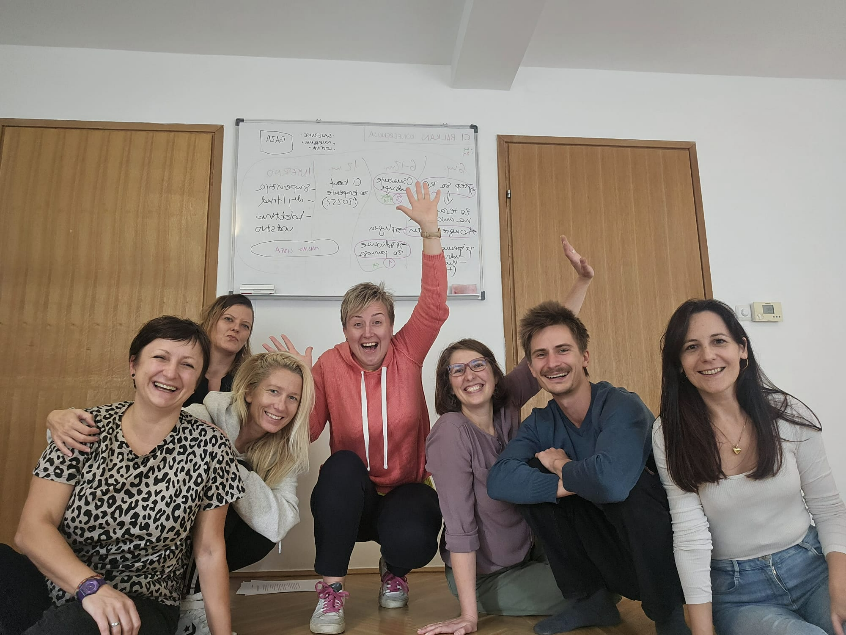
Left to right: Hana Fifić, Ida Todosijević, Ana Kuhanec, Mateja Rajačić, Sara Bursać, Vasyl Ros and Kristina Krajačić (missing: Sara Jager)
Finding Safety in Shared Experience
Others began to share similar experiences. One member reflected, “When I join, I start making jokes—just like we do in Balkan social spaces.” It sparked a collective inquiry: How can we communicate consciously, bringing awareness to our shared patterns?
A member suggested creating group guidelines to help us engage safely and inclusively. As we wrestled with our triggers and our desire to offer a supportive space for others from the Balkans in the CI community, we decided to develop a mission statement and apply to become an official focus group.
We hoped that by formalizing our structure, more CI participants from the Balkans could find us—and that we could, in turn, receive guidance from the wider organization.
Creating Guidelines for Connection
Once our group was approved, we began crafting our guidelines—a process that took several months and much reflection. One of our key principles reads:
“Distinguish between useful humor and playfulness and standard joking or teasing.”
This, along with eleven other guidelines, became the foundation for bringing safety and attunement into our shared space.
We wrote the guidelines in what we affectionately call “our language.” Though Bosnian, Croatian, and Serbian have differences in accent and vocabulary, we understand one another easily. If Macedonian or Slovenian members were to join—whose languages are more distinct—we agreed we would switch to English.
Inquiring Into Collective and Intergenerational Trauma
Beyond creating guidelines, our group began exploring themes deeply woven into our collective experience: the lingering impact of the 1990s wars and the intergenerational trauma that continues to shape the psyche and culture of Balkan people.
Author and therapist Resmaa Menakem calls this phenomenon traumatic retention. In My Grandmother’s Hands, he writes:
“As years and decades pass, reflexive trauma responses can lose context. A person may forget that something happened to them—and then internalize the trauma responses. When this same strategy gets internalized and passed down over generations within a particular group, it can start to look like culture.”
Our monthly meetings have become a compassionate space to notice and inquire into these embodied patterns—to bring curiosity, understanding, and the possibility of integration to wounds carried across generations.
Continuing the Journey
Today, the Balkan CI Focus Group continues to meet monthly, offering a safe and supportive space for practitioners and learners from across the region.If you are a CI Professional Training Participant, Alumn or Practitioner, you can find the Zoom link to our next meeting on the [Compassionate Inquiry Focus Group Calendar shared on the monthly newsletter] or contact Sara Bursać at [email protected] to be added to the WhatsApp group and monthly calendar invite.
In October 2024, I traveled to Croatia and suggested an in-person meet-up. Serendipitously, my visit to Zagreb coincided with a talk by developmental psychologist Gordon Neufeld on the six stages of attachment—part of a Balkan series sponsored by the Novak Djokovic Foundation. Seven of our thirty members attended both a full-day workshop and the Neufeld talk. It became a day of learning, laughter, and deep connection—a reflection of how our community continues to grow and heal together.