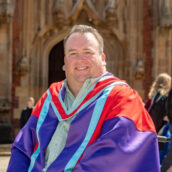
Season 03 – Episode 24: Healing Northern Ireland: From Personal Trauma to Societal Change, with Dr Paul Gallagher
By The Gifts of Trauma /
Listen this episode here:
or here
In this conversation, Kevin introduces us to Dr Paul Gallagher, a lecturer in trauma studies at Cork University who started his formal education at age 40, after a significant “gap” in his life. Born in Belfast in 1972 at the height of “The Troubles,” Paul recounts growing up in a war zone, where at 21, his home was invaded and his family held hostage. During this attack, he was shot and paralysed, and while physical and medical care were provided, psychological support was not.
Paul highlights:
- The crucial roles of community-led initiatives that provide vital support, education, and a path to hope for survivors.
- The inseparable connection between the academic understanding of trauma and practical, compassionate healing approaches such as those offered by the Wave Trauma Center.
The conversation concludes with Paul sharing his vision of a trauma-informed society in his deeply traumatized homeland.
Episode transcript
00:00:01 Kevin
Thank you for tuning in to another episode of the Gifts of Trauma podcast from Compassionate Inquiry. In this episode you’re going to hear a remarkable story of healing from Dr Paul Gallagher. I wanted to take a moment to let you know that Paul’s story may be triggering for some of you. Paul talks about his own violent and traumatizing experience in the midst of a traumatized society. It is a hugely inspirational and somewhat shocking story. Also, Paul and I are both from the north of Ireland and as we get a little deeper into our conversation, some of you may find our accent a little tricky to understand. I don’t wish to apologize for this. In fact, I’m very proud of how we sound. I just wanted to highlight that this may be a challenging listen for some of you on both these levels. I hope you can enjoy listening to this conversation even half as much as I had having it. All of us involved in the podcast consider your time and attention a deep act of generosity on your part. We are very grateful for it. Please enjoy this episode.
Kevin
Do you foresee a trauma informed school system? A trauma informed justice system? A trauma informed policing system? A trauma informed medical system? Do you see that? Or is that just, ‘I’m too busy looking after the people that I look after to worry about that.’ Do you see that happening?
00:01:25 Paul
We’re doing our best to make it happen in the work that we do and not having it just as being a buzzword for these organizations to come along and say we had a three hour session on trauma and now we’re trauma informed. Do you know what I mean? That’s not what it’s about. It’s about a complete learning process. So we’ve done work with the different parts of the police, we’ve done work with police inquiries in terms of investigations into the past, how to be able to understand the people in front of you and the people you’re supposed to be supporting. So teaching civil servants about this stuff and they’re going, yeah, this is great. Why didn’t we know about this years ago? Teachers and others, and you see it from the children, they call them children, who are coming into university. Well, why don’t we know about this type of stuff in school? Why is it hidden from us? Why is it all there’s trauma hidden from us because people are afraid in so many ways. Because it’s about how we tell them about the past, whose narrative is, whose story is. There’s no narratives, no story. It’s just about those who suffered harm and how we found ways to come through out those stories that young children need to hear, will be inspired by and they understand that things are going to happen to you and how you’re going to get through it.
00:02:39 Rosemary
This is the Gifts of Trauma Podcast. Stories of transformation and healing through Compassionate Inquiry.
00:02:57 Kevin
Welcome to another edition of the Gifts of Trauma podcast from Compassionate Inquiry. My name is Kevin Young, and I’m here today with a fellow countryman, someone I am very excited to speak to. His name is Paul Gallagher. His full title, which I notice, Paul, you don’t have in your little zoom thing is Dr. Paul Gallagher. And I want to talk a little bit about that. I want to talk about you being Dr. Paul Gallagher, and I also want to talk a little bit about that you don’t seem to use that anytime I’ve come across you. You don’t have the doctor part in front of your name, but for a little bit of context. I met Paul very recently through beginning a master’s in trauma studies at Cork University in Ireland. Paul is one of the lecturers / teachers on the Masters. And Paul, I just want to give a little story. So on our first night, I was actually in Portugal. I was on holidays. You know, a lot of you were Orla and yourself and Yasmin were introducing themselves, and you came on and you talked a little bit about yourself and you said, I started this process as a user of some trauma help. You started with a little mini piece of trauma education. You went on then to do a bigger piece of trauma education. Then you went on to do a degree in trauma education / trauma studies. Then you went on to do a master’s. And what you said, which really caught my heart, and you said, “Ah, I just decided to stay on and do the doctorate.” Paul, I almost fell in love with you. I just thought, who is this man? I need to talk to him. He’s just like me. And here he is with his doctorate in trauma studies. Paul, that’s my introduction of you, but I would love you to take a moment and in whatever shape or form it comes to you, introduce yourself. Who is Paul Gallagher?
00:05:02 Paul
First of all, thanks, Kevin, for inviting me on to the podcast. It’s an honor to be… be part of this. Who am I? I’m just. I’m Paul Gallagher. Paul. Some call me Dr. Paul. You ask me why I use it or don’t use it, I suppose. it sits at the bottom of my signature on my work email. But as far as that’s as far as it goes. I suppose some would say you should use that title and be proud of it. I mean, I’m proud that I did my doctorate and supposedly you could have there whenever I spoke about. I may as well just go on, and after doing a degree and doing a master’s and just as well, do the doctorate. I suppose looking back that was part of my journey through education over this past, say, 10 years. And look, I’m 53 now, and I suppose my sort of route back to formal education only started back whenever I was around, yeah, 39/40. So we came maybe about 20 years after, maybe we would normally jump from, say, school into third level education. So there was this big gap between that time, and between where I am now. I suppose when you think about life, we all have these big gaps and different things going on in between when maybe life gets in the road. And suppose for me, that was part of my trauma journey about life getting in the road. I suppose that’s what we’re here to talk about now, isn’t is?
00:06:33 Kevin
It is Paul. There’s a couple of things and I’m going to ask you to go into that a wee bit more. There’s a couple of things I’m interested in, Paul. I’m interested in you. I love people, I love chatting to people and getting really curious and finding out their stories. And this podcast, this was the mission statement, is Stories From Trauma to Healing. And I look at you and I’m going to ask some questions just about that. Your journey from trauma to healing, and helping others heal, in the role that you’re in now. And then there’s another thing that I’m really interested in, Paul, and you’re a perfect man to talk about this. And it’s the idea at the moment. Trauma is a big, it’s a big word, isn’t it? There’s this informal path through trauma education, things like Compassionate Inquiry, things like Internal Family Systems, things like Somatic Experiencing. There’s a whole rise in psychedelic work right now. So there’s this left field move into trauma and trauma understanding. And then there’s now catching up, maybe just a little bit later, the academic side of understanding trauma and understanding victimization and understanding how organizations either do or don’t have trauma-informed processes in the organization and the institution. So I’d really like to focus on those three things. But would you be willing, Paul, to tell us a little bit of why you walked up to the door of the WAVE Trauma Center? What is the WAVE Trauma Center?
00:07:58 Paul
Well, we the WAVE Trauma center is a charitable organization that was set up in 1991. And like many organizations that were set up from the ground up, this was set up by a group of women mainly around a kitchen table and having a cup of tea where they had been widowed by the events of what we call here the troubles, but this was a group of women whose husbands had been killed, had been murdered as a result of sectarian attacks in and around Belfast in the late 80s and into the early 90s. And they set this group up to support themselves, because they had been recently widowed. Their support systems were ruptured and shattered. So they basically came together and seeing themselves and recognized themselves as needing that support. And a lot of it was around practical support. The word trauma and all these other things maybe came later on. It was just more around looking after each other. But the group itself then mushroomed over the years, and I’ll talk a little bit more about it later on, but it mushroomed into becoming one of the largest charities receiving government funding as well as charitable funding and donations. And anybody out there listening, we’re always welcome to receive any donations then to keep the organization going. But for me, I arrived up the WAVE in around 2010, right? And this came about, many years after my trauma, my big T trauma that happened to me. But before I speak about that, I want to speak about the place that I was born into. Kevin will know as well, and others will know. I was born in Belfast in 1972, which was statistically the worst year of the troubles in terms of the shootings and bombings and killings, in that year. And I was born in that year. And I then arrived into a part of West Belfast which was really seen as being a military zone in many ways and a war zone in many ways. And that’s where my family brought me into as that’s where they lived alongside so many other people. And I grew up in this environment as a young child, walking around the streets with other boys, with the army coming past us and their tanks or whatever it was in their armored vehicles. And as young boys, as kids, watching the other young boys throwing stones at the army as they drove past and things like that, then, you would have done that. Not religiously every minute of the day, but sometimes you just did it because it was just learned behavior. And that’s what young boys were doing around us. I also then grew up then, where they get a bit more moving out of the area, beside a peace line, as we call it here, which is an interface between two communities. So I’d have been born into the nationalist state of defence, and the other, say, would have been the unionist, protestant, loyalist side of the fence too. But not knowing what any of this thing meant, any of these things meant to me. But I did know that there was danger on the other side of the fence and to be worried, and that was because if you went across the other side of the fence. There was a chance as a boy that you should have been beaten up by others on the other side. And that happened a couple of occasions when he strayed too close to that side. So there’s a sense of fear already being beaten, not just of me knowing this as a young boy and parents saying to be wary and things like that too, not instilling any sense of hatred about the other side, but when you’re afraid of the other side, maybe anger about maybe being chased or beating up and things like that sort of stick to us ,and we become sectarianized by the place that we were born into. This sectarianism goes back centuries and it’s built into us. We live in this sectarian soup. So this is where I was born and grew up in. Obviously you moved beyond throwing stones and you went to school and you get on with life. You grew up into being a teenager. Joy and life, but always knowing there was danger, always known and known around the area that people were being killed. There was bombings going on in the city centre and other places too. It was on the news every day that someone was being killed. But a lot of this to me was background noise. It was just our normal way of living. And I suppose the troubles, in many ways didn’t really come to my front door and to my family’s front door until I got to the age of 21, when literally there was a knock on the front door and I was just home from a day’s work. I was working in the civil service at the time. I was about to sit down with my family to have our dinner and the door went and four men pushed their way past my younger sister who opened the door, she was only 14, 15 at the time, and they were carrying automatic weapons, they had balaclavas on and boiler suits. And they came in and told us to sit down and shut up. And they were taking over the home, our home, and they were on an operation, as they put it. So we sat there, myself and my sister, my younger brother and my mother, and we didn’t know what they were there for, what they were going to do. And we sat and watched TV, 6 o’clock in the evening, where they sat there, one beside us, the other one’s upstairs. And this went on for about, possibly around 20 minutes, just sitting, waiting. And the next minute the door knocked again and I was told, go out. Bring whoever it is in. If you don’t, we’ll shoot your family. So I went out, opened the door and it was my father. And I asked him to come in, brought him into the room. And the next minute he was confronted with the men. He started arguing with them, saying basically, what are you doing in my house, get out of my house type thing. And one of them put a big Magnum revolver to his head and says, if you value your life, you’ll sit down. And he did, and I calmed him down and told him to sit down. And we sat down again. And things were obviously feeling a bit nervous and a bit fractious at this stage. And the next minute the door went again. About 20 minutes later, again. So it was nearly about an hour at the time, maybe about 40 minutes to an hour. And at this stage I opened the door and it was four of my sister’s friends, young girls, about 14. And I said to them, look, she’s away up the streets to another friend, go on around there. And I chased them. And I came back in and it was about an argument, like you were told to bring those in or whoever it was in. And I said, you can’t bring kids in to this situation. So they’re away, they never heard anything, they don’t know anything. And I sat down. And the next minute they went out of the room, closed the door behind. It was just me and my family sitting there. And we’re looking at each other, not saying anything, but thinking, maybe this is over. And the next minute, operations began shooting into the room. Now is closest to the door. So I was about, maybe 3ft away from him and he stood above me and opened up his machine gun into me. And I was hit six times through my right hand side and bullets through my body and some came in through my left hand side of me.
00:15:50 Kevin
Paul, can I pause you a second?
00:15:52 Paul
Yes.
00:15:53 Kevin
I’m just noticing. I’m finding it hard to breathe, man. And I just want to say. Can we just take a moment? I’m really hearing this story. I can feel my eyes widening. And I just want to honor what you’re telling us. I just want to really just take a moment and honor what you’re saying here. This is a… It’s a big story. I really appreciate you sharing it and just noticing that it is big in my system right now. Thank you for sharing it. I really appreciate it.
00:16:28 Paul
Thank you for listening and feeling it.
00:16:31 Kevin
Please continue, Paul, please.
00:16:33 Paul
So obviously in that instance, I was still conscious. I was going in and out of consciousness. I could hear my family asking, hear my mom ask the questions. Is everybody okay? Is everybody okay? And I was laying there listening to them all going to yep we’re okay. And I was laying there going to myself, not out loud, I’m not okay, I’m shot here. And then when they began to realized that I was shot there, the pandemonium happening in the room. I hear my mum on the phone to the paramedics phone, getting ambulance out here. My father and my brother were getting towels and trying to stop the bleeding. Remember my brother shaking me, holding my arm, stay awake, stay alive. Slapped me around the head and things like that just to keep me alive. And it was, yeah, sailing away nearly as the way you put it, that was very warm and far as you can and yeah, basically Dan in front of them. But I kept awake and I kept saying to myself, I’m here, I’m still here. And then the ambulance arrived and the paramedics got me out on the stretcher and must have put me full of adrenaline or something. And I was then on my way down to the hospital on maybe a 10 minute drive down there at this stage I was more conscious. I think I remember saying to the guys, don’t be worrying about me lads, I’m okay. You just work away and do your own thing. All this type of talking and everything else, whatever they put in me, I was singing, I was chanting. I remember this sort of Native American type chant coming out of me. I was doing this chant the whole way down, right through the hospital, right into the operating theater when the last thing I remember said to me was by the surgeon, can somebody shut this man up singing?. And they put the oxygen on me and that was me. And I woke up a couple of days later in intensive care, looking around me going, what happened there? What was that all about? Into myself because I couldn’t speak at this stage. So I woke up with this tube down my throat. I didn’t know where it was, but I remember there was this nurse standing over me and came in and said, look, you’re all right, you’re here, you’re in the Royal Victoria Hospital in the intensive care unit. You’re okay, we’re going to look after you, you’re going to be okay. I just remember that, speaking about compassion, that kindness to me has stuck with me since that day back in 1994. And I just remember that nurse, this guy here, I think he was only a bit older than me, just being an angel, do you know what I mean? And he was there through those days afterwards. He was there with cold towels tamping in the head and calming me down. And I couldn’t, as I say, I couldn’t speak. But I motioned for a pen. In the first instance, somebody brought a pen, a bit of paper, and they wrote down Don’t Worry, Be Happy, the old Bobby McFern song. And then below that I wrote Ja Lives, the Bob Marley song as well. So my inner sort of Rasta was coming out as well. And I think I conked out for another day. And then after that, then it was a matter of trying to communicate with a sheet of paper with the Alphabet printed on and just pointing out words and writing down things. Because I had this tube in for about 10 days until it came out. And I was able to breathe on my own again. I’d lost my lung. I lost my spleen. My femur was shattered. My spine was hit too. So that left me paralyzed. Suppose it was after about three or four days when the surgeons come around and explain to me that I was paralyzed because I hadn’t realized. You know, I was moving my arms and things like that and realized that my legs weren’t moving. I hadn’t even thought about it until they told me. And then that realization of yeah, and not being able to speak to anyone about it because it was still during the incubation stage. I was just remember crying, do you know what I mean? Because visitors were only allowed in for a few moments of it there. And it was a lot of the time spent on your own. And that moment, remember really being upset and going, that’s my life ruined. You know, when I was 21, I was fit before all this. And then, what’s life going to be like with paralysis and a wheelchair and all these different thoughts, fears going through my head as well.
00:21:22 Kevin
Just want to give that a minute as well Paul. How are you, Paul, in this moment telling that story?
00:21:33 Paul
Kevin, I’m okay telling that story because, look, I’ve told it before. I’ve told it a few times over the years since I started telling that story. But it took a long time to tell that story and to get to that stage where I could put that into words and put that into words, not just voicing these words, putting it down on paper as well. And that’s something I did I’d say whenever I came to WAVE later on. And that whole journey about trying to put this story into words, I suppose over the years too, after this, I had tried in the years, in the early years after this incident, I had tried to write about it. I got a paragraph done. I didn’t know. I didn’t know why I wanted to write it. I knew maybe just for me, I never spoke to anybody, else should I write about this? I remember finding an old floppy disk, one of those square floppy disks one time and open it up and there was about four or five lines on it. That was about as far as I got over the years. And it was like, well, who are you writing this for? What are you writing it for? What’s the point? It was only later on when I say, when he came to WAVE and I came involved in what was known as the WAVE injured group. And they had a book that they had compiled a couple of years before I had arrived. It was called Injured on that Day. And this was a compilation of stories that were written down by the members of this group about what had happened to them on that day. And I was asked then for the second edition, do you want to put your story in? And I says, of course, that sounds great. And he says, give me a thousand words. I says, I’ll give you a thousand words. So I went away and sat down in front of the front of my PC and started typing away. And I remember the gut turning over. Do you know what I mean? It was those emotions of doing this and going back and writing down in words just when I conveyed to you there now. And it was hard, it was hard to do, but I got it down to a thousand words. We ended up, it was 999 because I had to take fuck out of it and it wouldn’t let me wait. I was pretty meticulous in that. But I was able to then print it out and I was able to then leave it sitting on the kitchen table where my family could see it and could read it. And suppose that was maybe one of the first times that we hadspoken about the actual incident itself, because remember, this happened to me and I was whisked off to the hospital. I didn’t come home for about five or six months. By the time I recovered from the ICU, then onto the ordinary wards, recovered from the injuries, and then over to Musgrave Park Hospital, which is their rehabilitation center for these type of injuries. My family were there and witnessed what had happened to me. They had tried to keep me alive. The horror of what they had seen and were living through. Having to take away the couch that I was sitting on at the time and dispose of that with the blood on it, the holes in the couch and the other holes in the walls that were spread around the walls too, beyond me. And I suppose then they were coming down to me every day and visiting me with a smile on their faces and keeping me happy, making sure I’m okay. Whereas I suppose nobody was really asking them, are they okay too? Or I was never really thinking about how they were. It was all about me. People come down looking after me. The nurses, the doctors and all the other support systems around you, keeping me right, making sure I was okay. But there was no real supports really in Northern Ireland for all of us… it was really after that, once you’re out of hospital, you get some support around medical needs and physical needs and things like that. But there was never really any offer of support around psychological needs and things like that too. Maybe people just assumed you could get on with it and if you had any issues, you were physically medicalized, you were put onto antidepressants and things like that. And alcohol. Yeah, yeah, it was one way of coping. I enjoyed my alcohol maybe to excess in those days. And other substances too. That got me through as well. Sure. Yeah.
00:26:10 Kevin
I spoke to one of my other colleagues, guy called Stephen Brown. And we were just trying to paint a picture of how I was born 74, lived in Leonadun and then lived in Twinbrook and have a fair understanding of what you’re talking about and trying to paint a picture for people – when we talk about trauma and trauma support – and here where we live. I firmly believe that our whole society is traumatized. When you think about people like you, what happened to you. And then you just mentioned your family. In our module in the trauma studies, look, learning about secondary victimization. And yeah, your family didn’t get shot, but they were in the room where their son and their brother was shot. I’m assuming that’s not an easy thing to experience, watching somebody getting shot in your own living room and really highlighting the lack of support and probably an argument Paul, apart from the work that we were doing and a couple of others, we still really don’t have trauma awareness built into our legislation and our pathway to healing. I’m still not sure that’s fully there. Paul, tell me then, you said a little bit about that this thing has happened to you, and then you land into the WAVE trauma center, and somebody says, you give me a thousand words and you’re writing an essay there. Tell me about that next trajectory then from a thousand words to be included in a book on that day, to Dr. Paul Gallagher. That’s quite a journey as well. Tell me a little bit about that.
00:27:39 Paul
Okay, okay. Suppose when I was coming to WAVE was in around 2010, and what brought me to WAVE in the first instance wasn’t for support in terms of maybe asking for counseling or other therapies and things like that. Because I hadn’t. I hadn’t really thought that I needed that support. I was just getting on with life and everything else. And I suppose as I came to WAVE to get involved in victims issues with a small ‘p’ because I had seen how victims issues had become very politicized here in Northern Ireland. I seen how I was really politicized on television and in the papers and arguments around who’s a victim and who deserves to be a victim and who’s undeserved and who should be excluded and things like that. And I thought those arguments were really negative. And I’d seen people from WAVE on TV and I thought that their approach was very positive. And I thought maybe I’d like to get involved in what they’re doing. I didn’t know what they were doing, but I just wanted to be part of something. This was so many years after, 15 years after the incident. And I had nieces and nephews were coming through and growing up and they’ve been asking me questions like, why are you in the wheelchair? Things like that. And I would have said look, sore legs or sore back and things like that. I didn’t want to explain to them what had happened, especially at that young age. But they were getting older. Often they would have started sussing things out and finding things out about what had happened. I didn’t want them coming through with any sort of animosity for what had happened to me or having any anger issues around what happened to me by the people who did this. Yeah. Having any hatred of things. So I got involved in cross community work because I suppose in terms of explaining who did this to me because these were people from the other side of the peace line. These were loyalists and paramilitaries from the UFF or uda, whatever organization they were from. I suppose when I found out later on what their intention was in that operation, as they called it, was to take over our home to use it as a vantage point to attack my next door neighbor. And whenever my next door neighbor didn’t arrive, they just decided to shoot me instead because I was an easy target. And suppose they weren’t leaving without shooting somebody. But I didn’t want then my nieces and nephews coming up. And so I got involved in cross community work as I said and I wanted to show a different way to them how we tackle these issues as victims. We try to humanize ourselves and humanize the other as well. So I got involved in the local Interface Group working with people from the other side of the fence as well. So that part was happening within me and it was becoming maybe radicalized in that sense to be involved in community work. And WAVE then was the sort of next logical step. So I reached out to a man called Alan McBride. His wife and father in law had been killed with an IRA bomb about two months before my injury. And he says, look come along to WAVE and we have this injured group here and come along, see what, what’s happening. So that was my first entry in WAVE. And once I was in there, then it opens up a range of services that’s available. So you have the injured group, but there was also services like massage therapy and other physical therapies that I just thought were great for me, for relaxing me. And then the entry into the trauma education side of things and doing those sort of short courses in trauma. And that for me was this light bulb moment. For me, this turning on was something that I hadn’t known before. And it was that I was traumatized. I would have needed to know what trauma was. I didn’t know. But to do a short course and to come across what was happening in my brain and in my body that week and the slides on the PowerPoint and just to see me, that’s me, that’s what’s happened to me. And with my reactions over the years, how I cope over the years, or not cope, all these different things came rushing forward. I could feel hairs on the back of my neck standing up. I could feel my gut wrenching again as I was sitting in the class doing this with other people. And I didn’t even realize what was happening to me at that time. So I needed to know more. So I did more courses. I was able to sign up for an undergraduate degree in trauma studies. And again within those settings, not just doing it in a university setting, but doing it with other people who some had experienced trauma and some of you were working in frontline services. We were learning together and learning off each other and feeling safe and feeling trusted of learning this material. And for me that was more important than the textbooks or what was on the PowerPoint slides too. So that just then created this chance for me of learning with each other. And again then that was at queens. So I decided to stay on and do the Masters and Conflict Transformation and Social justice where trauma is so interlinked, trauma is about social justice. Do you know what I mean? Once we learn that it’s not just something that’s going on Inside us, it’s about how we behave in society, how we believe, how we’re validated, how we’re listened to, and how we can then not just be seen as these poor victims, but how we can contribute to society as well. And helping people to understand that around mental health issues. So humanizing people who have been impacted by trauma and then staying on. And again, as I said earlier and going through, may as well do a doctorate and doing that for the next four years, too. As soon as I’d finished them, I was able to say, at this stage, you may as well get a real job. Now you’ve done the hat trick of all the degrees. You had to get a real job. Instead of messing about in school, there was a job came up in WAVE as a trauma education officer, and I applied, and I got the role. So that has me then teaching on the degree in trauma studies and here teaching on the master’s in trauma studies at University College. Cork is where I met you
00:33:44 Kevin
Again, Paul. I don’t want to sound sickeningly complimentary, but I really just want to honor the process of what you’ve just talked about. That’s that second phase from the incident to today, because we know it could have been very easy for you to go the other way. It could have been very easy for you to be drinking wine out of a paper bag at, you know, the corner of some street in the city center, or worse. Could have been. It could have been easy for you to take your own life or whatever that might be. And had you done that, people probably would have said, ah, poor lad, not surprised he’d done that. It would have been completely understandable that you’d done that, but you didn’t. It’s just really making my heart sing to hear someone move through that, what you went through, and then be turning around and looking at other people coming along behind you and beside you and them out and offering them a hand. And it’s a real lesson that for anyone listening, you know, that healing is possible. And listen, I also don’t want to say, hey, I’m sure your life’s really easy and great, and I don’t want to imply that at all, but healing is possible. To move from that trauma to healing, and to hear your story is for myself, Paul, it’s inspirational. And again, I don’t want to be blowing smoke up your bum, but it is. That’s my truth, sitting here to hear you talk like that, it is really inspirational, and it gives me hope. For the place that we’re from.
00:35:19 Paul
Can I take you back just a few sentences there when you’re speaking there about it could have went another way, and it was close. It could have easily went another way. Do you know what I mean? At a stage before I was able to go on this second phase, you could say I was pretty low and there was suicidal ideations or things like that and talking to people looking at me, well, what’s he talking about here? You know what I mean? And worried about me. But there was then that change and I did have that. And how I got through those 15 years and through till now is around that good family support and how we cope and a good group of friends that kept me going even through those tough days of drugs and alcohol and everything else. Yeah, it could have. But it didn’t. And this notion of hope is something that I live by these days and actually being able to see a way out beyond that was great. And how we’re speaking about how things began to fall into place in terms of taking on these different roles as a student, but also taking on different roles inside WAVE as being part of another collective. So the injured group I spoke about this didn’t just meet and sit and chat. That group at that time was becoming politicized in terms of fighting for justice, social justice, in terms of reparations, in terms of bringing in financial support for people who had been basically left on the economic scrap heap, who had been left in so many ways. I’m coming here for somebody who was injured 94 there’s people who had been injured before I was born with severe life changing injuries in terms of bomb attacks, things like that too. And I met those guys in there who were years older than me, had their legs ripped off, they call it amputation, ripped off in bombs, who had been paralyzed in gun attacks like me, who had been blinded, who experienced deafness, who had experienced severe psychological damage. And we were in this group, as I say, we were\ campaigning, we wanted additional support, terms of reparations, we wanted a pension. So many of us, a lot of these guys were coming to pension age. They hadn’t worked in years. They were on benefits, on welfare for most of their lives because of their injuries. They didn’t get the access back to work. Disability discrimination laws didn’t exist until the 90s. So there was a grievance there in so many ways. And then it was this collective identity that we could come together because in so many ways before we met, we were stuck in our own homes with our own issues. But we came together and especially under the roof of WAVE, not just being the roof of WAVE, metaphorically, physically, and having that support of people in there to go, we could be able to help you and support you if you want to come together to do this. And then for them, people in WAVEs who had access to politicians or policymakers to give us that access to be able to speak to them, to design our own policies around what it would look like for us, we took ourselves out, collected a petition, 10,000 signatures across northern Ireland and brought it to Stormount, to our parliament here, and said to our politicians. Here’s the demand we brought in the framework for what reparations would look like, what a special pension would look like. This was back in 2012, and after a few years of campaigning, we brought up to Stormount and they said, yeah, it sounds like a great idea, there’s something we could do for the injured. And we thought up then, in years of politicking around this notion of who’s a victim and who deserves it and who doesn’t, whether this goes to good victims, bad victims, all that type of thing. So for us, that was part of even healing, for us too, coming together in that collective and creating this sort of new identity for ourselves, not just as victims, but as campaigners, as survivors, as people who could speak to the media, who could speak in front of Parliament, who could speak to anybody that was listening to say support us. It took years, but we ended up, we were successful and got this over the line.
00:39:21 Kevin
Paul, as I listen to you talk, there’s words that we use in Compassionate Inquiry. We use it in relation to therapy, but in relation to the antidote to trauma. And they’re words like connection, they’re words like compassion, empathetic abiding presence, attunement, listening to being seen, being heard. And it seems that a huge part of your journey, your healing, has been around accessing those sorts of things under the roof of WAVE, of being listened to, being seen, being heard, seeing yourself on a PowerPoint, seeing that’s what’s going on in my brain. Somebody understands, somebody seeing me is really powerful. Maybe what I want to do here is just offer. I’m always conscious of the people that are listening and that. And anyone that’s listening to Paul talk, and feels that they are despairing and hopeless. Reach out, reach out to somewhere in your own community. Certainly if you’re from here, reach out to WAVE. Reach out. No matter what state you’re in and what your situation is, there are people like Paul all around the world that are wanting to help. Paul, I’m just blown away by the story. Let me ask this question while I’ve got you. I don’t know when I’ll get to you again, but I’d love to pick your brain a little bit around… this sounds like a university question. Compare and contrast. Discuss the difference between, from your point of view, the idea of academic trauma understanding or teaching and the grounded healing that happens in WAVE. Compare and contrast those two things. Where do you see the similarities? Where do you see the difference between academic trauma work and massage and connection and friendship and that sort of thing that happens in WAVE?
00:41:06 Paul
It’s all connected. They’re completely connected. Because the trauma education piece that happened in WAVE, that is now part of WAVE and all the different degrees and all the other organizational work that we do, bringing people together in a room and learn about this stuff from the PowerPoint or wherever way it’s conveyed, it’s all connected. It all came out of need, right? So within WAVE 30 years ago, whenever it was first started off and became a charity itself, rather than just people sitting around and bringing in others, there’s a sense that understanding the words like trauma and all what they meant, you needed to know a little bit more about it. You needed to have the academic theories to be able to build on that. Because first of all, it was for the workers themselves, who became head workers, looking after their needs and making sure they weren’t retraumatizing people or causing any more harm. You didn’t want to do harm, so you had to know about what trauma is in first instance. You had to know about what vicarious trauma is. So these academic courses and other courses developed from the ground up because there was a need for staff and all. But then it became a need then for a realization that clients needed to know about this, though. So these were very basic courses that then developed into diplomas, let’s say, degrees and other things like that. So they have developed over the years through need and then all the other needs that we recognize within WAVE, around somatic healing, around talking therapies, around peer support and social support, all these things are based in the academic grounding as well. So one complements the other and has done over the years as we have medical students coming in and looking through our individual needs assessments, our assessments that people get when they come into WAVE asking them about their physical needs, their psychological needs, and all this is all taken in and asked of our clients as they come in. And medical students sift through these, and then they begin to see patterns in terms of hypertension and heart disease and all the different physical aspects that happen in our bodies. So then that feeds into services. We need more services in terms of this, that and the other to deal with all the whole body, all the different connections in terms of social support. It’s all based on the academia and on the practical lived experience too. So you can’t separate one or the other. And then me and others being part of teaching this to master’s level, to undergrad level, that can be clients, going through and doing these courses like myself. But also then you’re teaching a whole generation of people who are working in different fields. Like even our counseling degrees here and other degrees don’t deal with trauma per se. It’s a complete gap that I just still can’t get my head around. It isn’t in the curriculum, but we have got, as part of another branch of our trauma education, we have what’s known as citizen education where people like myself and others come in to. And this is part of the university curriculum in terms of social work, in terms of nursing and medicine and other professionals as well. When we meet first year students, face to face, and we come in and we are their case studies and they listen to us and they ask questions of us and look, I bumped into a nurse yesterday. I was in the hospital yesterday for a procedure. I bumped in the nurse that was there. They come through this process and she was saying like you could hear a pin drop in the room when you guys were coming in and explaining it. And I suppose when they first hear you’ve got these trouble victims coming in and they’re looking at each other, what the hell does the troubles have to do with us? That’s in the past, that’s years ago. Well, when we sit down they listen and go, okay, these are the people we’re going to be treating. These are the generations of people who’ve been impacted, but also their families and the people yet to be born will be impacted by what happened decades and decades ago as well. So that understand that they’re getting students in 18, 19 to 20 and older ones who are doing some of these courses that we teach on. They’re getting so much from, hopefully getting so much from us on the citizen education side, but also from the academic setting as well. So the question you’ve asked, compare and contrast, there’s completely melded together.
00:45:34 Kevin
That’s a beautiful answer. We’re taking a brief pause to share what’s on offer in the Compassionate inquiry community. Stay with us. We’ll be right back.
00:45:47 Rosemary
If you’ve been listening to our podcast and are curious about the Compassionate Inquiry approach developed by Dr. Gabor Mate and Sat Dharam Kaur, consider joining the professional training program. It’s open to all healing professionals, including naturopaths, physicians, body workers, coaches and therapists. In addition to learning how to use compassion to support your clients in their most vulnerable moments with greater empathy and authenticity, you’ll also deepen your own internal process. If you’re interested, tap this link to access more information.
00:46:22 Kevin:
I think the reason I asked it, Paul, is a few years ago I went to start a counseling degree and I went to the first night and I was already working within Compassionate Inquiry. inquiry at this time. And I went to start a standard counseling degree and on the first night and they gave us the syllabus and the curriculum and the reading list and stuff. And I just looked through it and thought, this is not for me, this is completely academic. There’s no understanding of trauma. There’s no understanding of how that spreads through families and communities. And then the first night I walked out and I thought that this is not what I want to be learning. So to find a place in a space where we’re talking like this, that my master’s or a degree in trauma studies is rooted in real life stories and what happens in real life examples is really wonderful. So I’m really happy to hear that. Paul, what about a vision for how we treat trauma here in Northern Ireland, the north of Ireland, whatever we want to call it, what’s your vision for that?
00:47:22 Paul
Even the word treat, you know what I mean? It’s. It’s coming from maybe the medical model and stuff as well, isn’t it? It’s how we heal, how do we heal and how do we. You said earlier, how do we get people, hope that there’s recovery. And you do that by example, leading by example and seeing how others can do it too. So I, when I came in the way that I’m seeing how others were helping, we’re empowering people, we’re nudging me in the areas that maybe I haven’t thought about before. This sense of choices here, you can be empowered by all these different choices and examples. First off, you come in the place, you begin to feel safe within it. You begin to build up trust again when you see that happening. And again, this all just follows the trauma informed principles that are out there. But basically those principles are very much common sense, a common sense grounded way of helping people to heal, to maybe start on new journeys as well. And that’s what I’ve been on. I’ve been on this journey and things have been falling into place for me over the years. Whereas before I just didn’t see how the doors could open. I didn’t know why would I want to write this story about me? What’s my story about? So you see locked doors, whereas now you can see all different doors opening up. So I see people looking at me and you say you feel really inspired by what I’ve told you and things like that. And I think that’s real. And I’ve been inspired by other people. I’ve seen other people coming into WAVE, they’ve been inspired by my story and they’re following maybe my footsteps and doing something similar too. And I’m loving that I’m part of that community and others are doing the same thing and they’re supporting each other. For me, that’s being inspirational is great because I’m not getting a big head about it because we’re all very modest here in Northern Ireland and stuff. Yeah. But if you have a lot to be supposed to say is I have a lot to be modest about. I have done well and I should call myself Dr. Gallagher all the time and things like that too. And other people do it and go, how did you do it? How did you get to where you are? I just said I just had people support me and I was able to take those opportunities. I was able to understand what post traumatic growth is. You know what I mean by doing this course, being able to see that as a concept one, day open a PowerPoint and see the inventory of post traumatic growth and pick the boxes on and get 55555 the whole way down. I’m experiencing post traumatic growth. And then there are other times you could be doing another survey and you go, I’m experiencing post traumatic stress disorder as well, and understand that you experience them both at the same time. And I’ve been up and down over the years just because at the moment I’m on a high and things are going well. I’ve experienced even along this journey times when it’s been tough too and say out of the hospital appointment yesterday. I’ve got three hospital appointments next week. I’m known as what’s a frequently flyer in hospitals. But you just have to take it in your stride and keep going until the body gives up. But if you keep the mind going as well and seeing. So you’re asking about a vision. So my vision is for as many people to experience a similar journey to me. And we’re I’ve been on and they mightn’t get there in the same way as me because none of us are on the same path. But just to know that there’s hope and to see that, yeah, maybe I can do this. Maybe I can come out of my home. Maybe I can come into your place and start doing these, maybe short courses, start sitting with other people, start opening up. And I see that happening here every single day with all the different activities that we have going. Like this day last week we had Halloween Fayre, where all the class people were making pickles and fudge and buns and things and coming in and selling those and making money for WAVE. A week before that we had people in here, digging up the garden, and planting bulbs, tulip bulbs, all sorts of bulbs, thousands of them. Knowing that in a few months time this place will be blooming with color. And those things that we come together are powerful. So that’s what the me I see in WAVE, but also in community as well. And just giving people that opportunity to come along and be part of something. What we say here, what’s on our mugs, is, be part of our trauma informed movement. And coming through trauma, it’s a social movement. What we need to be able to do is together we need to create those safe spaces. And you can’t do it alone, you can only do it with other people, as Herman and others will say. And yeah, that’s where I’m at.
00:52:02 Kevin
Thank you, Paul. And Paul, what about our… Do you foresee trauma informed school system, A trauma informed justice system, A trauma informed policing system, A trauma informed medical system? Do you see that? Or is that, is that just. I’m too busy looking after the people that I look after to worry about that. Do you see that happening?
00:52:20 Paul
We’re doing our best to make it happen in the work that we do and not having it just as being a buzzword for these organizations to come along and say, yeah, we had a three hour session on trauma and now we’re trauma informed. Do you know what I mean? That’s not what it’s about. It’s about a complete learning process. So we’ve done work with the different parts of the police, we’ve done work with inquiries into maybe the Omagh bomb and we’ve done it with other police inquiries in terms of investigations into the past. We’ve done it with people with behind the scenes in government as well, who are dealing with those who come through the mother and baby homes, the Magdaline laundries and things like that. How to be able to understand the people in front of you and the people you’re supposed to be supporting. So teaching civil servants about this stuff and they’re going, yeah, this is great. Why didn’t we know about this years ago? Teachers and others. And you see it from the children, they call them children, the 18 year olds who are coming into the universities. Well, why don’t we know about this type of stuff in school? Why is it hidden from us? Why is all this trauma hidden from us? Because people are afraid in so many ways to bring it into the schools. Because it’s about how are we talking about the past, whose narrative is, whose story is. There’s a way to. It’s no scenarios, no story. It’s just about those who suffered harm and how we found ways to come through it and told those stories that young children need to hear and be inspired by. And they understand that things are going to happen to you, but how you’re going to get through it. Things might not always happen in the same way as it did during that 30 years of mayhem. And we call the troubles understanding that these things of mayhem happened 100 years ago, 130 years ago when we had held over a couple of years when maybe there was four or five hundred people killed in those periods. And it can happen again. People want to go down that route. It can easily happen again. Violence can flare up at any time anywhere in the world and violence leaves its mark. So it’s not just about dealing with the aftermath of it, which kind of way is of course never again and meaning never again too. So helping people understand that when they’re angry, when they’ve been harmed, when they’re in fear, that their reaction in many ways of fighting or fleeing or whatever else is natural trauma responses and how to help us to regulate as human beings, but also to regulate as communities and societies as well. The people are trauma informed for them, they can go. Whenever the heat’s rising, they can go, okay, we don’t have to respond in the same way as we did years ago.
00:54:58 Kevin
Thank you, Paul. I really hear you say that healing the past or healing the present through looking at the past is setting us up for a better future. And I really like that idea as well.
00:55:09 Paul
And to bring it back is to do it with compassion. When you look around and see politicians shout and scream at each other, they’re all part of this traumatized society too in many ways. And sometimes they’re completely. It seems as though they don’t realize it themselves. And if they did, maybe they’d be more compassionate to others and two. But we live in hope. That’s all we can do and just keep chipping away. All the sectarianism that was then built into us years ago was engraved in us and was going on for centuries. And it might take a little bit longer to change it the other way, but you have to start somewhere. And that’s what I’m doing. I’m trying to desectarianize myself and try to get away from all that, to be honest with ourselves and look at myself and go that I’m a recovering sectarian biggot and to be honest about that. And they go, okay. And some of the things that you jump straight to are because of the things that happened to you and how you were brought up. So we can all start doing that and nearly forgiving ourselves for how we felt and the things that we said. And we can maybe start forgiving others too.
00:56:18 Kevin
Thank you Paul. You reminded me of a book by a guy called Resma Manaken. And the book’s called My Grandmother’s Hands. Are you familiar with that book? And he talks about police body, white body, and black body in America, and for me here could be very easily replaced with green body, orange body, and police body. But one of his core pillars of his message is that we need to heal ourselves before we can start interacting or looking at anyone else or at least do the work of healing ourselves alongside healing across borders and boundaries as well. And I really like that idea because to sit with someone in a room when you aren’t yet aware of your own trauma is probably a recipe for disaster. So thank you for sharing that, Paul. I’m conscious over time quite often ask a question at the end of the podcast when I’m speaking to people. And what I ask from people that I chat to is to answer this question, if you had the ear of humanity listening to you and you could whisper or shout something into the ear of humanity, what would you say?
00:57:26 Paul
I suppose I’ll take it right back to that instance when I woke up in intensive care and reached for a bit of paper and I wrote, don’t worry, be happy. Simple as that. Simple as that. Do you know what I mean? Don’t be stressing yourself out too much and try and be happy. Yeah, that’ll do.
00:57:47 Kevin
We could even segue into a little song there, couldn’t we? You can sing. I’ll watch. Paul. Dr. Paul Gallagher, I want to say a deep and heartfelt thank you for coming on to the Gifts of Trauma podcast from Compassionate Inquiry and telling us your story. I really would hope, and I’m going to work towards a vision where Compassionate Inquiry as an organization can get a lot closer to WAVE and I mean in a helping facility and WAVE to Compassionate Inquiry. and also Compassionate Inquiry. to the trauma studies in Cork. I would really love to start building some bridges there and seeing how that might grow and flourish. Dr. Paul Gallagher, thank you for coming on the Gifts of Trauma podcast from Compassionate Inquiry.
00:58:40 Paul
Thank you, Kevin.