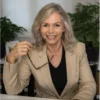

Rennet, a Trauma Therapist, Registered Clinical Social Worker and Psychotherapist, Somatic Experiencing® Practitioner, and Organizational Consultant, has supported individuals, families, groups, and frontline organizations for more than 20 years as they navigate complex trauma, relational wounds, grief, burnout, emotional/binge eating, and nervous-system dysregulation.
Efu is a Somatic Experiencing® faculty member and a Professor of Family Constellation System Therapy. For the past three decades, she has facilitated trauma healing therapy and training. Efu also co-founded AFYA, a Holistic Healing Center in Brazil that provides holistic healing methodologies to local community members and international clients.In this excerpt, these therapists explore what makes a wounded human become a wounded healer and why it is all about relating to their wounds. Hear the full conversation on The Gifts of Trauma Podcast.

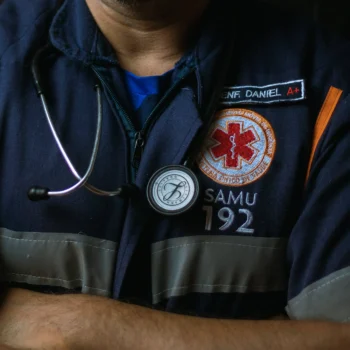
In Episode 1, Solea Anani told us the wound has its own consciousness. In Episode 2, three medical practitioners showed us what that looks like in a body, in a career, and in a life. In Episode 3, two therapists venture into the relational territory where most wounds occur and where most healing happens.
RENNET: My intention is to share that my wounds didn’t make me a healer, but my relationship to my wounds did. The wounds that I suffered along the way didn’t disqualify me from the healing work but made me attend to it with more humility, reflection, and care. And that place, I think, is where compassion flows for the people that I sit with.
Most healers are never taught that it’s how they relate to the wound that matters. Instead, they’re lauded for being strong, for being resilient, for pushing through. Both guests in this episode know exactly what that costs.
RENNET: I remember when someone told me, “You’re so brave.” And I said to them, “No, I’m done with being brave.”
I’m expected to be brave, I’m expected to be resilient, and I don’t want to be seen like that. I don’t want to have to be so brave and resilient all the time. When I don’t feel it, I have to acknowledge the pain. I have to acknowledge what’s happening in my body and that the wound often has history with it… It has language and it needs things from me.
Efu Nyaki knows that exhaustion intimately. Born in Tanzania and raised as a natural healer and a Christian, she spent years carrying her ancestral traditions into institutions (religious, academic and medical) that had no categories for what she brought. She fought to belong, insisting on having her place. One day she arrived at a moment familiar to almost every healer: the fighting itself became the wound.
EFU: I remember coming to a moment and realizing… all that fighting, it’s not healthy for me. And yet it’s amazing: I’m not saying I have to leave, but I cannot stay here. That’s the mystery of this oneness and connection. I keep emphasizing that I belong here. I belong here! I had to be a little bit stubborn. And that was so beautiful because it led me to Brazil, where I learned somatic experiencing, where I was able to be present in my body, and where I learned how to discern when I’m fighting too much so I can go back in to take care of myself.
In Episode 1, Solea told us that the wound will not speak until it is met with sincerity rather than resistance. What Rennet and Efu are describing, from opposite sides of the globe, through entirely different wounds, is this same moment of sincerity. The moment they stopped fighting, stopped “being strong,” and stopped asking the wound to be anything other than what it was. In that pause, in that stillness, something shifted. Not the wound itself, but their relationship to it, which Rennet told us at the beginning of this conversation, is the whole point.
RENNET: When I sit in front of someone, I sit in front of 4,000 of their ancestors. There are so many people that I sit in front of, and the losses, the pain, the history… Those experiences, knowing that it wasn’t only myself and my ancestors that I was sitting with, made me really compassionate and also very centred. Things that didn’t start with that person have come through them. And so for me, that made my heart a bigger piece of compassion.
Efu comes into the same place through a different door. While Rennet sees 4,000 ancestors gathered with the person in front of her, Efu listens with her heart, her body, and her whole being and waits for the ancestors on both sides of the room to find each other. Their methods are different, but their understanding is identical.
Presence is not a technique you learn in a training program. It’s what becomes available when you’ve stopped pretending the wound isn’t there.
EFU: Listening with the heart, listening with the whole body, listening to the other person in front of us with reverence. When I look at the person in front of me, I always see that they have their own ancestors behind them and I have my own ancestors behind me. So we all have the same dignity. And therefore, I’m not going to fix you. I’m sitting here with you so that you can learn something from me as I learn something from you. But I’m holding space. And then, with curiosity, maybe even as I look at your ancestors, I’m able to ask the right questions that will help unite our ancestors and create a bigger space of expansion where both of us are healed in that space.
Rennet closed the conversation with a poem she wrote for this moment.
RENNET:
I do not come untouched.
I come with places in me that have known silence, loss, and the ache of becoming.
But I have learned not to hand my wounds to another person and call it healing.
I have learned to sit beside pain without rushing it.
To listen for the wisdom beneath the survival.
To honour the body that carried what words could not.
The wound is not the gift.
The tending is.
The compassion is.
The humility is.
And perhaps this is healing: not arriving whole, but arriving honest.
Soft enough to feel, steady enough to stay, and human enough to say,
“I know something of pain, and I will not leave you alone with yours.”
The Gifts of Trauma is a weekly podcast that features personal stories of trauma, transformation, healing, and the gifts revealed on the path to authenticity. Listen to the full conversation, and if you like it, please subscribe, rate, review, and share.
The Gifts of Trauma is a weekly podcast that features personal stories of trauma, transformation, healing, and the gifts revealed on the path to authenticity. Listen to the full conversation, and if you like it, please subscribe, rate, review, and share.