
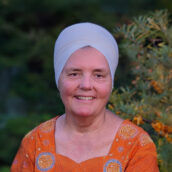
Season 03 – Episode 34: Sat Dharam Kaur, ND, on ‘Bridging the Gap’
By The Gifts of Trauma /
Listen this episode here:
or here
What if the chaos we’re witnessing is humanity’s collective trauma playing out on a global scale? Sat Dharam Kaur invites us to “mind the gap”—the space between our tumultuous present and unknown future—by mindfully pausing our reactivity and leaning into collective wisdom.
Our guest and hosts reflect on:
- How powerful peoples’ unhealed childhood wounds have and are impacting entire populations and ecosystems
- The potential for men to heal their trauma, with healed ‘wise’ feminine support
- How providing healing support from preconception through early childhood could end ‘inherited’ trauma
- Shifting towards a “culture of care” inspired by communities in nature
Sat Dharam concludes by inviting us toL “Step up. Go inside and feel…discern… What’s my role, my passion, my destiny? What can I do? How can I be of service? it’s [already] in our hearts. Then follow the thread, let it unfold. We’re all unfolding together, it’s this synergy between us that’s creating this profound shift.”
Episode transcript
00:00:00 Sat Dharam
It’s time to step up. And that may look a little different for everybody to go out into the world in our local regions or even more internationally, and be ambassadors, be a person speaking about the principles of Compassionate Inquiry, so that we have a wider, not necessarily audience, so that we create more waves of this alternative way of being in the world. It’s not about any one of us owning that space. It’s about all of us stepping into that space to be part of this, bridging the gap. It’s time to step up, to have the inner authority, to claim that inner authority and connect with that truth that’s in us, but also because we have the support of one another. I couldn’t do this alone. You couldn’t do this alone. None of us could do this alone. It’s time to step up because there are enough of us now. I think there’s a synergistic empowerment, really. And we know this is what we’ve created, something so beautiful. We know we can lean on one another. We know we can tap into each other, and that gives us a certain kind of confidence and strength and trust, safety. So it’s really about feeling into, I think, on an intuitive level, what’s the next step for each of us, and then working together, sharing, and ideally, being this force in the world that’s a healing force to move humanity towards peace, love, healing. It’s time to step up responsibility, sustainability.
00:01:23 Kevin
I’ll stand beside you doing that. I will stand beside you because of the feeling, because it feels right.
00:01:32 Rosemary
This is the Gifts of Trauma Podcast. Stories of transformation and healing through Compassionate Inquiry.
00:01:50 Kevin
So welcome to a special edition of the Gifts of Trauma podcast from Compassionate Inquiry. I’m joined today by my partners in trouble, J’aime and Rosemary, and we have the pleasure of having with us, Sat Dharam Kaur, Queen Bee. Sat Dharam has just said, let’s have an exploratory discussion, and maybe we can focus our exploratory discussion on bridging the gap between where we perceive or see or feel that the world is right now and what’s next. What’s next? Sat Dharam, maybe just as we start, on behalf of J’aime and Rosemary and I, welcome. It is absolutely wonderful to have you back.
00:02:36 Sat Dharam
Thank you, Kevin, and thank you, Rosemary and J’aime. It’s lovely to be with you again, as always. So, as you were mentioning, bridging the gap. It is an intense time, isn’t it? Very intense time on the planet. And what came to mind was in the subway in Toronto, the little sign that says ‘Mind the Gap.’ So that gap is of course, the ledge where you’re standing and that little gap before you step into the subway and don’t fall down in that space. And the metaphor of mind. Right, Mind the gap. And what does that mean to us, and I think that’s where we’re at, is let’s bring some mindfulness and a pause into this gap, for all of us between what is right now and what can possibly be next. Because it is a tumultuous time. Things are speeding really fast, just like that subway. And unless we have awareness, unless we hold back from our reactivity, unless we really consider the consequences of our actions. If I do this, what will happen? If I do this, what will happen? You know, we are at a…. I do believe we are at a turning point for the planet and humanity and consequently all beings, because we affect so much else. And it really matters, the choices we make right now, both individually, collectively, politically, spiritually, psychologically, it matters tremendously what we do right now. So that’s just the framing, a little bit of framing of how I’m responding to that word. Bridge the gap.
00:04:19 Kevin
Thank you, Sat Dharam. I was going to start the conversation with asking, how are you? I would like to do that because I just want to know just how you are.
00:04:28 Sat Dharam
I’m doing really well. Yeah. In… where I live now in Canada. We have a lot of snow. I’m looking forward to doing cross country skiing later, later today. It makes me very happy to ski in the forest. It’s a great time of introspection for me and really self exploration, I would say. Yeah, but all good.
00:04:46 Kevin
It’s always a pleasure to hear you, Sat Dharam and Sat Dharam, maybe setting the conversation up a little bit. You and I and some other people. We were involved in a conversation last week just around Compassionate Inquiry. Who we are, what we do, and what’s our place in the world. And then I went and after that conversation went and sat in silent retreat. So a lot of time to meditate. And I was thinking, without making this too religious, or that Jesus told us how to do it, and the Buddha told us how to do it, and Thomas Merton told us how to do it, and Krishnamurti has told us how to do it, and Sri Ramana Maharshi has told us how to do it, and maybe even Gabor Maté has told us how to do it. And we have had many instructions and guidance. Guru Nanak has told us how to do it, Shankaracharyat has told us how to do it. And yet here we are… Seems to be tearing each other limb from limb. And I was asking myself, how did we get here? What are we doing that has us literally tearing the planet and ourselves and nations limb from limb? And I’d love to know your thoughts on that. How did we get here?
00:05:57 Sat Dharam
Thanks so much. Kevin, a great question. How did we get here? And I think that this word gap is such a great word, isn’t it? There’s a gap, right? So you mentioned these amazing spiritual teachers who all did their own inner work and came out the other end with a teaching of love, equality, peace, sharing, collaboration, healing. Right? That was basically the message of all great teachers. Unity, and getting beyond our differences. And so what’s the gap? How come though we have access to all of these amazing teachings at our fingertips now, we can read the writings or listen to the talks directly of many of these wonderful beings, there’s a gap. And to your point is what are we doing here with Compassionate Inquiry? In a lot of ways we’re addressing that gap, because if we look at what’s going wrong and where do these intentions come from, in the people in power, that are in charge of the multinational corporations, we could make an assumption that it is something that happened to them when they were children and they didn’t have their attachment needs met. They have these distorted views of themselves and others, and because of their own wounding, they’re acting out. And unfortunately, because they have power, it’s affecting all of us in a negative way. So that’s where I am tremendously hopeful, passionate, purposeful about really just strengthening what we’re already doing in Compassionate Inquiry and expanding it. Because we do need to address these wounds in people for the healing. Now, whether people come to us or not, for healing, they may never. But in terms of how to change the direction in which humanity is going, I think that’s where we need to start. So part of what I’m sensing is that the work that we’re doing needs to be expanded to preconception, pregnancy, the early childhood years. So that’s where we can create the difference for future generations, is focusing on supporting parents and the pregnant women, and the very young children. So if we can get it right in those first few years and support young parents in getting it right, then in several generations we won’t have the disaster that we’re seeing right now. That’s where I arrive with the question, is what can we do and who are we and what’s our place in bridging the gap? So continue to do everything that we are doing, but even expanding and whether people in Compassionate Inquiry do this or whether we link with other organizations, but I think that’s where we can do something.
00:08:56 Kevin
Thank you. So I know Rosemary and J’aime will have lots of questions to ask as well. Another thing that was arising for me over the last few days of silence very strongly was the idea that for me, and this is linked very much to a conversation you and I had last week, very strongly the idea that for me, this is the end of the beginning. The preparatory work is now done. I got a real strong sense of that, that gotta finish my masters, gotta tidy up a few other things. But, you know, this is… we’re now the message was, Kevin, we are close to the end of the beginning. The preparatory work is done. Get ready to step up. And I don’t know what that step up looks like, but really strongly, the next phase is about to begin. And it got me thinking that Compassionate Inquiry, the first real, in inverted commas cohort ,was January 19th. And of course, it was birthing before that. But let’s say that birth happened January 19th. And here we are January 26th, seven years later. And I don’t know, am I making things mean things? The mind likes to do that. But here we are seven years in, and yeah, I just want to offer you that in relation to Compassionate Inquiry, that I get a sense that the preparatory work is done. We’re settling into ourselves. We’re finding a way of being in the world. We’re finding the kind of language and intention that we want to have. What’s your thoughts on that? Around this idea of minding the gap and bridging the gap.
00:10:31 Sat Dharam
Great, thanks for sharing that, Kevin. I think in one other talk that I had with all of you was this statement that we’re all one. Right? So there’s one consciousness working through each of us. And I very much sense that. And so Compassionate Inquiry is. You could call it a consciousness movement, right? That’s speaking through each of us a little differently. But that movement itself has an energy, has a flow, has a purpose, has an intelligence. Really… That’s what I feel. And I would 100% agree with you. It’s time to step up. And that may look a little different for everybody within CI, everyone touched by CI. And I agree, that it’s the end of the beginning. So we’ve launched and our programs are doing well, we’ve expanded. And so I know what my next role is. And I shared with the facilitators recently. Yeah, it’s time to kind of step up for many of us, not just the facilitators but for many of us now, to go out into the world in our local regions or even more internationally, and be spokesperson, be ambassadors, be a person speaking about the principles of Compassionate Inquiry, so that we have a wider, not necessarily audience, so that we create more waves of this alternative way of being in the world. And that it’s not about any one of us owning that space, it’s about all of us stepping into that space to be part of this, bridging the gap and to have the inner authority to claim that inner authority and connect with that truth that’s in us, but also because we have the support of one another. That’s the other main thing. Like, I couldn’t do this alone. You couldn’t do this alone. None of us could do this alone. But because there are enough of us now, I think there’s a synergistic empowerment, really. And we know this is what we’ve created, something so beautiful. We know we can lean on one another. We know we can tap into each other. And that gives us a certain kind of confidence and strength and trust, safety. So it’s really about feeling into, I think, on an intuitive level, what’s the next step for each of us? And then working together, sharing, working together, moving forward together. And ideally, being this force in the world that’s a healing force to move humanity towards peace, love, healing, responsibility, sustainability.
00:13:06 Kevin
I know when I hear you say that, Sat Dharam, the internal voice in me when we spoke last Thursday as well was, I’ll stand beside you doing that. I will stand beside you because of the feeling, because it feels right. It feels right, it feels appropriate, it feels timely, it feels necessary. I know all of those aren’t feelings, you know, but it feels true.
00:13:28 Sat Dharam
I wanted to say one more thing. What’s the alternative, in terms of bridging the gap? What’s the alternative? There’s no alternative. Yeah. Thank you, Kevin. Go ahead, Rosemary.
00:13:37 Rosemary
What has been showing up for me, as I’ve been listening and feeling into this conversation, is history shows that every 450 years or so, there is a shift in our cycle. A civilization superpower may shift, something changes. And I just wanted to share something that came up in a past interview with a guest, Eva Dalak. What I’m seeing as a pattern for this time, right now, for minding the gap, is that when we step across that gap, we’re stepping into something new that’s discontinuous with the old. And what you suggested, focusing on pregnant mothers, young families, that’s absolutely logical in a linear way. But if we step outside linear thinking, what Eva said was before there can be outer peace, we need to create a spaciousness inside ourselves. Outside where everything’s contracted, all of the chaos, all of the fear, it almost demands an immediate answer. But when we take time to go inside and breathe and find our inner peace, that’s when we can facilitate outer peace more consciously. And so where I am sitting is, yes, absolutely, focus on moms during pregnancy, focus on children – And – I see what CI offers as also a space where the world can step, to do its inner work because we don’t know what’s coming. I feel no fear as you have both said, and the world is going through fear, something that is called by physicists ‘strange attractors.’ We’ve got all of these bizarre events happening. The pandemic happened, Donald Trump happened. The world is very unstable. So I’m wondering if we could focus a little bit… the climate. I have a deep connection to South Africa. They’ve got flooding in the north, wildfires in the south. If you look at all of these climate change expanded events happening around the world, earthquakes, seismic activity, a lot of people are going deep into fear. I do see that Compassionate Inquiry offers a bridge out of that fear, a rope into the abyss of fear, to help people go inside and find their way out. I’m just wondering how that lands for you, this non linear shift or evolution that we need to go through to create something brand new, because a new version of the old system is just going to take us through another loop of that same old cycle. How does that land for you? Sat Dharam?
00:16:22 Sat Dharam
Thanks Rosemary. That certainly lands and I think in terms of going within, it certainly seems like in terms of the population there are more people. I’m not quite sure if this is true, but more people globally, percentage wise, that are practicing meditation or yoga or some sort of internal discipline than previously. I don’t have the statistics on that, but I would think that’s the case. So I believe that a lot more people are going within and certainly those connections to teachers, et cetera is more accessible than it used to be 500 years ago. So we have the privilege of having nine-day Vipassana retreats or yoga teacher trainings ,or compassion focused meditations online. We have the privilege of having easy access to timeless wisdom to practice with. So that’s fantastic. And we know in Compassionate Inquiry that unless we are regulated, unless we are calm, unless we have our own inner connection, we can’t really help the other. So it is on us, on each of us, to develop that capacity to hold ourselves, to be in stillness, to be able to pause, to mind the gap, pause, settle ourselves before we act. Now, if we create a culture as we have in Compassionate Inquiry that are able to do that, then obviously we can be that calming presence for others in need. No matter whether we’re talking about pregnant mothers or we’re talking about people who have just fled from a war torn country or fled from a fire or from flooding. That’s what’s needed is safety, calmness, a welcoming presence, connection. And if we can be that in whatever part of the world that we’re in, we’re doing what’s needed, right. And we’re making a difference. And then the next piece would be to be able to help individuals process the trauma and to support them in whatever ways are needed. Now that’s not necessarily Compassionate Inquiry’s job to support people in whatever ways are needed, but help them find the help that they need to be there to connect people to any resources that are available and help to find the help that is needed.
Rosemary:
Yeah.
Sat Dharam:
There’s more though, because in terms of the climate, we all know, everybody knows there’s a climate crisis, we all also recognize that very little is being done about it. It needs to be done collectively. I’m not quite sure how we work with that in Compassionate Inquiry other than expand our worldview to be bigger than just humans. And I talked about this before, that our responsibility is also to the ecosystems of the planet and not simply to the human species. And I think we can learn a lot from other cultures of whales, cultures of elephants, who’ve been around many more millions of years than humans have. And they have a culture of care where there are many, usually females looking after the young. Right, females, matriarchs leading the groups. So that’s something else, is how can we shift into a culture of care as the primary culture for humans, whether that’s led by females or males or people who don’t identify with either gender. But it’s kind of like the compassionate principle needs to be what’s in the lead rather than the principle of confrontation and competition, which is currently seems to be in the lead on the planet. So how do we make that the new worldview? That’s the question. How do we. Yeah, I mean it is happening in many places, but how do we bring that into leadership, I suppose is the question.
00:20:24 Rosemary
It’s interesting. I suggested that the pandemic was perhaps a ‘strange attractor ;in a way. It was also a training ground. We all learned that the world can be brought to a halt. We saw that nature will revive herself, when humans cease to interfere. And a guest we had on recently, Zach Bush invited us to acknowledge how we as humans are part of nature, to turn to the nature inside us, in our bodies, we are nature. And, I think the pausing, the presence, the inner work that Compassionate Inquiry does, there may be a way to expand it. I love what you said about the whale pods and how elephants express caring and compassion to their clans. Even doing the inner work connects us to nature in a very unique way. As people are scared, we’re leaving what we’ve always known, it’s starting to fall away. We don’t know what’s next. What you said earlier, what choice do we have? We can’t turn outward. Outward is falling apart, turn inward. And I love the way you put what you said about the Compassionate Inquiry community. There’s scale, it’s grown, and there’s a capacity to hold and create holding space for those who are new, who are coming into something totally different, totally nonlinear from anything they might have considered before. So thank you for that.
00:21:57 Kevin
We’re taking a brief pause to share what’s on offer in the Compassionate Inquiry community. Stay with us, we’ll be right back.
00:22:07 Rosemary
If you’ve been listening to our podcast, you may have heard guests connect their birth experiences with enduring subconscious, behavioral and emotional patterns. To help break this cycle, Compassionate Inquiry offers the portal a 28 week trauma informed training for perinatal health professionals such as midwives, obstetricians, nurses and doulas, who want to empower their patients to trust their innate ability to birth, bond with and nurture their child. To learn more and register, just follow the link in the show notes.
00:22:41 Sat Dharam
Thank you. I’ve also been reading recently The Evolved Nest by Darcia Narves, which is such an amazing book and the reflection there that for 250,000 years or more, humans have lived in hunter gatherer communities of 30 to 150 people. And the community was the secure base. The family was the secure base, but so was the whole community. And this idea of allomothering, or for the parenting not to be solely by one person, what happens if that one person has a crisis or that one person becomes ill or that one person is exhausted. And to recognize that in our human history as well as in the history of other species, like elephants and whales and cows, there can be an interdependency of mothering. And then I started to think about Compassionate Inquiry and we’re mostly female. And in a way, we’re all allomothers to one another. What a beautiful thought that is. Whether you’re male or female or who don’t identify with either gender, what we’re doing, if one person isn’t available, we reach out to somebody else. And because we have a common understanding and skills, we’ve learned, right? We’ve learned these therapeutic skills which are basically reparenting ourselves, reparenting one another. We can offer this to one another, and then the healing happens, and then we can offer it to more people and the healing happens. So that’s also what I see is can we create a culture of this understanding that we are repairing years and years, decades, generations of intergenerational trauma? And right now we’re in this repair process, globally, of repairing intergenerational trauma because of war, right? Because of climate disasters, because of whatever’s happened to cause the fall of various civilizations or the fall of countries. So now we understand the effects of this intergenerational trauma, and what needs to be done to heal it. So let’s give birth to something new that ideally doesn’t create this repeated cycle of wounding. It’s just so severe, wounding for people so that we can get to the next level. I mean, it’s very hard to progress spiritually or evolve intellectually or evolve even as a species when there’s so much stress and trauma affecting the population, especially, again, pregnant women and young children. So in order for us to evolve as a species, it would be really lovely to create a little less chaos and to move forward in peace.
00:25:36 Kevin
I’m wondering, have you come across in The Evolved Nest, the story… And I think this is a little bit about offering a male voice to this or an invitation to those who are defined as male in the world to step up as well. Have you come across the story of the bull elephants and what happened in South Africa around the end of apartheid?
00:25:56 Sat Dharam
Go ahead, share the story. Yeah, it’s really, really important. That’s what’s happening now. Yeah, that’s what’s happening now. That’s what ICE is doing.
00:26:03 Kevin
Yeah. So the story, very briefly is that around the end of apartheid in South Africa, some of the landowners saw an opportunity to invite tourism into South Africa by having the big five wild animals in South Africa, which includes, if my memory serves me right, elephants, rhinos, lions, tigers, and was it the giraffes? Anyway, so the big five that people wanted to come and see, was that right? Rosemary, did I get that right?
00:26:28 Rosemary
No tigers in Africa – No.
00:26:30 Kevin
No tigers, so elephants, rhinos,
00:26:31 Rosemary
And yes, there is the buffalo. The buffalo. Everybody forgets.
00:26:38 Kevin
Okay. The crux of the story is that elephants will suckle their young for about four years. So a young elephant will suckle with the mother for four years. The young male elephants will stay in that family herd until they’re about 10, so that they’re 10 years in this, in the family. And then at 10, those 10 year old males, they go and live aside with mature males and they will not become sexually active until they’re about 30. So they’ve got 20 years of being mentored by older males. How to behave, where to go, how to navigate life as a young male elephant. So that’s 20 years of guidance from older males in their community. And then what happened around this time, the end of apartheid, people wanted to have elephants on their land. So they went and they were taking the young male elephants at the age of 10 or 12 or 14, before they had been nurtured by the older males, and they were putting them on their reserves. And then for the first time in recorded history, they were finding dead, mutilated rhinos, mutilated and sexually abused. And they couldn’t work out what was happening to these these rhinos. And through a process of investigation, they found out that it was these young male elephants which had been removed from their mentoring herd, that didn’t know how to behave and were mutilating and murdering rhinos and sexually abusing them. This had never been recorded in history. And they worked out that it was these young males that hadn’t been nurtured, mentored, guided.
00:28:20 Sat Dharam
In effect, they had PTSD
00:28:22 Kevin
In effect they had PTSD. And when I look around the world, when we see young men who don’t have patriarchal people to look up to, role models to look up to, they don’t know how to behave in the world. They don’t know how to support women, families, societies, communities. So I really think there’s a place here for the divine masculine to step up, it has to have a role in the healing and the bridging of the gap from where we are to where we want to be.
00:28:50 Sat Dharam
And Kevin, didn’t you say earlier that you felt it was time for you to step up?
00:28:55 Kevin
Absolutely, absolutely. And an invitation for my masculine and male colleagues and friends to step up too.
00:29:02 Sat Dharam
Yes, because look at the models that are prevalent of the divine masculine. They’re the abandoned elephant models. Yeah, it’s fascinating, isn’t it? It’s culture, isn’t it? We’re talking about creating culture of nurturance whether it’s through the father’s older brothers or uncles, that have wisdom, or whether it’s through the matriarchal side and the mothers. You know, and the divine masculine or mature masculine, ideally would support the feminine, and the mature feminine support the masculine. So we also need this reciprocity, which is missing right now as well. It’s coming along, but it’s missing internationally for sure. Right now we have antagonism, fighting instead of reciprocity between mature feminine, mature masculine. Wouldn’t that be amazing? So that’s the other piece that we need to talk about in terms of bridging the gap, is this mutuality and respect, equality and collaboration. To have the best of both, then we have an amazing society.
00:30:02 Kevin
And forgive me as a…. sorry, Rosemary, we just want this. All right. I just want to address this as well. And then I’m aware I’m coming off silent retreat and all my words are spilling out in one go. Sat Dharam. Maybe my first question, because I look around and, hey, I’ve done some meditation and I’ve done some work and I look around and through the eyes that I’m looking through, I think this isn’t this difficult. It doesn’t seem to be that difficult. When I look out into the world, these answers, like, they’re pretty obvious and I know people can’t see me, but that sort of face palm of how men in particular are running the world and think, guys, this isn’t this difficult. Come on, let’s do this, let’s step up. And maybe that’s another invitation to my… To my masculine and male friends. It’s not that difficult. Do the work, be kind, mind your business, support and love each other.
00:30:53 Sat Dharam
Yeah, thanks, Kevin.
00:30:55 J’aime
This really weaves in beautifully. I’m actually a little nervous to also talk about it, but when Kevin was saying, like the head slap moment of, come on, guys, this isn’t that hard. We can do this. For me to listen to that, I think about how actually wildly disruptive that is for a man to do this. And I see all of the ways and the reasons why a lot of men don’t do this. And I feel it has to do with power and what we’ve been talking about here of the masculine and the feminine. I am going to refer one more time to that conversation with Eva Dalek and Zach Bush where they talked about the drama triangle. And this is a really important teaching that is from the center of Eva Dalak’s Work of getting into peace is getting off the triangle. And the triangle is the victim, the perpetrator, and the savior. The substance of that conversation we hosted a couple weeks ago was really talking about how a lot of the world is in a really big mess because we can’t get out of this savior mode. And I think this is a really interesting thing to talk about when we’re also talking about mobilizing in the Compassionate Inquiry community.
00:32:07 J’aime
I do want… Listen, my throat is starting to say, oh, J’aime, don’t say it, don’t say it. It’s interesting to me to look across all these platforms that are guided and led by men. Gabor Mate, Thomas Hubl, Richard Schwartz, Peter Levine, all the books. Right? Bessel… If you look at the population of their followers, it’s female. And I know Gabor has looked around at one conference I attended and said, guys, we got a thing going on here. I’m looking and I can’t find any… I can find maybe two or three men in here and all women. So he presenced that. But I’m curious to know, Sat Dharam, talk about minding the gap. I think we’re getting there where the feminine is holding more authority, that we can look at these communities of care and say, well, that’s a good idea. I’d like to talk about that in the presence of where we are and as a movement, and what’s coming up for you.
00:33:04 Sat Dharam
Great, thank you for bringing that up, J’aime. Well, I guess we need Kevin to get out there and talk to the men so that we get more men coming into Compassionate Inquiry and that’s the answer to everything. I think you’re spot on. Not only is there work to nurture parents before they conceive, nurture women during their pregnancies, and support new parents in the first few years of their lives, but also our work, a hundred percent is around, how can we support men in healing their trauma so that they can show up as a support in their communities, for their wives, for their children, for themselves, for other men, so they can be the wise elders for these young elephants. That’s also missing. It’s missing. We have good models of men. I think, in the men that you’ve mentioned, they’re good models. But where are their followers, male followers? And what’s missing there? So I’m not quite sure really what the answer to that is. The only other thing I can share is that I have a very supportive husband, I have supportive sons, I have a supportive son-in-law. So the family of men around me I can lean on. And I’ve had, all my life really, support from them. But also it’s Just part of my temperament is if I’m going to do something, I’m going to do it. So I meet my needs or I express my needs and I follow through with my own inner calling. So there’s a responsibility for women to stand up to the men and say, I’m going to do this, whatever that is, or I need this, or I feel this, rather than bowing down to, you know, it’s a responsibility for them to own their individuation, whatever that looks like, as well as work it out in relationship. There’s a responsibility for the men to come to terms with who they are among themselves without having power over women. Who are they if they don’t have power over women? I guess that’s the question, who am I if I don’t have power over women? But then we see, where does that begin? You know, is that part of the early childhood problem? If the women aren’t supported, is that one of the distortions that happens to a young boy that he needs to have power over a woman. So we have to address it on all levels, don’t we? We have to address this whole conundrum on all levels in terms of finding a way to hear from the men, and hear what’s going on for them, and listen to them and provide wisdom, provide guidance as the elephants do to their young. And also that idea of mutuality between women and men in relationship. And the other thing is we’ve changed the usual relationship, right? The hunter gatherer relationship was, the women were more in one spot with the kids and doing the berries and working with the meals where the.. While the men did the hunting. So now we’ve changed that. Where women are going out and working in the world, they’re trying to do everything, it’s not working. That’s. I guess that’s a question too. What’s the new model that can work sustainably for couples, whether they’re same sex couples or male female couples in families, so that the nurturing can happen and the mutuality can happen and there’s less stress and maybe turn it over to you, Kevin. What do you see? What do you see as a way forward?
00:36:22 Kevin
Yeah.Thank you. This is linking a lot of the episodes, previous episodes on the show Sat Dharam, and a couple of quick things when researching the menopause shows. Listen to a wonderful. I can’t remember his name now, a philosopher. He was talking about wheels and elephants and he was recognizing in both whales and elephants that the female lives, usually lives 20 years longer than the male. And they usually live about that 20 years after menopause. And he was asking the question, why is that, that there’s an evolutionary thing in there for that? And it was because they were the wisdom keepers. So the matriarchal whale and elephant, they knew the territory, they knew how to be in the world. And so that was a really important job that these female whales and elephants lived those extra 20 years. When I look at then, our patriarchal society, I was thinking again, this idea of a pyramid. And right at the bottom of that pyramid is family. It’s at the minute for women particularly, it’s almost, in our society, the worst place to be, the least support, the worst pay, the pay gap between men and women. And at the very top of that pyramid seems to be this competitive, financially wealthy, usually white male living at the top. And I was thinking to myself, what if we flip that pyramid over so that the highlight of life, the single best place to be, is a woman or person, who is looking after the needs of our children and young people. And that they were given every opportunity to succeed spiritually, academically. But what if we could support those families, that those women could be educated how they want to be, could be stimulated how they want to be through arts and music and culture and learning, that we could offer them financial support, food support, with their heating bill. What if that place was the aspirational place for a human being to be, like looking after other human beings. Wouldn’t that be… I mean, again, and I wonder, is this rose tinted glasses where I see this new world order where we really support people to do that role, all their needs get met and they have the single most important job is looking after our young. And then just below that, there are maybe women who don’t want to have children, but they can offer a supportive role to women who do. And it’s not a hierarchical thing, but really supporting women to be the most important aspect of our society, and away down the bottom is this financial, competitive, money making place. But we just seem to have that completely turned upside down.
00:39:18 Sat Dharam
Yeah, that’s exactly it. Thank you so much, Kevin. I was reading Winnicott’s description of the good enough mother, and I was struck when he said, but the good enough mother needs to be supported. She can’t be the good enough mother unless she’s supported by her partner and her community. So now we’re back to the community. So we need to have those supports for the mother, and both parents.
00:39:44 Rosemary
It’s so interesting. I don’t know much about whales. I do know about Elephant herds just from having lived in Africa. And we can learn much from them, I agree, but I’ve been sitting here contemplating the matriarch of the herd holds the herd together. Yeah, but the males, you’ll get a rogue male, you get the bachelors. They’re outside the community, they’re not in there with the females. So I think we can pull some great lessons from the elephant herds. And I think we need to go further, as Kevin has just been referencing, get the men involved in a whole different way. And maybe the gap in that equation, if I can put it that way, is just that the men need to do the inner work and then the masculine and feminine can come together in union and collaborate in a way that hasn’t been officially named before. My daughter got married in November and I met her mother in law, big family, Italian background. She is absolutely the boss of the family. But it’s not acknowledged. She runs everything, she does everything. But the dad is the one that sort of gets credited with being the leader of the family. That’s an old human pattern. And I think if Kevin, if you can do your job, and get all the men in the world to do their inner work, then we’ve got a good chance of shifting that dynamic and balancing the masculine feminine and definitely taking a non linear step in our human evolution, that wanted to share.
00:41:22 Kevin
And maybe.Sat Dharam, there’s a question there. You know what I’m thinking now is again thinking a lot over the last few days. The thing is never the thing. And I don’t want to name all men as this, but this patriarchal idea of how the world is right now, and you referenced it earlier, there’s something that stops men showing up. Every event I go to, there’s me and two other blokes and whether it’s a yoga class or a meditation or a CI thing, and men for me, and I don’t want to speak on behalf of all men, but a lot that I know, they’re afraid. They’re afraid if we do this, there will be a detrimental outcome for me. If I lose this power that I think that I have, that will be bad for me. So there’s a fear there. So then the question arises for Compassionate Inquiry and how we bridge that gap. How do we help men understand that this will be beneficial for them, that there is nothing to lose, there is all to gain. You don’t need to be afraid of losing something. There’s nothing. I’m getting very esoterical and spiritual now. The thing that you think you’re going to lose is actually an illusion. All you’re going to lose is a thing that wasn’t true in the first place. What do we do there? Sat Dharam, I would love your guidance and support and wisdom and knowledge around that question.
00:42:31 Sat Dharam
It seems to me that men in at least Western cultures, probably most cultures, have an internal dynamic that’s pushing them to succeed. Who are they if they’re not successful financially, job wise? Who are they if they’re not somehow in charge of something? Right? There seems to be a male need to be in charge of something, and to have that respect and admiration and acknowledgement that they’re in charge now. So we have to look at where is that coming from, culturally? Where is that coming from socially? How is that embedded in our conditioning? How much of it is true and needed? And what can that look like in other ways other than domination? So part of my reading the last little while with Winnicott and Bowlby and also others is looking at the internalized beliefs that we develop in the first few years of our lives, right? The beliefs about who we are, who the other person is, and what our relationship needs to be. And those are set by age three. So that’s what we’re looking at, is how do we change? Bowlby called them the internal working models. Who am I? Who’s the other? And what is this kind of relationship? And that hinges on our attachment patterns. And so that’s what has to shift. It goes back to that, I think, that early childhood dynamic between caregivers and the children. But then it also has to shift with… even in society, there are different ways of being a man. It can look like this, it can look like this, it can look like this. And maybe just opening that up more liberally, and so people can find their domain. What’s my domain? What’s my territory in manifesting my own inner masculine? So we have to find a way for that to be expressed in a healthy way that isn’t harmful to others. And I guess that’s the work.
00:44:29 Kevin
Can I reflect on that? I’m conscious of being the only man in this conversation. And when I think of that very practically, Sat Dharam, what does that mean for me as a man? What that means for me is… And I can see the arc of my life again, where all of these women have offered themselves or been guides to me. Now we come to where the beginning is ending. And what I need, as a masculine figure is I need a wise feminine that I can visit occasionally and say, Hey, this is going on. Don’t know what to do with it. Struggling a little bit here. Could you help me out? And if I can have the wisdom to know that wise feminine is not a threat to me. She’s actually a support to the development, the growth of that wise masculine. I don’t think men see that. I think they see that wise feminine is a threat to their masculinity and not a support to it. Yeah, practically for me, you know, almost have this vision of going to a cave somewhere and some wise feminine entity there that I can say, hey, can you help me out with this one? Struggling a little bit, and for her to say, yeah, why not try that? Or why not try this? So it makes me think of a very much a mutual supportive. It takes both to grow. It takes both to grow each.
00:45:45 Sat Dharam
It does, because they’re internal, aren’t they? We each have a wise feminine inside of us, and to some degree we need that, or it’s very healthy, when that’s reflected outwards in the world and we can connect with that other individual and have a mutual relationship. Absolutely. We’re not meant to be one or the other. J’aime, go ahead.
00:46:06 J’aime
Yeah, Kevin was getting at it, actually, when you came back with that, because as I was listening to you, Sat Dharam, thinking about, if we were to mobilize as a collective and begin to really harness this care, as mothers to be and to young families. That’s another gap, isn’t it? Then we’ve got to wait another couple decades to see what happens when those babies grow up. And I can’t wait to see that day. But here we are in the country, where I come from, somebody else was just attacked who was actually a man trying to provide care, an RN was killed trying to demonstrate that kind of beautiful, embodied masculine feminine. It’s an outright risk to be this kind of person in our present time in these kinds of situations. And I’m just wondering right here, while we’re in the gap, when we’re in the hole, how can we make sense of what’s happening, and how can we respond as a collective that’s holding these values right now?
00:47:12 Sat Dharam
Very acute question. Thank you, J’aime. Sometimes it takes a difference generator, like the President of the United States, or a disruptor, to shake people out of their compliance and complacency. To get angry enough to mobilize. And we see that happening globally now, too, don’t we, in several countries of the world, this mobilization. And what happens with that mobilization? We don’t know what’s going to happen, at this moment, with the mobilization that is happening, whether it will be successful in overthrowing the dominant male in each of these countries, or whether it won’t be. Whether the dominant male or the political regime just becomes more oppressive, which is the way it’s looking. But at some point, that mobilization, there will be a change of tide. At some point there will be a change of tide. And I think that’s what we’re preparing for. Whenever that changing tide happens, we’re ready, we’re mature, we have our presence, we have our connection to one another, our connection to ourselves, and we have some skills and some wisdom to offer. There does need to be a time, though, like primarily our conversation is focused on nurturing, isn’t it? And that’s what Compassionate Inquiry is about. But there also is a time to fight. There is a time to stand up for what is right and to show up. And sometimes that means somebody’s going to get killed. But there’s also that need. We can’t be complacent when things that are immoral and there will be people that do that. And each of us can ask ourselves, is that my responsibility right now? Where can I show up right now to stand up for what my values are, to what the collective values should be? Even when there are bullies, corrupt people in charge, Even if it means that my livelihood will be threatened or a country will be threatened, like Greenland or Canada. If we don’t stand up for what’s right, again, what’s the alternative? So this is a time of also mobilization. It’s a time of developing these nurturing capacities. But it’s also a time of mobilization and mobilizing together to say, no more, no more.
00:49:29 Rosemary
I just, I feel so much for all the people who are shut down… Like my thing for people, I want to help people fly, find their wings, not figure out how to live in a box. That’s been my through line from my life. And yeah, I see fear shutting people down, understandably…
00:49:48 Sat Dharam
It’s also, I’m just thinking of this now as you say that we’re privileged. We have a house, we have. What we have in terms of that shutdown is because people are living hand to mouth. How can they do anything other than live hand to mouth? If I look at my own self 40 years ago, would I have been able to stand on the street and demonstrate? I didn’t have the time. So that’s also an issue, is people don’t have the availability to mobilize sometimes, they’re just too busy or insecure. So insecure with the basic necessities of life. So I think we have to also be aware of that.
00:50:23 Kevin
And it’s maybe circular, Sat Dharam, because if that family, wise masculine, wise feminine was available at top end, if that support was there, running right down through our systems and our families and our societies, then we would be able to.
00:50:40 Sat Dharam
We would be able to. I think everything you shared was bang on. We. We need to create a new world order based on this model.
00:50:47 J’aime
I wonder if you wouldn’t be willing to revisit the savior, sort of archetype that maybe this is an invitation to disintegrate the savior. What do you think?
00:50:58 Sat Dharam
Here’s what it is. For Compassionate inquiry and for trauma led movements, the key is, the client is in the lead. So that’s it. If we go to the country and we say we’re here to help, how can we help? Or what do you need from me? Rather than trying to save or rather than telling somebody else what they need or who they should be or how they should be, our role can be… We stand beside you, we’re with you, we support you. Let us know how we can help. And this is what we can offer. In Compassionate Inquiry, we ask permission. This is what I can offer you. Is this something you would like? So that’s how we get around being the Savior, is. It’s led by the other. And we step in as we’re invited, if we’re invited, not as we think we need to fix whatever unworthiness we have inside of ourselves. Yeah.
00:51:55 Kevin
I also think, Sat Dharam, what Compassionate Inquiry in particular does well in that respect is this idea of savior. There isn’t… You’re queen bee. Okay, so there is a boss, but there’s also a collective. You know, there isn’t a running out from the front line on your own, you know, making that charge by yourself. There is… there seems to be a gathering of collective and a gathering of wisdom from different people voices. And be they male, female, not identifying with either black, white, whatever the race, the gender, the sexual orientation, the religious orientation, whatever it may be. What I see compassion, what I really enjoy about Compassionate Inquiry and that it does well, is it seems to gather itself with all of those voices before it takes that step forward, which is something that I really enjoy. And as a man stepping up, I think there is a fair chance of ridicule from men who aren’t ready to step up. And what I really enjoy about Compassionate Inquiry is that I can almost retreat back into it when that happens and be nurtured and be supported, and be held and be dusted down, given a hypothetical cup of tea and say, okay, you’re okay. Off you go again. Away I go. So I think that J’aime as well speaks a little bit, that it removes that savior complex. Yeah, maybe Rosemary’s just said that maybe CI is my wise woman in a cave. Sadra. I’m very conscious. It’s time for our wrap up, so I want to see if we can land our conversation as much as it. It has been really beautiful and nothing happens by accident. I ordered a book for a friend because they didn’t have it. I thought they, should, is a big word. They could have this book in their library. And it was the Upanishads. I opened it just today when I got home. And the very first little quote in it is, You are what your deep driving desire is. As your desire is, so is your will. As is your will, so is your deed. As your deed is, so is your destiny. And I would love to see if we can extract another little bit of wisdom from you now that we have you here. And if we take that statement right back to the start, you are what your deep driving desire is. Help us from your perspective, mind the gap. What could our deep driving desire be that might help humanity bridge that gap?
00:54:33 Sat Dharam
I think that deep driving desire first is accessed by each of us. First of all, it’s not for me to tell anybody what their deep driving desire is, but if I look back on my life, especially if I look back from probably the age of about 16, 17, and what this deep driving desire was in me, even though I couldn’t put a finger on it, but it was a sense of the world can be different and there’s something missing, and I want to help. And we can free people, right? We can create spaces and opportunities and processes to free people from conditioning, from the past, from self harm, from limitations, and again move towards that abiding unity that does exist, once we can step out of these restrictive patterns that are present in our thinking and feeling. So in terms of bridging the gap, I think that’s, as Rosemary said early on, that’s the first part, is to go inside and feel …right? Feel and discern, what’s my role? Who am I? Where’s my passion? What’s my destiny? What can I do? How can I be of service? Each of us, it’s in our hearts. It’s already there. And then just follow the thread, follow the thread, let it unfold. Because we’re… I think my sense is we’re all unfolding together, and we’re doing this together. And it’s this togetherness and synergy between us that’s creating this profound shift. If we keep doing so, it’s all we can do. And I trust that there is a higher force. You know, I trust that we’re all part of some greater force. I don’t know which way it’s going to go. It doesn’t matter really. It does matter. But in some way I just trust that, and I’m going to just do what I’m supposed to do.
00:56:33 Kevin
That’s worth ending our conversation on. On that note, you could maybe do us a little favor in the podcast team, Sat Dharamm. Would you do that for us? Could I ask you to find your fierce, compassionate voice so the one that maybe has a little growl behind it and invite our listeners to subscribe? Could you do that?
00:56:51 Sat Dharam
Dear listeners, on behalf of Kevin, he has a request and the podcast team, to please subscribe to this podcast so more people can hear and benefit from the wisdom and the sentiment expressed.
00:57:11 Kevin
Sat Dharam, Kaur, J’aime, Rosemary thank you for being on this very special edition of the Gifts of Trauma podcast from Compassionate Inquiry.
00:57:20 Sat Dharam
Thank you, each of you, for doing your inner work and bringing this beautiful podcast to life and creating the space for, not only myself, but other speakers, for their words to be heard and for these thoughts insights to contribute to this unfolding of whatever’s happening through us. Very beautiful.
00:57:46 Rosemary
The Gifts of Trauma is a weekly podcast that features personal stories of trauma healing, transformation and the gifts revealed on the path to authenticity.
Listen on Apple, Spotify, all podcast platforms. Rate, review and share it with your clients, colleagues and family. Subscribe and you won’t miss an episode.
Please note this podcast is for informational purposes only. It is not a substitute for personal therapy or a DIY formula for self therapy.


Resources
Websites:
Courses:
Presentations:
Books:
- *The Complete Natural Medicine Guide to Women’s Health
- *A Call to Women: The Healthy Breast Program & Workbook
- *A Naturopathic Guide to Preventing Breast Cancer
- *The Complete Natural Medicine Guide to Breast Cancer
- Home Is Where We Start From: Essays by a Psychoanalyst
- The Evolved Nest
- The Upanishads
Podcasts:
- Sat Dharam, Your Addiction Reveals Your Hidden Pain
- Zach Bush, MD & Eva Dalak, Relating to Our Original Imprint