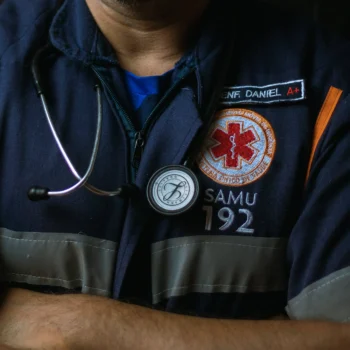

A board-certified emergency medicine physician trained in Compassionate Inquiry®, Bret Hunt occupies a unique niche in the healing arts, bridging the gap between acute medical intervention and deep psychological inquiry.
Joe Baldock is a Compassionate Inquiry® Practitioner, coach, facilitator, and self-proclaimed “caveman” who works with individuals using Compassionate Inquiry® and facilitates compassion-informed workshops for teams in the homelessness sector.
This excerpt addresses the question, “What happened to men?” The possible answer takes us back 5,000 years, to a time when everything changed. Hear the full conversation on The Gifts of Trauma Podcast.

TrueCreatives
“Traumatized masculinity isn’t a character flaw. It’s a survival adaptation that’s outlived its usefulness.”
This distinction is at the heart of this conversation, as it may be the one thing that changes everything.
KEVIN:
We [men] seem to be the epicentre of the world’s problems, but completely disengaged from its healing, its wellness, its improvement, its rising consciousness. Overall, women carry the burden of the world’s trauma that men cause. Some men do step in to help with the healing—but not enough.
Stepping into this conversation are Bret Hunt, an emergency medicine physician and Compassionate Inquiry® (CI) Practitioner, and Joe Baldock, a CI Practitioner and Circles Leader. Neither is here to defend men but to understand them. They’ve both done and continue doing their own healing work.
BRET:
My psychology has been shaped by being wounded. I’ve had experiences with anxiety, depression, addiction, and codependence.
JOE:
I’m a man who reaches in as much as he can before reaching out. I say what everyone else is thinking, consciously or unconsciously. I put it out there, sometimes skillfully, sometimes not.
“What does it actually feel like to be a man in the world today?”
JOE:
Being a man today is being separate and divorced from the boy that you were—and the boy that you were supposed to become if you’d been able to keep on playing and being how you were being. Growing up in Essex, I thought I was gay. I thought I was a girl. I thought I was all these things that I thought were bad. In what I’d now call a toxic masculine culture, it wasn’t okay to dress up in my grandma’s old clothes, play with girls’ toys, dance around and sing. Those parts of me were really repressed for a long time.
BRET:
What so many of us were taught about what it means to be a man—that facade of the tough guy, the superhero, the one man who can do it all alone—is starting to be exposed for what it is. It’s not a deep or meaningful role. There’s a lot of confusion, loneliness and disconnection from the natural world, from children, from women, and from our inner feminine aspects. And there’s a lot of fear. If we’re lonely and confused, there’s a lot of fear… because where do we go from here? It’s clear things ain’t working.
KEVIN:
Not being allowed to become whatever you want to become is traumatizing. And when you can’t do that, you show up confused, angry, fearful, disconnected—all words that we use around trauma. So replacing the term “toxic masculinity” with “traumatized masculinity”… How does that land with you both?
BRET:
I love that because it’s a description, not an indictment. When we use terms like toxic masculinity, we can’t reach anybody. They’ve heard it and they feel the shame. It’s like talking about addiction. You could describe somebody as a heroin addict or as someone who’s experienced a lot of pain. Which is going to invoke greater feelings of compassion? Traumatized masculinity. It’s an evolved term for this state of being and it’s very apt.
The distinction matters enormously. “Toxic” implies something inherently poisonous—something to be condemned and contained. “Traumatized” implies that something that happened can be healed, with the right conditions. One forecloses. The other opens a door. Joe embodied this by noticing…
JOE:
The word “constriction” is coming up for me. I’m thinking of an English guy who is holding so much in. You can see it in his jaw, in his face, in the inflammation in his body. The word “toxic” makes me think of the purple colour of poison in cartoons. In CI sessions, when I feel into toxic masculinity, I actually experience it somatically, visually and metaphorically as a poison around my heart. Terry Real talks about men who are “half beings” because they’re not allowed to embrace their feminine qualities. On the flip side, we have women who aren’t allowed to own their masculine qualities. We live in a world populated by “half people.” That’s not a society conducive to holistic health.
Where did this begin? Bret offered a theory that reaches back further than most might expect.
BRET:
In 2015, scientists discovered a profound drop in the diversity of the Y chromosome, about 5,000 years ago. 90 to 95% of men disappeared from the genetic map. Something happened to men that didn’t happen to women. The predominant theory is that massive, widespread violence coincided with the widespread adoption of agriculture. We went from being egalitarian hunter-gatherer bands to an agricultural species, which brought both a surplus of wealth and a highly stratified society. My theory is that the men who survived that decline in genetic diversity were more guarded, less trusting and maybe more vicious. I think at that time it was really dangerous to be a man, so perhaps it was a survival thing.
A survival thing. Not evil. Not inherent. Adaptive in that moment, and then epigenetically passed down to every generation since. It’s become encoded in our biology, our culture, our language, in the way boys are raised, and in the way men are taught to hold themselves in public.
BRET:
In our culture, [for men] feeling is taboo. If you look at the history of colonization, something colonists consistently wrote about was how emotional and dramatic indigenous people were. It was seen as a negative, as something ‘to be stamped out of them.’ That’s such an old wound we don’t even recognize it any more.
The takeaway from this conversation isn’t a solution. It’s a reorientation. Before we can change anything, we have to be willing to ask—not what’s wrong with men—but what happened to them. And to hold that question with curiosity rather than condemnation.
Responsibility without blame. That’s the question this series is asking. And it begins here.
The Gifts of Trauma is a weekly podcast that features personal stories of trauma, transformation, healing, and the gifts revealed on the path to authenticity. Listen to the full conversation, and if you like it, please subscribe, rate, review, and share.
Editor’s Note: This post is comprised of edited excerpts drawn from The Gifts of Trauma podcast transcript. Selected passages have been carefully woven together to create a cohesive narrative that speaks in the guests’ voices and faithfully represents their perspectives. – Rosemary Davies-Janes